Dance technique4 minutes

Following Salsa correctly: Reacting actively and sensitively

By Mary De LucaUpdated

In short
  • Following Salsa correctly requires active body tension in the upper body while maintaining flexible joints in the legs.
  • The leader's signals are not perceived with the eyes, but through the physical contact of the hands and the dance frame.
  • A clean weight shift on the ball of the foot ensures that you can start in any direction at any time without delay.
  • Active following means applying the exact same energy to your partner's impulse to keep the connection stable.

Find your perfect dance partner

On udansa you will find like-minded people who, just like you, want to polish their dance technique, as well as suitable dance schools and socials in your area. Simply create your free profile and take your dancing to the next level.

Find your perfect dance partner

If you wait blindly for the next move in Salsa, you are usually dancing behind the beat. Only active body tension makes you receptive to the subtlest signals from your partner and lets you become one.

What you need for stable following

  • Basic knowledge of the Salsa basic step in the respective timing
  • Flat dance shoes or shoes with a smooth sole for easy turns
  • A stable body awareness and an upright posture
  • The willingness to completely hand over the lead and to concentrate

Why active following is half the battle in Salsa

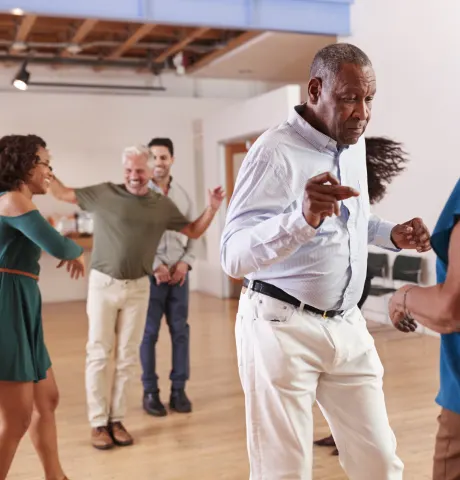
Salsa is a constant conversation without words. For this dialogue to flow, the follower's response must be immediate and precise. Many mistakenly believe that following is a passive role where you simply let yourself be moved. The opposite is the case: in order to follow Salsa correctly, a constant, active presence in your own body is essential. It is about decoding the direction, dynamics, and intensity of an impulse in a fraction of a second and physically implementing it.

This subtle communication is based on physical principles of tension and compression, which only work if the Salsa follower tension is precisely dosed. If you are too limp, the leader's signals vanish into thin air. If, on the other hand, you are too rigid or lock your joints, you appear heavy and immobile. Only through elastic stability in the upper body, paired with a constant readiness for weight shifts, does the feeling of effortless lightness emerge. This fine interplay distinguishes the purely mechanical execution of learned figures from real, intuitive partner dancing.

The right balance between core stability and flexibility in the knees allows for a lightning-fast reaction to every impulse.

Five steps to the perfect response

  1. Finding your own axis

    Stand upright and shift your body weight slightly forward onto the balls of your feet, while your heels still lightly touch the floor. This way, you are always ready for a quick Salsa weight shift follow and stand stable on your own axis.

  2. Activate your dance frame

    Bring your elbows slightly in front of your body and keep your forearms parallel to the floor. Build up a noticeable, yet elastic tension in your upper back and shoulder blades to fix your dance frame, udansa style.

  3. Establishing hand contact

    Place your hands into the leader's hands with light, constant pressure, without gripping tightly. As soon as you feel your partner's hand move, let this movement flow directly into your entire upper body so you can feel the Salsa connection.

  4. Wait for the impulse

    Only move when you feel a physical impulse through the connection, and resist the urge to anticipate the steps of the learned figure in your head. Focus on learning to actively follow Salsa by waiting attentively for the signal.

  5. Keep your steps compact

    Place your feet precisely under your own center of gravity and keep your knees slightly bent. This keeps your pelvis mobile and prevents you from throwing your partner off balance with a stride pattern that is too wide.

The most important do's and don'ts for followers

Correct

  • Meet the leader's pressure with exactly the same counter-pressure
  • Balance your own weight on the balls of your feet
  • Consider your arms a firm extension of your back

Wrong

  • Letting yourself be pulled or pushed passively
  • Shifting your weight onto your heels and falling backward
  • Letting your arms go soft and losing the connection

The checklist for your perfect connection

Before the dance

Preparation

When taking your position

Arrival

During movement

During

Frequently Asked Questions

  1. Good Salsa follower tension feels like an elastic rubber band. You are neither completely limp nor stiff as a board, but rather offer your partner a pleasant, springy resistance that transmits every movement directly.

Salsa courses near you

Find the right course now to specifically improve your partner dance technique.

View all matching courses