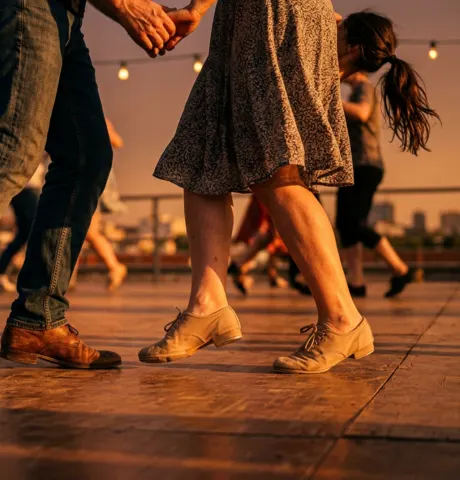
Dance technique5 minutes

Holding your Salsa dance frame: stability as a couple

By Mary De LucaUpdated

In a nutshell
  • The Salsa dance frame is the stable connection between arms and torso that transmits signals between partners.
  • It ensures that impulses arrive directly in the body's center and do not fizzle out in limp arms.
  • A good frame is based on elastic basic tension and stable elbows in front of the body.
  • Only through this firm structure does leading and following become precisely possible, independent of footwork.

Find your dance partner on udansa

On udansa, you will find dance enthusiasts in your area who, just like you, want to polish their technique and share their passion for Salsa. Sign up and discover suitable courses and dance partners right in your neighborhood.

Find your dance partner on udansa

The dance frame is the communication network in partner dance. It determines whether a Salsa feels light and harmonious or turns into an exhausting tug-of-war.

DefinitionSalsa dance frame

The Salsa dance frame describes the stable posture of the arms, shoulders, and upper body while dancing as a pair. It serves as a mechanical connection to transmit leading impulses precisely and without delay.

The invisible bond between partners

When you start with Salsa, you usually focus entirely on your feet. However, the real key to a harmonious partner dance lies higher up. The Salsa dance frame, often referred to as the frame, is the physical structure that connects leader and follower. It consists of the alignment of the shoulders, the position of the arms, and an active basic tension in the entire upper body. Without this frame, signals dissipate into thin air: if the leader pulls on a limp hand, only the follower's arm moves, while the body remains in place. Only a stable frame ensures that impulses are transferred directly to the body's center.

This firm yet elastic structure forms the foundation for the entire Salsa leading and connection. It ensures that both dancers move across the floor as one unit. This is not about rigid muscle power or cramping up. Rather, the salsa arm position creates a stable window in pairs where communication can take place. Anyone who learns to keep this frame constant makes dancing much easier for themselves and their partner, as misunderstandings and constant re-adjusting become a thing of the past.

Salsa, Kizomba, and Bachata dancers in front of a white wall with copy space
The right balance of body tension and flexibility ensures a harmonious connection in partner dance without the need for force.

Stability is not a matter of raw strength

A common misconception in partner dance is the assumption that stable salsa body tension is synonymous with strength. The opposite is true. A good Salsa dance frame behaves like the shock absorbers of a car: It is stable enough to indicate direction, but flexible enough to cushion bumps and small timing errors. Anyone who tenses and locks their arms completely takes away all freedom of movement from their partner and makes subtle changes in direction impossible. This creates an uncomfortable pushing and pulling that disrupts the flow of the dance.

To be able to hold the salsa frame, the elbows must always remain positioned slightly in front of the body. As soon as the elbows move behind the line of the back, the frame collapses and the salsa upper body connection is lost. Leaders should take care not to actively move the partner's arms, but rather to use their own upper body as a signal transmitter. Followers, in turn, resist by building up a light, constant counter-pressure. This fine balance ensures that even complex figures succeed effortlessly later on, because the impulse arrives without delay.

The subtle difference in the Salsa frame

Correct

  • Always keep your elbows slightly in front of your body
  • Initiate leading impulses from your upper body
  • Maintain a light, elastic counter-pressure

Wrong

  • Letting your elbows fall behind the line of your back
  • Pulling or pushing your partner using only arm strength
  • Letting your arms hang completely limp

A good dance frame is like an invisible conversation, where no one has to shout to be understood.

Salsa dance instructor

How the frame paves the way for figures

Working on your dance frame pays off especially when you move beyond the basic steps. While beginners often struggle with coordinating feet and arms, for advanced dancers, the frame separates footwork from leading. No matter how fast the feet move or which step variations are danced: the upper body remains calm, present, and receptive. This gives both partners the necessary security to unfold on the dance floor.

If you want to deepen your Salsa journey, it is worth looking at the big picture. Getting started is easiest with a structured overview like the guide Learn to dance Salsa. Those who want to train their general posture and leading quality in parallel can also transfer valuable principles from the Discofox technique for posture and leading to Salsa. After all, a stable frame is not an end in itself, but the tool that gives you the freedom to enjoy the music to the fullest.

Two roles in the same frame

Leading

The active initiator

Sending signals from the center

The leader keeps the elbows stable in front of their own body and transmits changes in direction through the rotation of the ribcage, instead of pulling with the hands.

Following

The sensitive receiver

Keeping body tension active

The follower keeps the arm position stable and responds to the leader's gentle pressure with active body tension in the upper body.

Frequently Asked Questions

  1. The frame collapses when the elbows move behind your own back. This causes the body tension to dissipate, and leading signals no longer reach the partner's center.

Discover Salsa courses near you

Find the right dance school to train your dance skills under professional guidance.

View all matching courses