
Find your perfect dance partner
On udansa, you will find like-minded people in your area who share your passion for Discofox and with whom you can try out new techniques directly on the dance floor.



By Mary De LucaUpdated
On udansa, you will find like-minded people in your area who share your passion for Discofox and with whom you can try out new techniques directly on the dance floor.
If you want to shine in Discofox, you need much more than just a sequence of steps. Only the interplay of subtle leading, stable body tension, and fluid footwork turns the dance into a harmonious experience.
In partner dance, body tension refers to the controlled activation of the core and arm muscles, which enables the direct transmission of leading signals between partners.
The basis for a fluid and elegant Discofox does not lie in the number of figures learned, but in a stable yet flexible posture. A correct Discofox posture is characterized by an upright spine, slightly lowered shoulders, and activated body tension. The weight always remains on the balls of the feet, which enables a fast reaction time and supports the typical dynamics of the dance. In contrast to classic ballroom dances, partners in Discofox do not stand rigidly opposite each other, but maintain an elastic distance that leaves room for turns and wrapping figures.
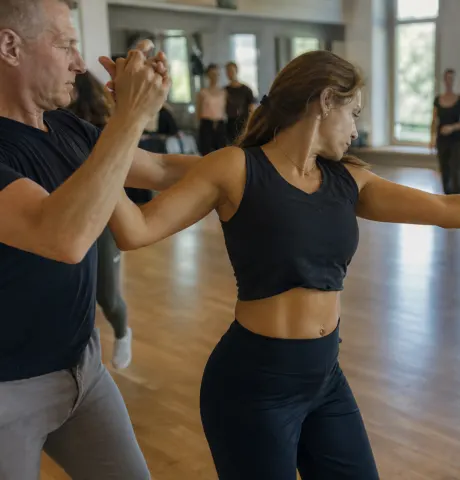
The arm position is particularly decisive for whether the leader's signals are received. The elbows should remain slightly bent in front of the body and form a stable bridge to the partner. If body tension collapses, contact is lost, which leads to stumbles and misunderstandings. Anyone who internalizes an upright posture also protects their back and immediately appears more confident and elegant on the dance floor.
A precise Discofox lead technique is not based on muscle power, but on the principle of push and pull through the core. Experienced leaders send subtle Discofox lead signals that are transferred directly to the partner's body via the connection of the hands. The hands never grip tightly, but maintain a loose yet present contact that works with a slight spring tension in the arm. This way, the following person immediately senses the direction of the movement without being pulled or pushed.
For the following role, it is just as important to actively anticipate these signals and respond with appropriate counter-tension. Only this shared body tension makes it possible to execute complex wrap figures cleanly in a fraction of a second. Anyone who learns to control lead signals purely from the weight shift of their own body dances much more relaxed and harmoniously.
Correct
Wrong
Only when your body tension is right and the signals flow without delay, does Discofox become a weightless glide across the dance floor.
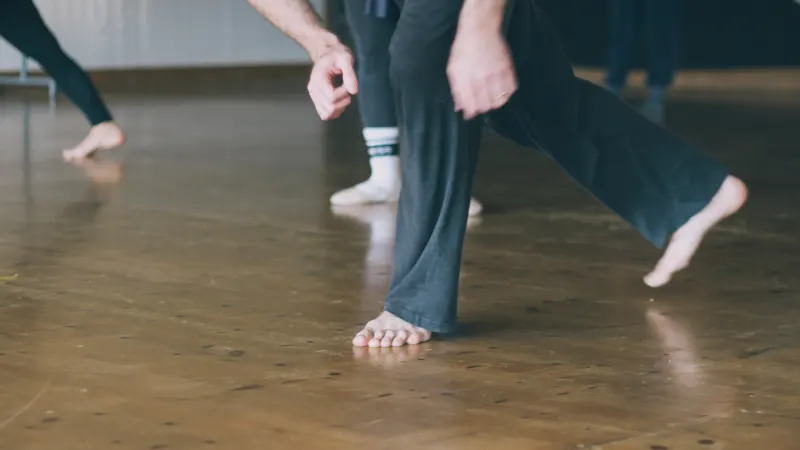
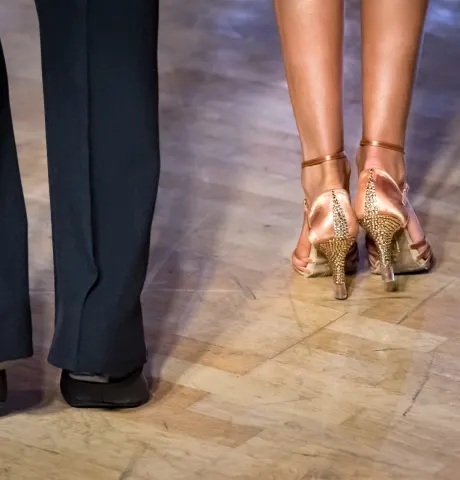
The visual impact on the dance floor is significantly shaped by clean Discofox footwork and the right styling. When dancing, your knees should always remain slightly elastic and bent to softly cushion quick changes in direction. Steps are executed flat across the floor, with your feet gliding closely past each other. This not only prevents tripping, but also ensures the typical lively and controlled overall appearance.
When it comes to Discofox styling and especially Discofox lady styling, it is all about adding a personal touch to your movements. While the footwork secures the rhythm, your free arms can be used for accents, for example by extending them in a controlled manner during turns. A harmonious Discofox styling rounds off your performance, with flowing, breathable materials and dance shoes with a smooth sole optimally supporting your movement.
Providing security and orientation
The leader sets the direction and the tempo by giving clear, close-to-the-body impulses and always leaving the partner the necessary space for turns.
Receiving and implementing impulses
The follower reacts sensitively to the signals, maintains the necessary tension in the arm, and translates the impulses into movement without delay.
Good posture is characterized by a straight back, slightly lowered shoulders, and an engaged core. Your weight should be on the balls of your feet so you can react flexibly to leading signals at any time.
Leading signals should never be given by pulling or pushing with your arms. Instead, the impulse is created by shifting your own body weight and is gently transmitted through a stable arm connection.
Ladystyling is about using free moments in the dance to, for example, elegantly move your free arm or let your hip movement flow smoothly without losing your basic tension.
Find the right dance school and take your technique to the next level.
DiscofoxLimbach-Oberfrohna · Germany
Discofox Club - 14-tägigWednesday · 20:30 · Oct 21
Limbach-Oberfrohna
Couple danceLimbach-Oberfrohna · Germany
PaartanzkreisFriday · 18:15 · Oct 23
Limbach-Oberfrohna
Couple danceLimbach-Oberfrohna · Germany
Silberkurs für PaareSunday · 16:15 · Oct 25 - Nov 15
Limbach-Oberfrohna
 Learn to lead Discofox: The physics of connectionLearn the physical principles of leading in Discofox. By mastering the interplay between your center of gravity and hand connection, you can execute every movement without effort.
 Discofox posture: 5 steps to a confident lookLearn how to achieve the perfect posture from head to toe in Discofox. This guide shows you the way to a stable and elegant presence on the dance floor.
 Avoiding Discofox mistakes: The 7 biggest technique blundersMistakes in posture and leading in Discofox creep in quickly. With these tips, you can correct your technique and prevent loss of tension on the dance floor.
 Discofox footwork: smooth rolling for stable stepsLearn how to use proper Discofox footwork to roll your feet gently and give your steps maximum stability.
 Discofox Lady Styling: Elegant arms and fluid hipsLearn how to perfect your presence and turns in Discofox through targeted body tension, elegant arm movements, and fluid hip motion.
 Discofox styling for men: Leading with confidence and easeLearn how to cut a confident and relaxed figure on the dance floor with masculine posture and subtle styling details in Discofox.
 Discofox dance shoes: The guide for perfect grip and turnsThe right shoe determines your dynamics and joint protection when dancing Discofox. Our guide compares chrome leather soles and dance sneakers for your perfect performance.
 Discofox Turning Technique: Fast spins without dizzinessWith the right Discofox turning technique, dizziness on the dance floor becomes a thing of the past. This guide shows you how to stabilize your axis and use your head correctly.
 The 5 best Discofox fitness exercises for dancersGet ready for the dance floor: use these targeted exercises to strengthen your muscles and improve your balance for the perfect Discofox.
 Discofox Competition Technique: Precision for the FloorSwitching from intimate club Discofox to expansive competition dancing requires a whole new level of body control. Learn how to optimize your body tension and step size for the big stage.
 Discofox Styling Trends: The Modern Club LookDiscofox in the club is becoming smoother, more relaxed, and more dynamic. Learn how influences from Hustle and West Coast Swing are modernizing this popular partner dance.
 Discofox on any floor: 5 tips for difficult surfacesWhether it is a slippery parquet or sticky concrete: with these 5 practical tips, you can quickly adapt your Discofox technique to any floor and dance safely at every party.