
Let's glide across the dance floor together
Find motivated dance partners and professional dance courses in your area on udansa to put your footwork directly into practice.



By Bernhard De LucaUpdated
Find motivated dance partners and professional dance courses in your area on udansa to put your footwork directly into practice.
Forget dull step counting and frantic hopping. Only by rolling your feet correctly and keeping your knees soft will your Discofox become a floating, joint-friendly pleasure.
Discofox footwork describes the way the feet touch the floor, roll, and shift body weight to create a fluid movement.
If you think of Discofox as a stiff, choppy movement, you are overlooking the magic of proper joint work. A soft and fluid movement is not created by the step sequence itself, but by active Discofox footwork that starts in the ankle. As soon as you learn to use your feet purposefully, the often hectic hopping transforms into an elegant glide. The secret lies in a permanent, elastic micro-movement of the knees, the so-called Discofox knee-bend technique.
This technique does not mean that you go into a deep squat. Rather, your knees remain soft and flexible to cushion every step like a shock absorber. This allows you to immediately gain balance, as your center of gravity is lower and more stable. Especially during quick changes of direction or complex wrapping figures, this flexibility ensures that you do not lose your footing. If you are interested in the exact differences between the step patterns, take a look at the guide Discofox 3-step or 4-step.
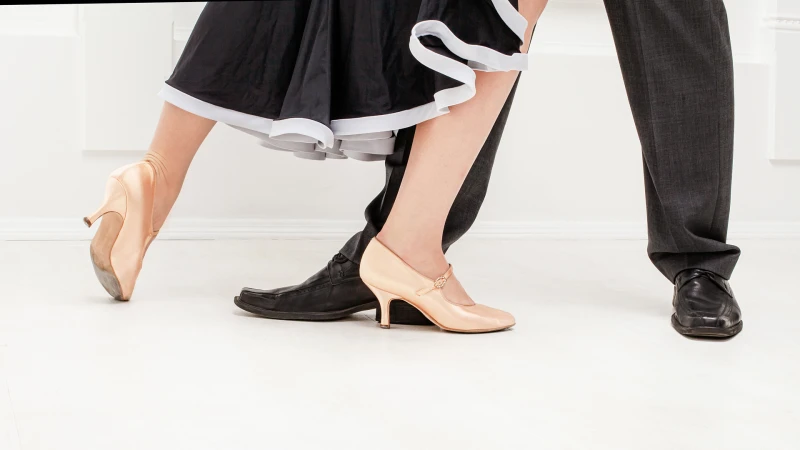
To guarantee joint-friendly dancing, we have to look at how the foot touches the floor. Many beginners tend to step flat or stomp with their heel, which sends vibrations unfiltered into the knees and spine. The solution, dancing on the ball of the foot in Discofox, provides a remedy here: every forward step is placed fluidly over the ball of the foot before the weight gently transfers to the whole foot. The heel only kisses the floor very lightly without bearing the full body weight.
For the backward step, this movement is reversed. You place the toe or the ball of the foot down first and roll the foot backward. This controlled rolling motion in Discofox steps takes the speed out of the movement and prevents you from falling backward uncontrollably or pulling your partner along. Through this conscious rolling motion, you gain valuable milliseconds of time, which makes your movements appear extremely musical and harmonious, even when the DJ speeds up the beat.
Like this
Don't do this
Only when your feet work like cat paws does the Discofox gain its typical, almost floating elegance and lightness.
Clean footwork is the foundation for harmonious interaction as a couple. When both dance partners roll through their feet fluidly, the entire connection stabilizes. Restless, bouncy steps are immediately transmitted to the partner as interference signals through the arms. Calm legwork, on the other hand, ensures that leading signals arrive precisely and without background noise. If you stand stably, you can also react more sensitively.
If you want to test your legwork at the next party, check out our tips at find Discofox party. A smooth movement sequence not only saves your energy, but also makes you look extremely confident on crowded dance floors. As soon as rolling through your feet becomes second nature, your mind is free for styling, musical interpretation, and playing with your partner.
Dynamics and cushioning moving forward
When stepping forward, place your foot flat over the ball and glide forward in a controlled manner. Keep the knee of your standing leg slightly bent to cushion your weight softly.
Control and balance when moving backwards
When stepping backwards, the tip of the foot touches the floor first, followed by the ball of the foot. Only at the very end does the heel lightly touch the ground to gently slow down the movement.
In Discofox, you start with the ball of your foot on forward steps and roll your foot down softly. This cushions the movement and protects your joints in the long run.
Bouncing is usually caused by straight knees and landing abruptly on your heel. Always keep your knees slightly bent and use the discofox ball of foot solution for smoother transitions.
Yes, fluid rolling saves a tremendous amount of energy and protects your knee joints. By using the discofox knee bend technique, you take the pressure off your bones and use your muscles as suspension.
Take your footwork to the next level in a suitable course.
DiscofoxLimbach-Oberfrohna · Germany
Discofox Club - 14-tägigWednesday · 20:30 · Oct 21
Limbach-Oberfrohna
Couple danceLimbach-Oberfrohna · Germany
PaartanzkreisFriday · 18:15 · Oct 23
Limbach-Oberfrohna
Couple danceLimbach-Oberfrohna · Germany
Silberkurs für PaareSunday · 16:15 · Oct 25 - Nov 15
Limbach-Oberfrohna
 Discofox posture: 5 steps to a confident lookLearn how to achieve the perfect posture from head to toe in Discofox. This guide shows you the way to a stable and elegant presence on the dance floor.
 Avoiding Discofox mistakes: The 7 biggest technique blundersMistakes in posture and leading in Discofox creep in quickly. With these tips, you can correct your technique and prevent loss of tension on the dance floor.
 Learn to lead Discofox: The physics of connectionLearn the physical principles of leading in Discofox. By mastering the interplay between your center of gravity and hand connection, you can execute every movement without effort.
 Discofox technique: The key to posture, leading, and stylingMaster the Discofox technique for an elegant performance on the dance floor. Learn everything about proper posture, subtle leading, and stylish moves.
 Discofox Lady Styling: Elegant arms and fluid hipsLearn how to perfect your presence and turns in Discofox through targeted body tension, elegant arm movements, and fluid hip motion.
 Discofox styling for men: Leading with confidence and easeLearn how to cut a confident and relaxed figure on the dance floor with masculine posture and subtle styling details in Discofox.
 Discofox dance shoes: The guide for perfect grip and turnsThe right shoe determines your dynamics and joint protection when dancing Discofox. Our guide compares chrome leather soles and dance sneakers for your perfect performance.
 Discofox Turning Technique: Fast spins without dizzinessWith the right Discofox turning technique, dizziness on the dance floor becomes a thing of the past. This guide shows you how to stabilize your axis and use your head correctly.
 The 5 best Discofox fitness exercises for dancersGet ready for the dance floor: use these targeted exercises to strengthen your muscles and improve your balance for the perfect Discofox.
 Discofox Competition Technique: Precision for the FloorSwitching from intimate club Discofox to expansive competition dancing requires a whole new level of body control. Learn how to optimize your body tension and step size for the big stage.