
Improving mistakes together
On udansa you will find like-minded people to refine your posture with, as well as suitable courses in your area for the perfect dance flow.



By Bernhard De LucaUpdated
On udansa you will find like-minded people to refine your posture with, as well as suitable courses in your area for the perfect dance flow.
If you want to shine in Discofox, you do not need countless figures. Often, it is small, unconscious posture errors and loss of tension that make dancing together feel sluggish and lead to stumbling.
Focus on posture technique
All analyzed errors relate directly to the biomechanics and dance posture in Discofox.
Clear distinction
The list deliberately excludes rhythm errors and step sequences to sharpen your posture.
Independent rating
No money or sponsorship was accepted from dance schools for the creation of this list.
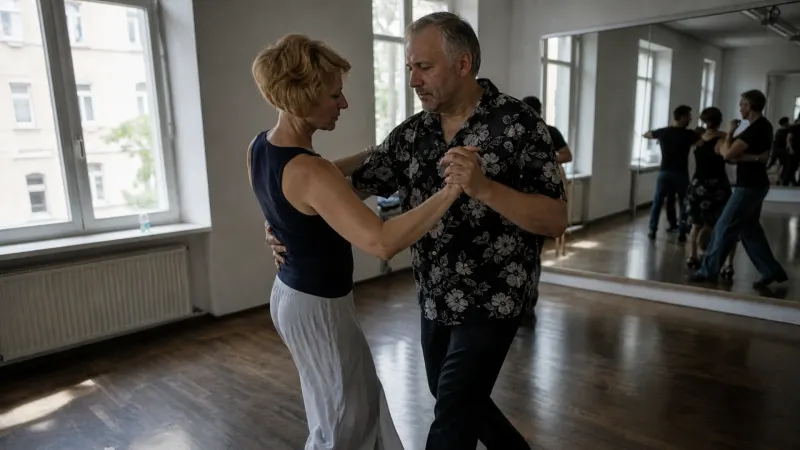
Posture error, affects both partners, common during turns
When the elbows slip behind your own torso, the dance frame collapses. Leaders can no longer transmit signals, and followers react late, which leads to frantic movement.
Postural error, leads to back pain and loss of balance
Collapsing at the hip shifts your weight backwards. This creates too much distance between partners, and steps become sluggish, which makes tripping more likely.
Leading error, concerning the connection of the hands
Anyone who cramps their fingers around their partner's hand blocks the natural rotation in the wrists. This leads to painful leverage during wrap figures and prevents smooth leading.
Tension error, leads to jerky movements
When your arms are fully extended, there is no buffer left for movements. Every weight shift is transmitted as a hard jolt to your partner, which makes the dance restless and uncomfortable.
Posture errors, impairs balance in the room
Anyone who keeps their gaze permanently fixed on their own feet rounds their neck and loses their orientation in the room. Furthermore, this head position causes the entire upper body to slump forward.
Leading errors, typical during quick changes of direction
When signals are given with pure muscle power from the biceps instead of from the core, dancing becomes exhausting. This sloppy technique leads to misunderstandings and takes the lightness out of the dance.
Postural error, leads to rapid fatigue
If you pull your shoulders up while dancing, you tense your neck and block the freedom of movement of your arms. A stable and elegant frame is only possible with low, relaxed shoulder blades.
A harmonious dance flow in Discofox is not created by the complexity of the figures, but by the quality of the physical connection. If one of the partners loses body tension, the communication on the dance floor breaks down immediately. The result is constant pulling and tugging on the arms, which not only looks unaesthetic but also puts strain on the joints. To dance a fluid Discofox, both partners must maintain a constant, elastic base tension in the torso and arms.
A typical mistake is the so-called noodle soup, where the arms are left completely limp. The opposite is the screw clamp, where the joints lock and every movement of the partner is blocked. The goal is elastic suspension. If you want to learn how to maintain this physical connection without using force, it is worth taking a look at the principles of other dances, for example how to build Salsa leading through subtle signals. For Discofox, the rule is: only with a stable but adaptable frame tension can turns and changes of direction be initiated without stumbling.
You prevent tripping by keeping your weight on the balls of your feet and maintaining an upright body axis. Anyone who steps with their heels first or leans their upper body forward loses balance and will inevitably step on their partner's feet.
You can recognize poor posture by drooping elbows, a rounded back, or a collapsed hip. If you notice that your partner has to pull hard on your arms to move you, you are lacking the necessary body tension.
Find the right dance course now to improve your technique directly on the dance floor.
DiscofoxLimbach-Oberfrohna · Germany
Discofox Club - 14-tägigWednesday · 20:30 · Oct 21
Limbach-Oberfrohna
Couple danceLimbach-Oberfrohna · Germany
PaartanzkreisFriday · 18:15 · Oct 23
Limbach-Oberfrohna
Couple danceLimbach-Oberfrohna · Germany
Silberkurs für PaareSunday · 16:15 · Oct 25 - Nov 15
Limbach-Oberfrohna
 Dancing Discofox: steps, figures, and music of the most popular couple danceDiscofox is the most versatile couple dance of all. Learn everything about steps, styles, and how to get started quickly.
 Salsa leading and following: The art of subtle connectionDiscover how the subtle interplay of leading and following works in Salsa and how to elegantly improve your posture and styling.
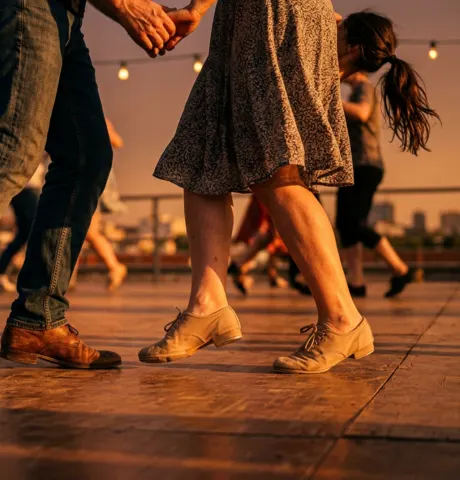 Discofox technique: The key to posture, leading, and stylingMaster the Discofox technique for an elegant performance on the dance floor. Learn everything about proper posture, subtle leading, and stylish moves.
 Discofox footwork: smooth rolling for stable stepsLearn how to use proper Discofox footwork to roll your feet gently and give your steps maximum stability.
 Discofox Lady Styling: Elegant arms and fluid hipsLearn how to perfect your presence and turns in Discofox through targeted body tension, elegant arm movements, and fluid hip motion.
 Discofox styling for men: Leading with confidence and easeLearn how to cut a confident and relaxed figure on the dance floor with masculine posture and subtle styling details in Discofox.
 Discofox dance shoes: The guide for perfect grip and turnsThe right shoe determines your dynamics and joint protection when dancing Discofox. Our guide compares chrome leather soles and dance sneakers for your perfect performance.
 Discofox Turning Technique: Fast spins without dizzinessWith the right Discofox turning technique, dizziness on the dance floor becomes a thing of the past. This guide shows you how to stabilize your axis and use your head correctly.
 The 5 best Discofox fitness exercises for dancersGet ready for the dance floor: use these targeted exercises to strengthen your muscles and improve your balance for the perfect Discofox.