
Find your dance partner on udansa
Here you can find like-minded people to conquer every dance floor with. Connect with others and find your next dance class or the perfect party in your area.



By Bernhard De LucaUpdated
Here you can find like-minded people to conquer every dance floor with. Connect with others and find your next dance class or the perfect party in your area.
Difficult floors are no reason to avoid the dance floor. With the right adjustment of your steps and your center of gravity, you can master slippery parquet just as well as dull club floors.
Field-tested methods
All presented techniques have been checked for their practical suitability by experienced Discofox instructors.
Immediate applicability
The tips can be applied immediately at any party without the need for special equipment.
Independent selection
No payments or sponsorship deals were agreed upon for the creation of this list.
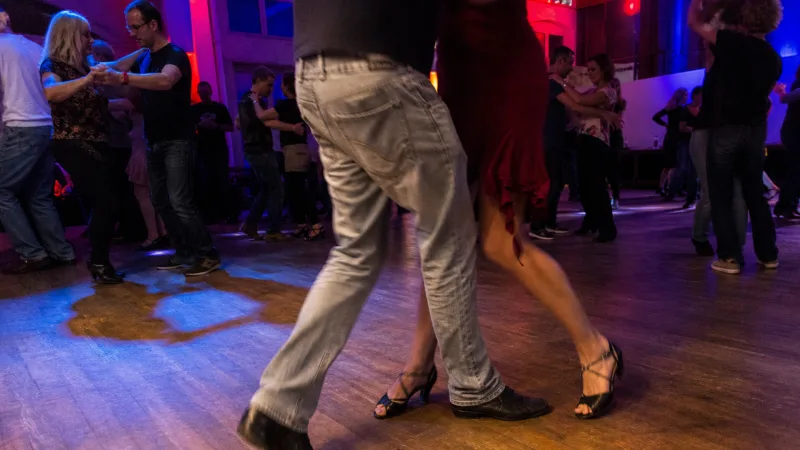
For extremely slippery surfaces, effective immediately
Shorter steps reduce leverage and ensure that your center of gravity always remains directly over your feet. This immediately minimizes the risk of slipping on smooth dance floors.
Universally applicable, easy on the joints
By keeping your knee joints soft and slightly bent, you lower your center of gravity. This gives you more stability and allows you to elastically compensate for sudden sliding movements.
For sticky club floors, protects your joints
On sticky or dull floors, flat turns can get stuck and put strain on your knees. Lift your turning foot slightly and shift your weight onto the ball of your foot to reduce friction.
For uneven surfaces and crowded parties
Avoid expansive wrapping figures on slippery or uneven surfaces. Keep your lead tight and dance more compactly in place to avoid compromising each other's balance.
For all difficult floors and outdoor events
Use conscious, continuous body tension as a couple to immediately compensate for uneven surfaces or a partner slipping briefly. The connection through the arms must remain elastic, but stable.
Anyone who dances regularly at parties knows that reality rarely matches the perfectly maintained floor of a dance school. Sometimes the dance floor is like an ice rink, sometimes your feet literally stick to the ground, or you are dancing under the open sky on rough concrete slabs. To keep your balance and avoid injuries in these different conditions, you have to adapt your dance technique. The secret lies in flexibly regulating your own center of gravity and step size.
On a very slippery surface, the greatest danger is sliding away uncontrollably. Here, it helps to make your steps significantly smaller and to keep your weight more consciously over the middle of your foot. Avoid wide lunges, as these minimize the grip of the sole. If you keep your knees slightly bent, you lower your center of gravity and increase stability. On a sticky floor, however, turns get blocked. To protect your knee joints, you should not force turns through the friction of the sole, but rather lift more. For turns, place your foot down minimally instead of dragging it flat across the floor. When you are moving on uneven terrain while dancing Discofox outdoors, adjust your dynamics and avoid expansive wrapping figures.
Adapting to difficult floors works best through precise coordination within the pair. Stable body tension is essential to catch sudden slipping moments of your partner. If you want to learn more about the biomechanical basics of leading, our guide on learning to lead Discofox will help you. The more difficult the floor, the finer and more controlled the signals must be to prevent overreacting on the dance floor.
On extremely slippery floors, you should shorten your steps and bend your knees slightly. This lowers your center of gravity and prevents your feet from sliding uncontrollably.
On sticky floors, you should slightly lift your feet during turns instead of pivoting flat. This protects your knee joints, as it avoids the blockage caused by high friction on the sole.
When dancing outdoors, you should choose flat shoes without delicate leather soles and place your steps very carefully. You can compensate for uneven ground by maintaining increased body tension.
Find the right course now and learn Discofox from scratch for any dance floor.
DiscofoxLimbach-Oberfrohna · Germany
Discofox Club - 14-tägigWednesday · 20:30 · Oct 21
Limbach-Oberfrohna
Couple danceLimbach-Oberfrohna · Germany
PaartanzkreisFriday · 18:15 · Oct 23
Limbach-Oberfrohna
Couple danceLimbach-Oberfrohna · Germany
Silberkurs für PaareSunday · 16:15 · Oct 25 - Nov 15
Limbach-Oberfrohna
 Discofox technique: The key to posture, leading, and stylingMaster the Discofox technique for an elegant performance on the dance floor. Learn everything about proper posture, subtle leading, and stylish moves.
 Learn to lead Discofox: The physics of connectionLearn the physical principles of leading in Discofox. By mastering the interplay between your center of gravity and hand connection, you can execute every movement without effort.
 Discofox posture: 5 steps to a confident lookLearn how to achieve the perfect posture from head to toe in Discofox. This guide shows you the way to a stable and elegant presence on the dance floor.
 Avoiding Discofox mistakes: The 7 biggest technique blundersMistakes in posture and leading in Discofox creep in quickly. With these tips, you can correct your technique and prevent loss of tension on the dance floor.
 Discofox footwork: smooth rolling for stable stepsLearn how to use proper Discofox footwork to roll your feet gently and give your steps maximum stability.
 Discofox Lady Styling: Elegant arms and fluid hipsLearn how to perfect your presence and turns in Discofox through targeted body tension, elegant arm movements, and fluid hip motion.
 Discofox styling for men: Leading with confidence and easeLearn how to cut a confident and relaxed figure on the dance floor with masculine posture and subtle styling details in Discofox.