
Find your perfect dance match
Create your free profile on udansa and find like-minded people who want to work on the perfect connection with you, whether in your living room or at the dance studio.



By Bernhard De LucaUpdated
Create your free profile on udansa and find like-minded people who want to work on the perfect connection with you, whether in your living room or at the dance studio.
If you want to harmonize perfectly on the dance floor, you need to understand the subtle signals of leading in detail. Training together in your living room offers the perfect, safe space for this detailed work.
Training together within your own four walls offers a decisive advantage over the hustle and bustle of a dance studio or a party: absolute peace and focus. Without loud club music, distracting glances, or the pressure to constantly deliver new moves, you can concentrate entirely on the essentials. It is about feeling the subtle nuances of tension and compression and calibrating your own body tension. Anyone who learns to interpret a partner's signals precisely in a quiet environment will react much more intuitively on the dance floor later on.
To make real progress while training at home, you should shift your focus away from complex moves and toward fundamental principles. Use the time for targeted learning to lead and follow Salsa: The basics of connection. At home, you can slow down movement sequences significantly, discuss mistakes immediately, and repeat exercises until they feel effortless. This conscious attention to detail creates deep mutual trust and a dancing harmony that raises your overall level.

Stand at an arm's length from each other. Place your palms loosely against each other, without interlocking your fingers, and build up a light, elastic pressure that comes from your entire body center.
The leader closes their eyes and gently guides the partner forward and backward. This helps the leader learn to sense the partner's position purely through the arm connection and the dance frame, instead of relying on their eyes.
Now the follower closes their eyes. The leader performs simple basic steps and changes of direction, while the partner learns to react exclusively to physical impulses rather than visual cues.
Increase the difficulty level by releasing your hands completely and maintaining contact only through a single palm. Try to lead simple turns and position changes without breaking physical contact.
Now turn on some slow Salsa music and try to implement the practiced principles fluidly in rhythm. Continue to focus primarily on the feeling of the connection and not on the complexity of the figures.
Training the right way
Avoid mistakes
Preparation
Arrival
During
It is best to practice two to three times a week for 20 to 30 minutes each. Short, highly focused sessions are significantly more effective for technical training at home than hours of unfocused dancing.
Yes, that is actually highly recommended. Use a door handle, a sturdy chair back, or practice the steps solo in front of a mirror to strengthen your own balance and body tension independently of your partner.
If you lose your orientation, you should immediately reduce the tempo drastically. Go back to the basic step, rebuild your body tension, and perform the movement again in slow motion to find the point of error.
Bring the technique you learned at home directly into a professional dance course.
Couple danceLimbach-Oberfrohna · Germany
PaartanzkreisFriday · 18:15 · Oct 23
Limbach-Oberfrohna
Couple danceLimbach-Oberfrohna · Germany
Silberkurs für PaareSunday · 16:15 · Oct 25 - Nov 15
Limbach-Oberfrohna
 Salsa leading and following: The art of subtle connectionDiscover how the subtle interplay of leading and following works in Salsa and how to elegantly improve your posture and styling.
 First lead signals in Salsa: Creating connectionDiscover the physical and anatomical foundations of tension and compression in Salsa leading. Learn how to build a perfect connection with your partner.
 Leading Salsa correctly: A step-by-step guideLeading Salsa correctly is not a matter of strength, but of technique. In this guide, learn how to give clear signals from your core and lead your partner with ease.
 Following in Salsa: Reacting actively and sensitivelyFollowing in Salsa is not about being passive, it is a highly active process. With the right body tension and balance, you react lightning-fast to every impulse from your partner.
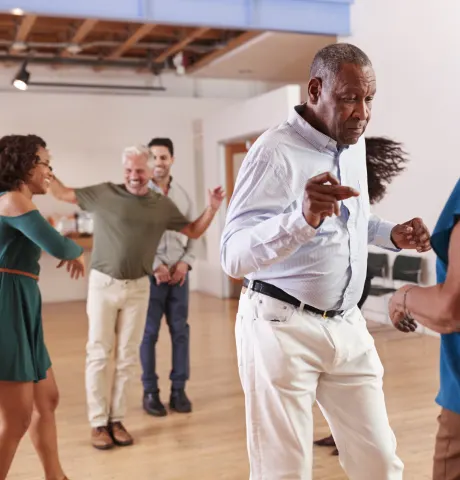 Holding your Salsa frame: Stability in a coupleThe Salsa frame is the foundation for subtle leading and harmonious dancing. Learn how to create stability as a couple with the right body tension and arm positioning.
 Salsa leading style test: Do you lead or follow too firmly?Find out with our Salsa leading style test whether you grip too firmly or act too softly while dancing. Optimize your connection for a harmonious dance experience.
 Salsa Arm Styling for Ladies: Elegant Movements for FollowersElegant arm styling adds a personal touch to your Salsa dancing. Learn how to move your arms and hands expressively without losing the connection with your partner.