
Salsa connects people on the dancefloor
On udansa you will find dance enthusiasts in your area who, just like you, want to refine the fine art of connection on the dancefloor. Sign up and discover suitable dance partners, courses, and workshops.



By Bernhard De LucaUpdated
On udansa you will find dance enthusiasts in your area who, just like you, want to refine the fine art of connection on the dancefloor. Sign up and discover suitable dance partners, courses, and workshops.
Salsa is not about memorizing steps, it is a constant conversation without words. Only by understanding physical forces and body tension do two individual dancers become a fluid unit.
Maintaining connection in Salsa describes the continuous physical and sensory contact between two dancers. This connection enables the seamless transmission of impulses through the interplay of body tension, pressure, and pull.
Anyone starting to dance Salsa quickly realizes that steps alone do not create a harmonious couple. The true magic arises from the invisible connection between the dancers. To successfully learn to lead and follow Salsa, we must understand the mechanical foundations of our bodies. Every movement on the dance floor is based on physical principles like action and reaction. When the leader gives an impulse, this energy does not simply travel as a push through the arms, but as a controlled wave of force that originates in one's own center and arrives at the partner's center. Without this physical understanding, the dance degenerates into mechanical pulling and tugging, which is frustrating and tiring.
A deeper understanding of these mechanisms also helps you when you look for like-minded people on our platform udansa. A stable dance partner with whom the physical chemistry is right makes grasping these physical laws much easier. Getting started is easiest if you first let go of complex step patterns and instead focus on simply feeling the weight transfer. Anyone who internalizes the physical foundations can later shine in any style, as the laws of biomechanics are the same everywhere.

The most important interface in partner dance is the connection of the hands and arms, but the actual work is done by the core muscles. A precise Salsa leading technique is based on the constant interplay of compression and tension. Pushing and pulling must never be confused with raw force. It is much more of an elastic system, comparable to a soft coil spring. When the leader builds up gentle pressure, the follower absorbs this via activated core tension and moves backwards in proportion to the impulse. With pulling, it is exactly the other way around: the distance created generates a fine tension that gently pulls the partner along.
To maintain this connection, constant body tension is essential. Limp arms, often referred to in dance jargon as spaghetti arms, absorb every piece of information before it can reach the center of the body. Arms that are too stiff, on the other hand, block any flow and lead to painful blockages. The secret lies in an elastic basic tension, the so-called tonus. This makes it possible to transmit the finest signals in a fraction of a second without the need for visible or strenuous physical effort. This creates a silent dialogue that seems like pure telepathy to outsiders.
Correct
Wrong
Salsa is not a battle for dominance, but a physical conversation where one whispers and the other listens attentively.
A harmonious dance only emerges when both partners understand their role as an active part. Learning to lead and follow Salsa does not mean that one person rules and the other blindly obeys. The leader is responsible for making clear suggestions and guiding the couple in the right direction. They must read the room, interpret the music, and time the impulses so that the partner is physically capable of following them at all. A good leader does not force, but invites.
The follower, on the other hand, is by no means passive. Following is a highly active task that requires extreme concentration and sensory sensitivity. A good follower waits for the impulse, interprets it in milliseconds, and implements it with their own energy and body tension. Anyone who tries to anticipate the steps as a follower destroys the connection and throws the system off balance. Only when both sides take on their physical responsibility does the fluid flow emerge that makes Salsa so popular worldwide. If you want to dive deeper into the world of rhythms, our guide on Salsa rhythm and music theory will help you to coordinate the impulses even better with the beats.
Clarity and spatial awareness in partner dance
As a leader, you carry the responsibility for the direction and timing on the dance floor. Your impulses must be precise, gentle, and always come from your own center of gravity to be readable for your partner.
Focus on responsiveness and body tension
As a follower, you react actively to your partner's signals. Through an upright posture and constant body tension, you pick up every impulse immediately, without rushing ahead of the movements.
A good leader is characterized by clarity and empathy. They provide cues in a timely manner and from their own body center, instead of pulling or pushing the partner with their arms.
Spaghetti arms occur due to a lack of body tension in the shoulder girdle and torso. You avoid them by keeping your elbows slightly in front of your body and building up an elastic basic tension throughout your entire upper body.
No, when following you react exclusively to the physical cues of the leader. Anticipating figures leads to misunderstandings and disrupts the shared balance on the dance floor.
Focus on purely feeling pressure and tension while practicing without music. Take slow steps and ensure that every weight shift by the leader triggers a direct reaction in the follower.
Find the right dance school on udansa now and put theory into practice immediately.
Couple danceLimbach-Oberfrohna · Germany
PaartanzkreisFriday · 18:15 · Oct 23
Limbach-Oberfrohna
Couple danceLimbach-Oberfrohna · Germany
Silberkurs für PaareSunday · 16:15 · Oct 25 - Nov 15
Limbach-Oberfrohna
 Learn to dance Salsa: The complete beginner's guideLearning to dance Salsa is the perfect way to bring movement, rhythm, and new connections into your life. Our guide shows you how to get started, even without any prior experience.
 Learn Salsa rhythm: Beat and music theory for dancersDo you want to learn Salsa rhythm and finally dance on beat with confidence? Our guide explains the music structure, the key instruments, and how to find the beat effortlessly.
 Salsa leading and following: The art of subtle connectionDiscover how the subtle interplay of leading and following works in Salsa and how to elegantly improve your posture and styling.
 Leading Salsa correctly: A step-by-step guideLeading Salsa correctly is not a matter of strength, but of technique. In this guide, learn how to give clear signals from your core and lead your partner with ease.
 Following in Salsa: Reacting actively and sensitivelyFollowing in Salsa is not about being passive, it is a highly active process. With the right body tension and balance, you react lightning-fast to every impulse from your partner.
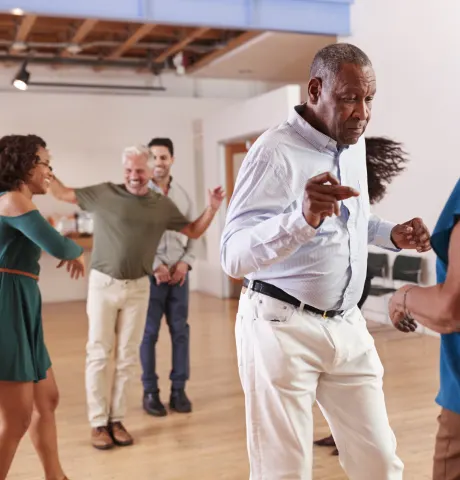 Holding your Salsa frame: Stability in a coupleThe Salsa frame is the foundation for subtle leading and harmonious dancing. Learn how to create stability as a couple with the right body tension and arm positioning.
 Salsa leading style test: Do you lead or follow too firmly?Find out with our Salsa leading style test whether you grip too firmly or act too softly while dancing. Optimize your connection for a harmonious dance experience.
 Salsa Arm Styling for Ladies: Elegant Movements for FollowersElegant arm styling adds a personal touch to your Salsa dancing. Learn how to move your arms and hands expressively without losing the connection with your partner.
 Salsa styling for men: dance with confidenceSalsa styling for men adds that special touch to your dance. Learn how to impress on the dance floor with the right posture and masculine body movement.