Salsa dance styles5 minutes

Salsa dance styles: The variety of steps in comparison

By Bernhard De LucaUpdated

In a nutshell
  • The various Salsa dance styles can essentially be divided into circular movement forms like Salsa Cubana and line-based styles like the L.A. and New York Style.
  • Salsa Cubana is characterized by grounded, circular dancing around each other and playful wrapping figures.
  • The L.A. Style is danced in a straight line on the first beat of the music and is known for its speed as well as spectacular show effects.
  • The New York Style is danced on the second beat of the music and impresses with elegant, smooth movements as well as complex footwork.

Find your perfect Salsa partner on udansa

Whether you love the circular movements of Salsa Cubana or want to try the elegant lines of L.A. Style: on udansa you will find like-minded people for every dance style. Connect with others, share your passion, and discover dance partners as well as courses right in your area.

Find your perfect Salsa partner on udansa

The term Salsa hides an entire universe of rhythm, elegance, and joy of life. Those who understand the subtle differences between the styles will find their favorite dance faster and move more harmoniously on any dance floor.

DefinitionCross-Body-Lead

Cross-Body-Lead refers to the fundamental transition figure in line-based Salsa styles. In this move, the leader guides the follower past them so that both have swapped places on the dance line by the end of the movement.

An overview of the colorful world of Salsa dance styles

Salsa is not just Salsa. Anyone entering a dance school or a social for the first time will quickly realize that the movements on the dance floor can differ significantly. The various Salsa dance styles have historically developed in different regions of the world and each bring their own philosophies, dynamics, and footwork systems. While some styles are characterized by circular movements and playful interaction, others focus on precise, linear symmetry and spectacular show elements.

To understand the variety of Salsa styles, it helps to take a look at the geography of the dance. The two main currents can be roughly divided into circular styles, led by the classic Cuban variant, and linear styles, also known as Cross-Body-Lead styles. When you know the differences, it is easier for you to choose the right course and adapt flexibly to your dance partners on the dance floor. It is also worth taking a look at related rhythmic worlds: If you are wondering how the related music differs, our guide on Mambo music vs. Salsa music will help you.

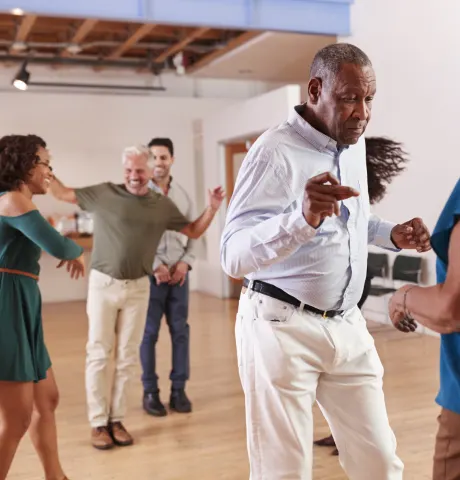
Active, happy seniors learning a new dance during a class in a studio
Small corrections with a big impact: the precise alignment of the feet determines the balance during fast turns in line-based Salsa styles.

Cuban circles versus American lines

Salsa Cubana, also known as Casino in its country of origin, is the epitome of joy and spontaneity. Partners move primarily in circular paths around each other. Leading often involves significant body movement, and the steps are closely connected to the floor. A striking feature of this style is that dancers often interact very playfully with one another, incorporating solo steps and Afro-Cuban elements. Furthermore, this style forms the basis for Rueda de Casino, where multiple couples dance in a circle and change partners synchronously upon a call.

In stark contrast are the line-based Salsa dance styles that became popular in the USA. In Salsa L.A. Style (Los Angeles Style), dancing takes place on a line, specifically on the first beat of the measure (On 1). This style is extremely dynamic, energetic, and shows clear influences from show dance, including rapid turns and drops. The elegant Salsa N.Y. Style (New York Style), which was significantly shaped by Mambo legends, is danced on the second beat (On 2). It appears softer, more harmonious, and focuses on fluid transitions and precise footwork. If you are interested in the subtle differences in dance posture, you will find exciting details in the comparison of Mambo Classic and New York Style.

How to master Salsa styles with udansa

Correct

  • Focus on a single style at the beginning
  • Pay meticulous attention to the correct timing in the beat
  • Use the entire space for fluid movements

Wrong

  • Mixing up styles randomly while learning
  • Placing steps inaccurately and ignoring the beat
  • Blocking your partner's line of dance

If you feel the rhythm in your body, you dance every style with heart. The steps are just the geography, the music is the actual destination.

Salsa dance instructor

Step systems and the magic of timing

The foundation of every style is the basic Salsa steps. Even though all styles are based on the classic eight-beat pattern of Salsa music, the weight transfer differs significantly. In L.A. Style, the leader breaks forward with the left foot on the first beat, while in New York Style On 2, the decisive change of direction only occurs on the second beat. This rhythmic shift changes the entire dance feeling: On 1 feels driving and direct, while On 2 radiates a jazzy, relaxed elegance.

For beginners, it is advisable to focus on one step system first to develop a solid sense of rhythm. As soon as the basic steps have become second nature, switching between styles becomes much easier. If you want to further refine your dance technique and work on your balance, the principles from Mambo offer excellent foundations. You can find helpful tips on this in the guide to improving Mambo dance technique, which can be applied to line-based Salsa in many respects.

Two worlds on the dance floor

Cuban

Salsa Cubana (Casino)

Circular and grounded

Salsa Cubana thrives on the circular movement of partners around each other. It is grounded, rhythmically playful, and leaves plenty of room for spontaneous, Afro-Cuban solo elements and close body leading.

Line

L.A. & New York Style

Linear and elegant

The American styles from Los Angeles and New York are danced strictly along an imaginary line. They emphasize long, elegant lines, fast multiple turns, and very precise, coordinated leading.

Frequently Asked Questions

  1. For absolute beginners, Salsa Cubana is particularly suitable because the circular basic step feels more natural. The L.A. Style is also very intuitive to learn, as you dance on the first beat of the measure.

Salsa courses near you

Find the right dance school and learn your favorite Salsa style from scratch.

View all matching courses

Everything about Salsa dance styles: The variety of steps in comparison