
Dancing together in a circle
On udansa you will find the right Salsa courses and dance partners in your region to join the next Rueda round right away. Experience the dynamics of group Salsa from Cuba for yourself on the dance floor.



By Mary De LucaUpdated
On udansa you will find the right Salsa courses and dance partners in your region to join the next Rueda round right away. Experience the dynamics of group Salsa from Cuba for yourself on the dance floor.
Rueda de Casino breaks with the classic patterns of partner dance and turns Salsa into an exhilarating team sport experience. Once you have experienced the fiery interaction in a circle, you will not want to miss this energy again with udansa.
Rueda de Casino refers to a Cuban form of Salsa dancing where several couples form a circle. They perform the figures synchronously based on the commands of a leader and continuously switch partners.
Rueda de Casino is not an ordinary partner dance, but a dynamic group experience in a circle. Originating in Cuba in the 1950s and 60s, this dance form combines the classic elements of Cuban Salsa with an infectious sense of community. Several couples form a circle (Spanish "Rueda" for wheel) and dance the same figures in sync. The special thing about it: upon a specific command, all leaders simultaneously switch their partners within the circle. This creates a constant flow that requires enormous concentration, but above all, brings a lot of fun and a strong sense of togetherness.
Anyone who wants to learn to dance Salsa will find a particularly playful approach in Rueda. Since all couples perform the same movements at the same time, the group supports the individual. You orient yourself visually by the neighboring couples, which takes away the fear of making mistakes, especially for beginners. At the same time, the constant changing of dance partners trains your adaptability. You learn to adjust to different leading styles and heights in a flash, which massively improves your dancing flexibility.

The heart of every Rueda round is the so-called caller (Spanish "Madre" or "Cantante"). This person is the brain of the circle: they decide spontaneously which figures will be danced next and call out the corresponding commands loudly to the group or signal them with hand gestures if the music is loud. All dancers must react in seconds and execute the announced Salsa Rueda steps synchronously. The role requires not only a sense of rhythm but also a good eye for the group's level to perfectly control the intensity of the round.
The list of Rueda de Casino figures is long and ranges from simple basic steps to highly complex wrapping figures where the entire circle artfully intertwines. Among the absolute classics is the command "Dame" (give me), where the leaders pass the partner to the right, or "Enchufla", a fundamental turn that often serves as the basis for partner changes. For the dancers, this means: without knowing the common Rueda commands, dancing along is hardly possible. You have to learn the vocabulary of Rueda like a language of its own.
Moving in the circle correctly
Mistakes in Rueda
Rueda de Casino connects people in a very special way, because you don't dance for yourself, but as part of a large, pulsating organism.
If you want to learn Rueda de Casino, you should already have a solid sense of rhythm. Since all actions must be perfectly synchronized with the beats of the music, a secure understanding of timing is essential. It helps immensely to familiarize yourself with counting Salsa rhythm beforehand, so you can execute the caller's commands precisely on the first beat of the music.
In practice, a Rueda is usually very informal. Often, a circle forms spontaneously on the dance floor at a Salsa party. An experienced dancer takes on the role of the caller, invites other couples to join, and the dynamic begins. To keep up, it is recommended to attend a special Rueda workshop or course. There, you will learn not only the steps but also the non-verbal communication within the circle that makes this dance style so popular worldwide.
The voice of the circle
The caller is responsible for the entire dynamic of the circle. They must have the music in their ears, call the figures in advance, and keep an eye on the dance level of the entire group so that no one loses their way.
The art of synchronicity
As a fellow dancer in the circle, the focus is on maximum attention and quick switching. You must grasp the caller's commands immediately, whether acoustically or visually, and implement them in sync with the other couples without delay.
For Rueda de Casino, you should already be confident with the basic steps of Cuban Salsa. A good sense of rhythm to the beats of the music is the most important prerequisite for synchronicity in the circle.
Commands are either called out loudly into the room or, when the music is loud, signaled through clear hand gestures above the head. This way, every couple in the circle can recognize the figure in time.
If you have made a mistake, try to stay calm and quickly focus on the basic step again. The easiest way is to re-enter the flow of the Rueda regularly during the next partner change.
Find the right dance school now and learn Rueda de Casino in a group.
Couple danceLimbach-Oberfrohna · Germany
PaartanzkreisFriday · 18:15 · Oct 23
Limbach-Oberfrohna
Couple danceLimbach-Oberfrohna · Germany
Silberkurs für PaareSunday · 16:15 · Oct 25 - Nov 15
Limbach-Oberfrohna
 Learn to dance Salsa: The complete beginner's guideLearning to dance Salsa is the perfect way to bring movement, rhythm, and new connections into your life. Our guide shows you how to get started, even without any prior experience.
 Learn to count Salsa rhythm: The beat guideLearn how to count the Salsa rhythm without mistakes. Our compact guide explains the structure of the 8-beat cycle for a confident start.
 Salsa Party Guide: Your first social danceIs your first salsa party coming up? Don't worry: our compact guide explains the exact flow of a salsa social from the very first minute.
 Salsa dance styles: A comparison of stepsFind out which Salsa style suits you best. We compare Cuban Salsa with the linear styles from New York and Los Angeles.
 Salsa Cali Style: Fast footwork from ColombiaThe Colombian Cali Style fascinates with its breathtakingly fast footwork and dynamic kicks. Learn what makes this unique dance style special and how you can master the basics.
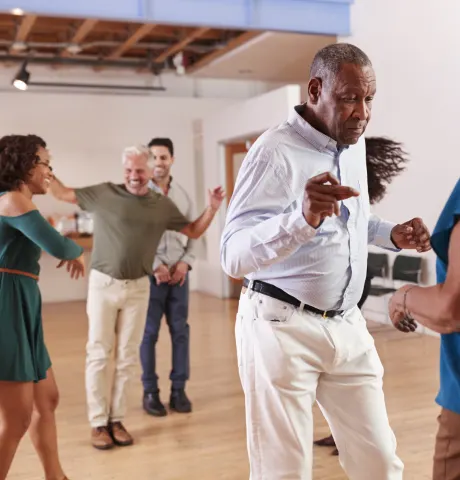 Salsa Romántica: Smooth steps and soulful flowDiscover the soft and sensual world of Salsa Romántica. Learn how to adapt your steps to the gentle music and how to dance with a deep connection as a couple.
 Salsa Shines for beginners: Footwork step by stepLearn the most important Salsa Shines for beginners and improve your footwork without a partner. Our guide shows you the best solo steps for your training.
 Salsa Dance Trends 2026: The urban shift on the dance floorThe Salsa scene is evolving rapidly. Discover how urban influences and modern fusion trends are revolutionizing classic styles on the dance floors in 2026.
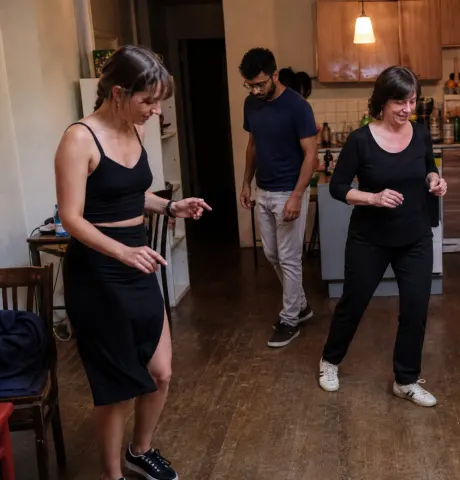 Salsa circular vs linear: Floor space managementSalsa circular vs linear: Learn all about the circular floor space of Salsa Cubana compared to the elegant linear movement of slot styles.
 The 7 most common mistakes in Salsa steps and footworkIf you want to learn Salsa, you will often stumble over the same hurdles in your footwork at the beginning. This overview shows you the seven most common mistakes in Salsa steps and how to avoid them from the start.