

Find your youth dance course now
On udansa you will find the right dance school for teenagers in your area, offering exactly the courses that fit you and your schedule. Discover offers near you and start your dance adventure directly with peers.
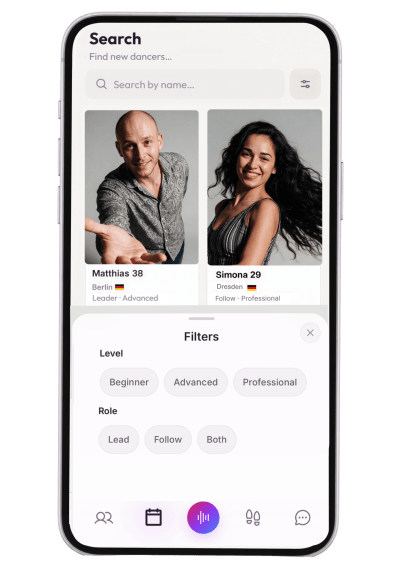

For many young people, stepping onto the dance floor is their first big social debut. Here, music, movement, and new friendships combine to create an unforgettable experience with udansa.
The World Dance Program, or WTP for short, is an internationally standardized guide for dance schools that summarizes the most important social dances for practical use in everyday life. It forms the foundation for most student dance courses.
The classic dance course for teenagers is far more than just learning step sequences to the beat. For many young people, it marks an important step in the process of growing up. In the protected environment of a dance school for teenagers, peers meet on equal terms, learn social rules, and overcome their initial shyness toward the opposite sex. Historically, the student dance course served as a social debut, but today the focus is on the shared experience and the joy of movement.
For teenagers, who often come into contact with fixed partner dance structures for the first time, the course offers a structure that provides stability. It is not about athletic peak performance, but about learning social basics that remain useful for a lifetime at festive occasions like school graduations or family celebrations. Through conscious body work, the teenagers gain a completely new self-confidence that also has a positive effect in everyday life outside the dance school.
A common prejudice is that a dance course for students is stiff, old-fashioned, and full of strict, outdated rules. Teenagers often fear embarrassing themselves or being forced into uncomfortable clothing. However, the reality in modern dance schools is different. The dance course sequence for students is designed to be dynamic today: to current chart hits and modern rhythms, teenagers from the age of 14 learn the basics of ballroom and Latin American dances. No one has to be perfect, and the focus is on the fun of moving together.
Another misconception concerns finding a partner. Many believe that you must register with a fixed partner. In practice, the opposite is the case: registration is usually done individually, and dance partners are changed regularly during the course. This takes the pressure off and ensures that all participants quickly make contacts and learn to lead and follow flexibly. If you want to prepare optimally for your first lesson, you will find valuable tips in the guide Your first dance lesson in Berlin: How to prepare.
Use the first few hours to get used to leading and following, without focusing too much on your feet. Your gaze belongs on your partner, not on the floor.
For many young people, the student dance course is the first place where they learn that closeness and respect go hand in hand on the dance floor.
Anyone who decides to learn to dance at 14 or dance at 16 benefits far beyond the duration of the course. In addition to improved coordination and posture, the course strengthens social skills. Teenagers learn to take responsibility for themselves and their partner, to coordinate with each other, and to treat one another with respect. The crowning finale of every course is the festive graduation ball, where what has been learned is presented in a celebratory setting.
For parents, the youth dance course guide offers the certainty that their children are acquiring valuable life skills in a safe environment. The costs for youth dance courses, which vary depending on the region and the scope of the course, are therefore a sustainable investment in the child's personal development. Anyone who wants to delve deeper after the basic course can later look into advanced programs, such as those presented in the area of Medal courses in Berlin: From the world dance program to the badge.
The classic for teenagers
In the classic youth dance course, students get to know traditional partner dances such as Waltz, Cha-Cha, and Discofox. The focus is on a shared sense of rhythm and social etiquette.
Modern solo dances for students
As a modern addition or alternative, many young people choose dynamic solo dances like Hip-Hop or street dance. Here, the focus is on individual body control, charisma, and urban choreographies.
As a rule, an age between 14 and 16 is ideal for starting. During this phase, schools offer special courses that are perfectly timed to fit into the school day.
Find the perfect start into the world of dance and meet people your age on the dance floor.
Wednesday · 13:15-14:45 · Nov 11, 2026 - Feb 24, 2027
Leukersdorf
Friday · 13:20-14:50 · Nov 13, 2026 - Feb 26, 2027
Waldenburg
 Your first dance class in Berlin: How to prepareEvery beginning is easy: With this guide, you can prepare perfectly for your very first dance class in Berlin and get started completely stress-free.
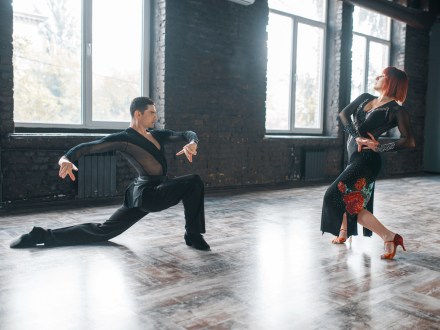 Medal Courses in Berlin: From the World Dance Program to CertificationThe structured path to your dance certification in Berlin: Learn how the World Dance Program and medal courses are structured and how to prepare perfectly.
 Teen dance courses: The perfect start at a dance schoolTeen dance courses open the door to a new social world for young people. Find out how starting at a dance school works, what it costs, and why it is so much fun.
 Mastering your dance course mid-term and final ballThe final ball is the highlight of every student dance course. We show you what to expect at the mid-term ball and the grand finale, and how to prepare optimally.
 Dancing as a hobby for teens: Your path to the clubDancing is more than just a beginner course. Discover how you can fully enjoy your new hobby as a teen in a dance club, by earning the German Dance Badge, or by joining a formation team.
 Boost confidence through dance: Overcoming shynessDancing boosts confidence and improves body awareness for teens. Learn how to overcome shyness and make new friends.