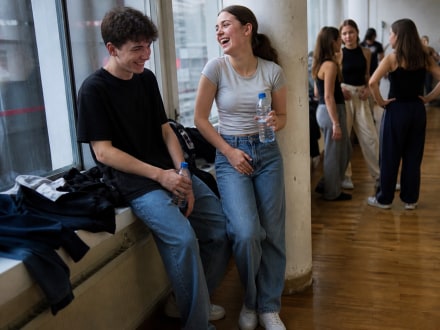
Find your dance partner of the same age
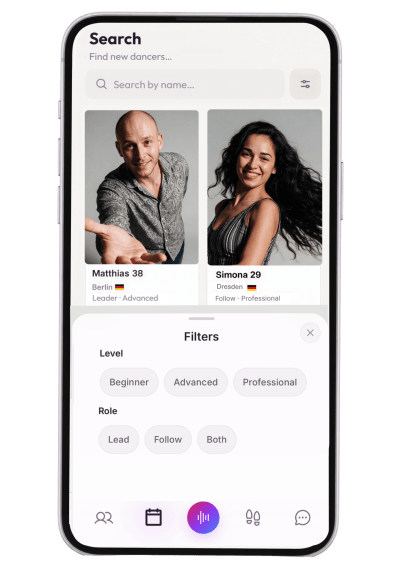
On udansa, you can connect easily with people your age who share your vibe. Find your dance group or a nice companion for your next dance class in your area.

Shyness often feels like an invisible wall. On the dance floor, you learn to break down this barrier step by step and experience your body in a completely new way.
Self-confidence through dancing describes the process in which young people gain mental strength and social security through physical coordination, mastering steps, and social interaction on the dance floor.
The thought of dancing in front of other people initially triggers heart palpitations and sweaty hands for many teenagers. In a phase of life where your own body is constantly changing anyway, every movement under observation feels like a risk. But this is exactly where the positive effect of dancing comes in. Those who face the challenge quickly learn that everyone else in the room is struggling with the same insecurities. When trying out new steps together, constant self-observation fades into the background. Focusing on the rhythm and the movement drives away the circling thoughts in your head.
A structured dance course for teenagers offers a protected environment where mistakes are not only allowed, but completely normal. When the entire group trips over their own feet at the same time and laughs about it, the supposed failure loses its terror. This shared experience brings people together and takes away the pressure to have to be perfect. Step by step, the fear of being judged by others fades, which directly carries over into everyday life outside the dance studio.
Puberty often turns your own body perception upside down. Limbs seem to grow overnight, and your usual coordination starts to falter. A targeted sense of body awareness for teenagers is not built through theoretical thinking, but through active experience in space. Dancing trains coordination, improves posture, and conveys a new sense of your own limits and possibilities. Anyone who learns to move upright and in rhythm radiates this presence in everyday life as well.
This newly gained physical security has a direct effect on mental well-being. An upright stance signals activity and self-confidence to the brain. Overcoming shyness while dancing works particularly effectively through this physical channel. Instead of making yourself small or hiding behind your smartphone, the dance floor demands an open position. Once you have experienced how your own body masters complex choreographies, you will face other challenges, such as presentations at school, with significantly more composure.
Before entering the dance floor, take three deep breaths into your belly. This lowers your heart rate immediately and signals to your body that there is no danger.
Anyone who learns to move to the music gains a whole new presence in the room, which immediately carries over into everyday life.
The biggest hurdle for beginners is often the question of who will be by their side during the course. Finding a suitable dance partner for students is much easier today than it used to be. Modern dance schools have long since stopped requiring you to show up as a couple when registering, instead assigning partners flexibly on site. This takes the pressure off and ensures that everyone dances with everyone else. If you are specifically looking for people your own age to practice with outside of fixed course times, it is best to use specialized platforms.
On udansa, you can specifically search for a dance partner of the same age without having to make a firm commitment right away. The shared hobby connects you immediately, as the focus is on the common task. You do not need to have long small talk conversations to break the ice: the steps and the music provide the perfect conversation starter. In this way, initial attempts at dancing together often turn into lasting friendships that extend far beyond the dance floor.
Taking responsibility and setting the direction
As a leader, you take responsibility for the direction and the next step. This trains your decisiveness and gives you the confidence to take the initiative at the right moment.
Perceiving signals and reacting flexibly
As a follower, you react sensitively to the signals of your partner. This trains your attention, your trust in others, and the ability to fully engage with the moment.
Just sign up without a partner. In most youth courses, partners are rotated constantly anyway, so everyone dances with everyone and no one is left standing on the sidelines.
Find the right course for your start on the dance floor.