

Find your dance partner for the dance class
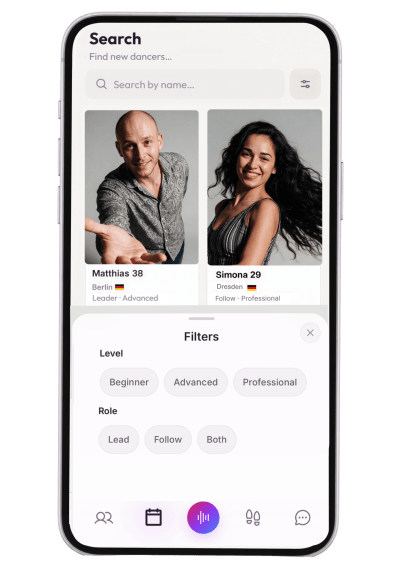
Create your free profile and find people your age who share your passion and with whom you can take the first step onto the dance floor.

Starting your first partner dance really stirs up your emotions. Here, you will learn how to turn your nervousness into anticipation and how to handle the unfamiliar closeness in a relaxed way.
Shyness when dancing describes the emotional barrier and physical tension that arises from the unfamiliar closeness and the fear of making mistakes in front of others. It can be gradually overcome by focusing on moving together.
The first step into a dance school often requires the most effort. The idea of suddenly standing opposite a stranger, holding their hand, and moving to the beat of the music can trigger a racing heart and sweaty palms. This reaction is completely normal. Our brain reacts instinctively with caution to unfamiliar social situations and physical closeness. When dancing, the personal comfort zone that we carefully maintain in everyday life is consciously opened up. Anyone who understands this dynamic quickly loses their shyness in a dance class.
It helps to realize that almost everyone in the room feels exactly the same nervousness. No one is born a perfect dancer, and this insecurity connects you more in the first few minutes than it might seem. If you learn to interpret this excitement not as a blockage, but as a sign of anticipation and focus, you lay the foundation for a new sense of self-confidence.
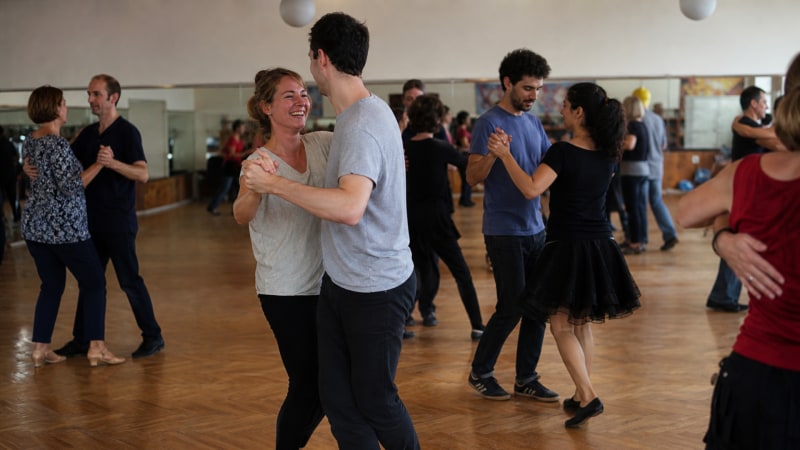
The fear of the first physical contact can be reduced through targeted mental preparation. Partner dance is based on a clear division of roles, which has nothing to do with dominance, but rather with organization. To get comfortable with this, it helps to shift the focus away from your own body. Instead, concentrate entirely on the music and the simple movement sequences. If you are wondering how best to pick up the rhythm, it helps to recognize the beat in ballroom dance to gain confidence for your own feet.
Set yourself small, achievable milestones for your first lessons. It is not about shining flawlessly or looking particularly elegant right away. Your goal for the first lesson can simply be to maintain eye contact for a few seconds and learn your partner's name. By consciously reducing the pressure of expectations, the stress level in your mind drops noticeably, and the initial insecurity gives way to curiosity.
Before starting a new dance, take three deep breaths into your belly. This immediately lowers your pulse and signals to your body that everything is okay.
The biggest hurdle in dancing is not the sequence of steps, but giving yourself permission to simply be a beginner in the presence of others.
As soon as the first music starts, it quickly becomes clear that dancing is a team sport. The unfamiliar closeness loses its intimidation once you realize that your partner is just as focused on the steps as you are. No one is staring at your feet or judging every movement. In a good student dance course, there is an atmosphere of shared experimentation where mistakes are simply part of the process.
Use the shared movement to positively influence your own body language. Anyone who stands upright and breathes signals safety to their own nervous system. With every dance together, every survived turn, and every laugh over a botched step, your confidence in your own abilities grows. This is how the dance course turns from a test of courage into a place where you can get to know yourself in a completely new way and make genuine connections.
Embracing fear playfully
You accept shyness as part of the adventure and focus on the shared rhythm. You take mistakes with humor to immediately relax the situation for yourself and your partner.
Trying to force control
You are trying to control every movement convulsively and withdraw internally when you make mistakes. The fear of rejection blocks your natural movement and makes it difficult to connect with your partner.
It is completely normal to have sweaty hands, as your body is reacting to the excitement. Simply wipe your hands discreetly on your trousers before dancing with a partner and do not worry, as your partner is likely feeling the exact same way.
Find the right start and learn to dance in a relaxed community.
Wednesday · 13:15-14:45 · Nov 11, 2026 - Feb 24, 2027
Leukersdorf
Friday · 13:20-14:50 · Nov 13, 2026 - Feb 26, 2027
Waldenburg
 Recognizing the beat in ballroom dance: Understanding rhythm made easyThe secret to ballroom dance lies in listening to the music correctly. Learn how to confidently recognize the beat in Waltz, Tango, and Slowfox and move in harmony.
 Teen dance courses: The perfect start at a dance schoolTeen dance courses open the door to a new social world for young people. Find out how starting at a dance school works, what it costs, and why it is so much fun.