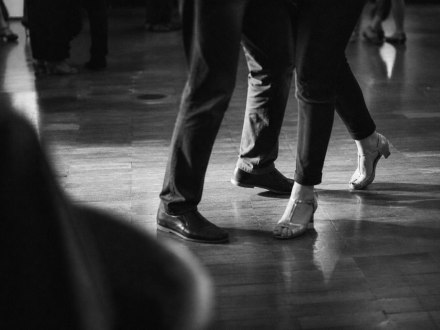
Find your partner for Tango
Whether you are looking for your first steps or want to meet experienced dancers for the next milonga: on udansa you will meet people who share your passion.
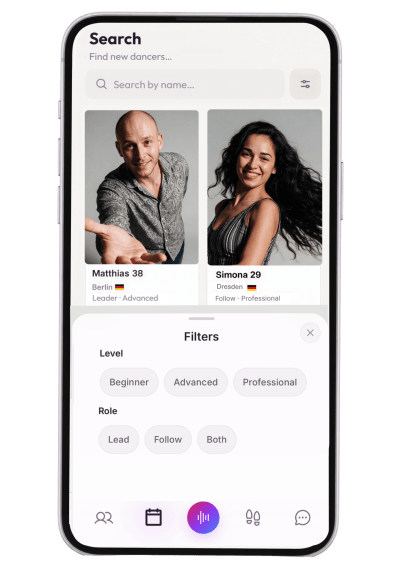

Argentine Tango is much more than just a dance, it is an intense conversation without words. Anyone who embarks on this journey learns not only steps, but a completely new way of connection and mindfulness as a couple.
Milonga refers to both the traditional dance event where Argentine Tango is danced, and an independent, faster musical style in 2/4 time. At a milonga, traditional rules of conduct apply, such as inviting someone to dance via eye contact.
Tango Argentino differs fundamentally from the classic ballroom dances you might know from dance school. While the European tango follows fixed step sequences and a strict posture, the South American variant is a pure dance of improvisation. The basics of Tango Argentino are not based on memorized choreographies, but on constant, silent communication within the pair. Every step is created in the moment, carried by the music and the subtle coordination between the dancers.
Anyone who wants to learn Tango Argentino quickly discovers that the famous close embrace (the "abrazo") is not a rigid corset. It is rather a space of trust, in which the partners support and lead each other. This deep connection is what makes it so appealing: the leader suggests a direction, the follower interprets this movement and executes it with their own elegance. In this way, every song becomes a unique conversation without words.
The roots of this dance lie in the late 19th century in the immigrant neighborhoods of Buenos Aires and Montevideo. In the history of Argentine Tango, African rhythms, European melodies, and the longing of the people in the port districts blended together. From this melancholy and the search for closeness, a culture emerged that is now part of the UNESCO World Heritage. The bandoneon, an accordion-like instrument, still sets the emotional pace today with its sighing sound.
For beginners, a structured Argentine Tango dance course is the best way to enter this world. Unlike fast-paced trendy dances, it is less about complicated figures at the beginning, but rather about walking, balance, and the axis in your own body. A good course for beginners takes away your shyness regarding the close embrace and shows you how to move across the dance floor in a relaxed way and in harmony with the music.
In your first few lessons, focus entirely on your own balance. Once you are stable on your own feet, walking together in an embrace will immediately feel much easier.
Tango is not a sport, it is a feeling that you transfer through your feet to the floor and share with your partner.
As soon as you have mastered the basics, you will inevitably be drawn to a milonga, which is what traditional Tango evenings are called. There, you will experience the vibrant Argentine Tango community, which follows its own rules and rituals. Invitations are often made without physical contact via the cabeceo, a glance followed by a nod. This creates a respectful atmosphere in which everyone can feel comfortable. If you do not have a regular partner yet, the Argentine Tango platform udansa will help you find like-minded people for your course or the next milonga.
Tango is a lifelong learning process that shows a new face with every partner and every song. It is worth paying attention to the subtle signals from the beginning instead of just counting steps. If you are curious about other dance styles, you can also find information about completely different forms of movement, such as smooth footwork in Kizomba, to further refine your general body awareness.
The art of the invitation in dance
You set the direction, pay attention to the space, and invite your partner to take a step with a clear movement of your upper body.
The art of active listening
You feel the movement in your partner's upper body, maintain your own axis, and shape the suggested step with your elegance.
You do not need special tango shoes to get started. It is important to have a clean sole that glides easily on the floor, such as leather soles or smooth synthetic soles, so that your knees are protected during turns.
Find the right start and discover the fascination of Tango for yourself.
 Argentine Tango embrace: The art of subtle connectionThe abrazo is the heart of Argentine Tango. Discover how to build a harmonious connection with your dance partner through proper posture and a sensitive embrace.
 Argentine Tango steps: From walking to your first figuresStarting with Argentine Tango begins with the walk. Learn how a fluid dance emerges from the caminata, the flexible basic step, and elegant Ochos.
 Argentine Tango Music: Understanding Rhythms and OrchestrasArgentine Tango thrives on its unique music. Learn how to hear the differences between Tango, Vals, and Milonga and understand the great orchestras.
 Milonga Etiquette: How to navigate the Tango floor with confidenceVisiting a milonga is a fascinating experience full of tradition. With the right etiquette and the perfect pair of tango shoes, you will glide across the dance floor with confidence.