Find your Tango partner on udansa
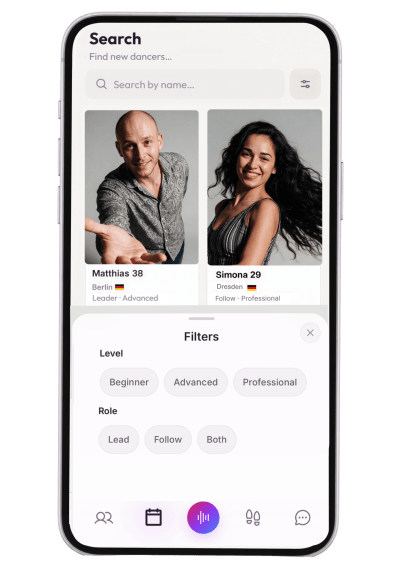
On udansa, you will find like-minded people who want to practice the Tango basic step with you and spin the first elegant rounds on the dance floor together.

Argentine Tango fascinates with its flowing elegance, which manages entirely without rigid step patterns. Here you can learn how a fascinating dialogue without words emerges from simple walking and classic basic elements.
Ochos are one of the most well-known basic figures in Argentine Tango, where the feet trace a figure-eight loop on the floor through a rotation of the hips. They are usually performed by the follower and can be danced forwards or backwards.
Starting with Argentine Tango is fundamentally different from other partner dances. There are no rigid step sequences that you have to memorize to look good. Instead, the entire system is based on natural walking in space. When walking in Argentine Tango, both partners move synchronously, with steps placed precisely under one's own center of gravity. This conscious walking, also called caminata, is the actual foundation of the dance.
Anyone who wants to learn Argentine Tango quickly realizes that every step is a conscious transfer of body weight. Only when one foot is standing stably does the next movement follow. This apparent simplicity requires concentration, but it gives the dance its characteristic elegance and calm. The upper body remains calm and upright, while the legs do the work under the hips.
Although Tango is a pure improvisation dance, a structured sequence helps when learning in a course. The classic Tango Argentino basic step, also known as the "Basico" or eight-step basic form, serves as an excellent tool to train orientation in space. It guides the couple in a closed form through different directions: a step back, to the side, several steps forward, a crossing of the legs, and the final step into the basic position.
It is important to understand that these eight steps are rarely danced in one go in practice. They are rather a modular system. Experienced dancers break up the pattern at any time to adapt to the space on the dance floor. The precise Tango Argentino footwork ensures that the feet glide flat over the floor and contact with the parquet is never lost.
Feel free to practice walking and weight transfer on your own at home every now and then along a line on the floor to strengthen your own balance and axis.
In Tango, walking is already half the dance. Anyone who can walk upright, balanced, and in harmony with their partner is already dancing with deep elegance.
As soon as walking and the basic step are secure, the first real Tango Argentino figures bring dynamics and rotation into the dance. Among the best-known elements are the Ochos in Tango Argentino, where the follower's feet trace a visual eight on the floor. This fluid movement is created through gentle dissociation, a rotation of the upper body and pelvis, which is gently initiated by the leader.
Another key element for turns is the Giro in Tango Argentino. In this circular dance, one partner circles the other in a precise sequence of side steps, forward steps, and backward steps. These turns require good balance and axis tension from both partners, but they open up endless possibilities to react to the music and make the dance come alive.
The classic walk chest to chest
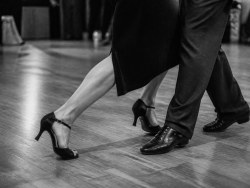
When walking in the track, the partners move directly in front of each other. The feet of the leader and the follower are positioned on parallel lines, which allows for a very direct and stable connection.
The foundation for elegant turns
When walking in outside partner position, the axis shifts slightly. The couple moves in a way that allows their legs to glide past each other, which clears the path for complex turns and cross steps.
The best way to start is by focusing on conscious walking as a pair. Focus on weight transfer and walking together in rhythm before you memorize complex step sequences.
Find the right dance school and start your first steps in Argentine Tango.