Milonga practice5 minutes

Dancing Argentine Tango on a crowded dance floor: steps in tight spaces

In short
  • Argentine Tango on a crowded dance floor requires extremely small, precise steps and an upright, compact posture.
  • Movement shifts from large steps to vertical weight changes and gentle turns on the spot.
  • Good improvisation and avoiding rigid choreography prevent collisions in the dense flow of the milonga.
  • Compact figures like the Ocho Cortado help to maintain the flow of the dance even when space is severely limited.

When the dance floor is bursting at the seams, the true mastery of Tango reveals itself. Those who learn to direct their energy inward discover an unexpected intensity within the dense crowd.

DefinitionRonda

The ronda refers to the circular direction of dance at a milonga, where all couples move counter-clockwise on concentric paths. It ensures order and safety on a crowded dance floor.

The art of reduction in a dense crowd

Anyone visiting a traditional milonga for the first time is often in for a surprise. Instead of expansive steps and sweeping leg movements, the couples move in a dense, almost hypnotic mass. On a busy dance floor, space is a rare commodity. Anyone who stubbornly reels off step sequences from the dance studio here risks painful collisions and disrupts the flow of the entire community. Nevertheless, tightness in Argentine Tango by no means implies a loss of dynamics or expressiveness.

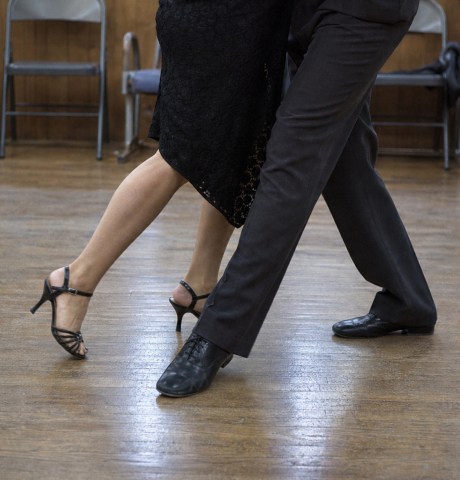
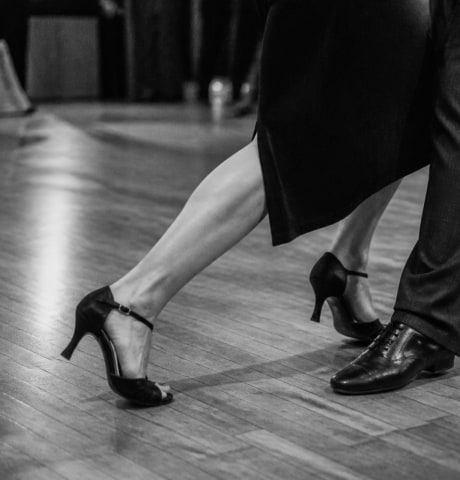
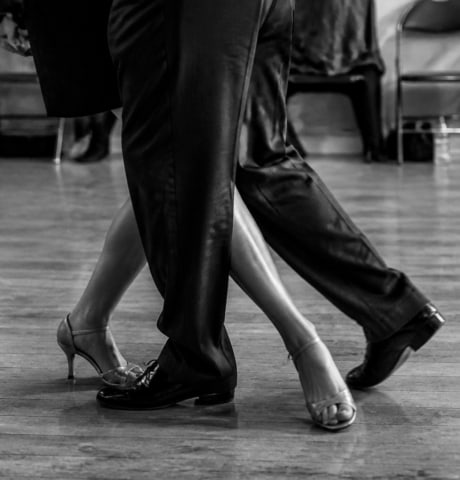
The secret lies in reduction. To be able to dance Argentine Tango on a full dance floor, you have to shift the movement inwards. Every signal becomes finer, every weight shift more precise. Instead of bridging the distance with large steps, you use the vertical axis of your body. The energy does not flow forward, but through the soles of your feet into the floor and via the Argentine Tango chest lead directly to your partner. This creates an intense dialogue that works even on the surface of a single paving slab.
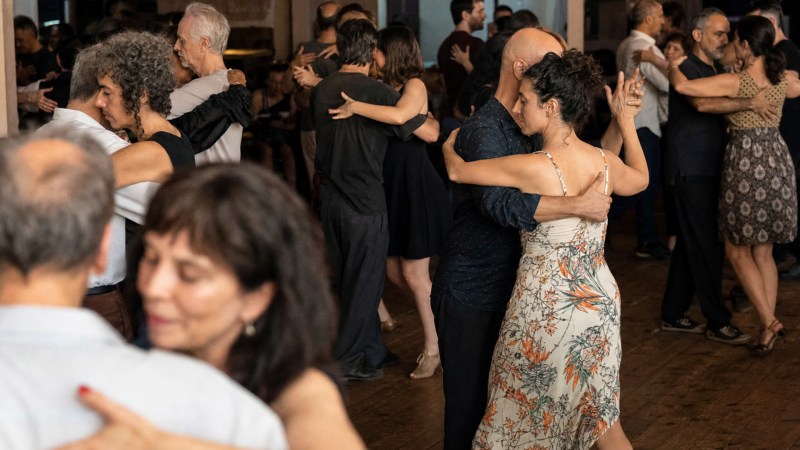
Anyone who keeps their lane in the busy flow of the milonga and chooses small steps protects themselves and other couples from collisions.

Small steps with a big impact at the milonga

When space becomes tight, the entire geometry of the dance changes. Large forward steps give way to a controlled walking style kept close to the partner. The knees remain soft and slightly bent to be able to change direction at any time. A crucial tool for Tango Argentino when space is limited are steps that take place on the spot or in tiny circular paths. Instead of pushing forward, the leader uses small side steps or the rocking step principle, the so-called Traspié, to stay in the flow of the music without taking up space.

A common mistake in a dense crowd is sticking rigidly to fixed patterns. Anyone who tries to force an eight-pattern learned in class without regard for the surroundings will fail. At a full milonga, figures like the Ocho Cortado or ultra-small turns on the spot are your best allies. They allow you to adjust your orientation in the room at lightning speed. If you are unsure whether your basics are sufficient for the dense crowd, the Tango Argentino level test can help you correctly assess your foundations.

Navigating safely through the crowd

Correct

  • Keep steps extremely small and flat on the floor
  • Lead the movement through the chest
  • Move steadily in the flow of the outer ronda
  • Pause and enjoy the music vertically

Don'ts

  • Take sweeping steps backward or blindly to the side
  • Let your dance frame go limp
  • Push straight across the middle of the dance floor
  • Let the lack of space stress you out

At a crowded milonga, you do not dance for the spectators, but exclusively for your partner and the music within your own embrace.

Tango teacher, Berlin

Improvisation as the key to maximum freedom

The most important skill on a crowded dance floor is improvisation. You do not plan three steps ahead, but react in milliseconds to the gaps that open up in front of you and close again immediately. This requires an extremely high level of attention from both partners. The leader must scan the surroundings while simultaneously sending signals through the upper body so clearly that the follower can follow instantly. The dance frame remains stable, yet flexible enough to gently nestle against other couples without losing the connection.

This form of dancing has an aesthetic all its own. It is intimate, highly focused, and incredibly musical. When the feet have no room to roam, the body begins to interpret the nuances of the instruments more finely. A tiny lift of the heel, a gentle delay in the step, or a brief pause in harmony with the violin replace the expansive forward step. Anyone who masters this art no longer perceives a full dance floor as an obstacle, but as an invitation to a particularly deep, shared dance experience.

Two worlds of movement in Argentine Tango

Width

The open space

Tango with plenty of freedom of movement

Here you use expansive steps, wide turns, and dynamic forward movements. This style requires a lot of free space on the dance floor and is danced primarily in shows or very empty halls.

Closeness

The compressed axis

Tango in a crowded space

Here, ultra-small steps, tight turns on the spot, and the vertical axis dominate. The movement goes inward and into the floor, which makes dancing in the dense crowd of a milonga possible in the first place.

Frequently Asked Questions

  1. The best options are ultra-small turns on the spot, weight-shifting steps like the Traspié, and compact figures like the Ocho Cortado. These movements require hardly any space and allow you to react immediately to obstacles.

Tango events near you

Find the best milongas and workshops to perfect your dancing in a small space.

See all matching events

Find your partner for the Milonga

On udansa, you will find like-minded people who want to master the crowded dance floor at the Milonga with you and practice the art of small steps.

Find your partner for the Milonga

Read more