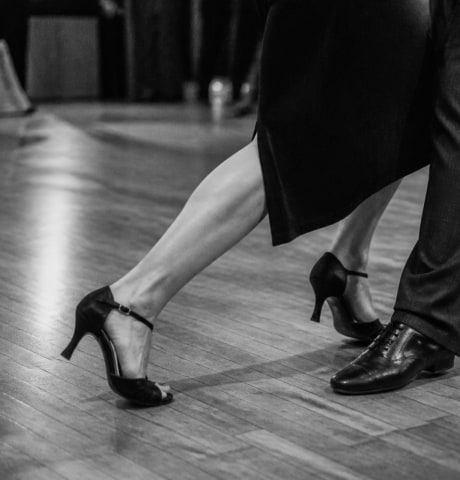
How circular movement is created in space
The giro, the classic turn in Argentine Tango, fascinates with its fluid circular movement. In contrast to the linear steps in Argentine Tango steps: From walking to the first figures, the couple leaves the straight line here and moves around each other. The biggest hurdle for beginners usually lies in coordination, as both roles move in completely different patterns. While one partner forms the stable center, the other circles it in a precise sequence of steps.
To understand this dynamic, a look at the step sequence for the circling part, usually the follower, is helpful. This follows the so-called molinete pattern, a fixed combination of side step, forward step, side step, and backward step. Only through this exact sequence does a round, fluid movement emerge that works without hesitation. Anyone who masters these steps individually lays the foundation for dancing the turn fluidly as a couple later on.