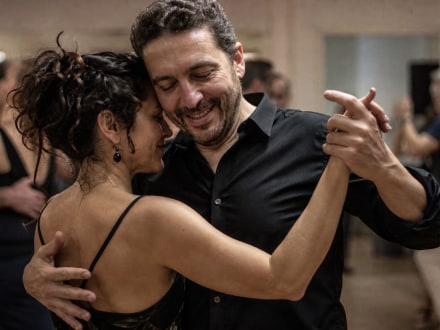
Find your perfect partner for the Abrazo
On udansa connect, you will find like-minded people in your region who share your passion for Tango and want to practice the perfect embrace on the dance floor with you.


The embrace in Tango is not a rigid hold, but a living dialogue between two bodies. Learn how you can build a deep, non-verbal connection with your partner through the right posture.
In Argentine Tango, the abrazo refers to the embrace between dance partners. It forms the foundation for non-verbal communication and the continuous flow of movement within the couple.
In Argentine Tango, the term abrazo describes far more than just a static hold. It is the heart of the communication between dancers. A successful Argentine Tango embrace is characterized by being both stable and flexible at the same time. It creates a protected space in which two bodies can act as one unit without losing their own axis. Anyone who wants to learn Argentine Tango quickly realizes that the quality of this connection determines how effortless the movements feel.
The embrace is often misunderstood as a rigid corset or a mere formality. However, in Tango, it is the primary medium for non-verbal communication. Through constant, gentle contact, all signals for changes in direction and dynamics flow. A rigid grip blocks this flow, while a posture that is too slack causes signals to vanish into thin air. It is only through the subtle interplay of body tension and yielding that the magic of dancing together emerges.
The physical foundation for a stable connection lies in the upper part of the body. A correct Argentine Tango posture requires a conscious lengthening of the spine, with the shoulders relaxed and dropping downwards. The upper body in Argentine Tango is tilted slightly forward, so that the partners approach each other at the level of the sternum. This tilt ensures that the weight is shifted slightly towards the partner, which increases stability and secures the shared center of gravity.
From this position, the contact in Tango can be maintained without the arms having to exert excessive force. In Tango, the arms serve merely as a frame and antennas, not as a tool for pulling or pushing. The actual leading impulse originates directly from the torso and the sternum. When the leader's upper body rotates or tilts, this movement is transferred directly to the follower. This creates a harmonious dialogue that works without words and purely through physical presence.
Take a deep breath together before the first step. This synchronizes your rhythm, releases tension in your upper body, and lets you feel your shared axis immediately.
The embrace in Tango is not about holding, but about living together in movement. It gives your partner freedom, while providing them with support.
In Argentine Tango, a fundamental distinction is made between the close embrace (Abrazo cerrado) and the open embrace (Abrazo abierto). In the close Abrazo, the upper bodies nestle closely against each other, which allows for a particularly intimate and direct transmission of impulses. This form is preferred especially on traditional, crowded dance floors. The open embrace, on the other hand, leaves more space between the partners, which creates room for expansive turns. Both forms are equally valuable, and experienced couples often switch fluidly between them during a dance.
For leading and following in Argentine Tango to work, mutual mindfulness is crucial. The leader dictates the direction and dynamics, but must at all times respect the balance and personal space of the follower. The follower, in turn, is by no means passive, but reacts actively to the impulses and fills the offered space with their own presence. This deep Tango connection between partners makes every dance a unique conversation that arises in the moment and is carried by the quality of the shared Abrazo.
Intimacy and direct connection in the abrazo cerrado
The close abrazo is characterized by direct chest contact. It offers maximum closeness, deep connection, and is perfect for traditional, crowded dance floors, as the movements remain compact and intimate.
Freedom for dynamic turns in the abrazo abierto
The open abrazo leaves a noticeable distance between the upper bodies. It creates the necessary freedom for wide turns and playful elements, but it requires particularly precise arm guidance and high body tension.
The embrace should be firm enough to transmit impulses clearly, but soft enough to allow your partner to breathe and move. Avoid holding on tightly or clinging to your partner: the connection should feel like an inviting, secure embrace.
Find the right course to take your posture and connection in Argentine Tango to the next level.
 Argentine Tango: Close vs. open embraceThe choice between a close and an open embrace shapes the entire feeling of Argentine Tango. Learn how physics and anatomy define these two dance styles.
 Shared axis in Tango Argentino: A guide for couplesThe shared axis is the foundation of Tango Argentino. With this guide, couples learn how to share their balance and merge into a stable connection.