Tango technique5 minutes

Argentine Tango: Embracing with a significant height difference

In short
  • In Argentine Tango with a significant height difference, the traditional embrace must be flexibly adapted to the anatomy of both partners.
  • The shorter follower should orient their chest lower, towards the leader's solar plexus, instead of forcing an artificial height by standing on tiptoes.
  • The taller leader should place their right hand lower on the partner's back and consciously adjust their stride length to the shorter partner.
  • Both partners should maintain their own axis and avoid leaning on each other or throwing the other off balance through pulling or pushing.

When heights differ significantly in Argentine Tango, rigid textbook rules reach their limits. With the right adjustments, what seems like an obstacle becomes a particularly sensitive and stable connection.

DefinitionAsymmetric embrace in Tango

Adjusting the Tango embrace means shifting the physical contact point and arm position within the couple so that, despite anatomical differences, relaxed, non-verbal communication is possible. In this process, the vertical axis of each individual remains completely independent.

The physical challenge of unequal axes

When a tall leader and a shorter follower meet in Argentine Tango, traditional posture rules quickly reach their limits. The classic idea that foreheads or ribcages meet at exactly the same height cannot be implemented for purely anatomical reasons. Anyone who now tries to compensate for the height difference through brute force or unnatural bending blocks the shared flow of movement. The key to a harmonious Argentine Tango level lies in accepting the asymmetry and consciously shifting the point of contact.

For the taller leader, this primarily means not resting their arms on the partner like heavy weights. A common mistake is pulling the follower in to artificially reduce the distance. Instead, the leader must offer a stable but light frame that leaves the smaller partner room to breathe. The follower, in turn, should avoid hanging onto the leader or standing on tiptoes to artificially gain height. Only when both partners remain stable in their own axis can sensitive communication emerge.

How to successfully adapt the Tango embrace

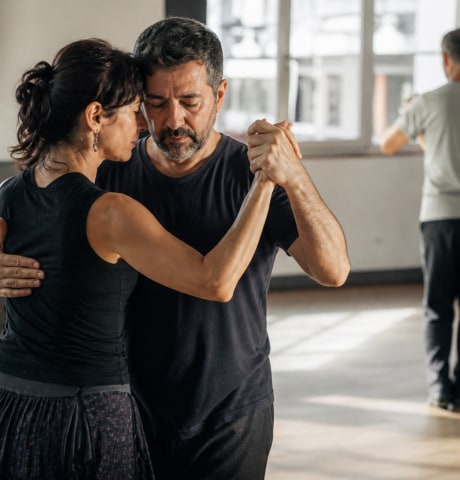
For Tango dancing with a height difference to work, the geometry of the embrace must be flexibly adapted. The traditional chest-to-chest contact inevitably shifts with uneven pairs. The shorter follower tends to orient their chest towards the leader's solar plexus or lower ribs. This is completely legitimate and creates an amazingly stable connection, as long as the alignment of the torsos remains parallel. The leader adjusts their right hand and places it lower on the follower's back, usually in the area of the shoulder blade or slightly below, to avoid applying pressure to the neck.

On the open side of the embrace, meaning the connection between the leader's left hand and the follower's right hand, the height of the hands is adjusted. The joined hands should be at a comfortable middle height that is reachable for both partners without tension in the shoulder girdle. This often means that the hand position is slightly lower than is common for couples of the same height. This adjustment prevents the shorter follower's arm from having to be stretched steeply upwards, which would block the shoulder and endanger balance.

The direct comparison for the asymmetrical posture

How it works

  • Keep your own axis stable over your standing leg
  • Place the leader's right hand lower on the back
  • Adjust the step length to the smaller partner
  • Establish contact at the height of the leader's solar plexus

This blocks you

  • Leaning forward or standing on your tiptoes
  • Resting your arms heavily on your partner's shoulders
  • Taking giant steps that drag your partner along
  • Trying desperately to force chest-to-chest contact

In Tango, it is not about being the same height, but about finding a shared center. A difference in height simply forces us to listen to each other even more sensitively.

Tango instructor, Hamburg

Coordinating stride length and dynamics in an uneven pair

A significant height difference does not just influence posture, it directly affects the dynamics of the steps. Since the taller partner naturally has a longer stride, they must consciously moderate their movements. Large lunges or wide circles quickly break the delicate connection. The leader should keep their steps more compact and give the follower time to dance out their own space. The movement comes primarily from the pelvis and not from shifting the upper body weight forward.

The shorter partner uses active body awareness in dance to keep their own axis stable. Instead of rushing after the leader, the follower fills the offered space with precise footwork. Especially during turns, the so-called giro, clean technique is essential. If the shorter partner learns to rotate around their own axis independently of the leader's frame, the embrace remains light and free of tension even during quick changes of direction.

Two roles in harmonic balance

Leading

The great leader

Give space and stay upright

The leader maintains an upright, proud posture and does not lean forward. The right hand rests relaxed and lower on the follower's back, while the step length is consciously controlled and kept compact.

Following

The shorter follower

Maintaining your own axis and connecting

The follower remains firmly anchored in their own axis, without standing on their tiptoes. Contact is maintained in a stable and attentive way through the connection of your own chest with the leader's solar plexus.

Frequently Asked Questions

  1. No, that is a common mistake. Standing on tiptoes robs the follower of stability and leads to quick fatigue. The heels should maintain contact with the floor for a secure stance.

Tango courses near you

Find the right course to take your posture in Argentine Tango to the next level.

View all matching courses

Find your perfect Tango partner

Here you will find like-minded people to refine your posture with, and experienced teachers who can easily balance out any height difference.

Find your perfect Tango partner