Bodywork5 minutes

Body awareness in dance: Take the self-test

In a nutshell
  • A well-developed self-awareness while dancing allows you to execute movements precisely without constantly looking in the mirror.
  • The self-test determines your current dance level of body awareness based on your everyday movement habits and your reaction to weight shifts.
  • Through the self-assessment, you will find out whether you act more intuitively, technically-controlled, or visually oriented on the dance floor.
  • The test result provides you with concrete approaches to train your body awareness in a targeted manner and to make movement sequences more fluid.

Your movement begins in the mind, but it lives in your whole body. Find out with our quick self-test how strong your connection to your own movement in space really is.

Why self-perception transforms your dancing

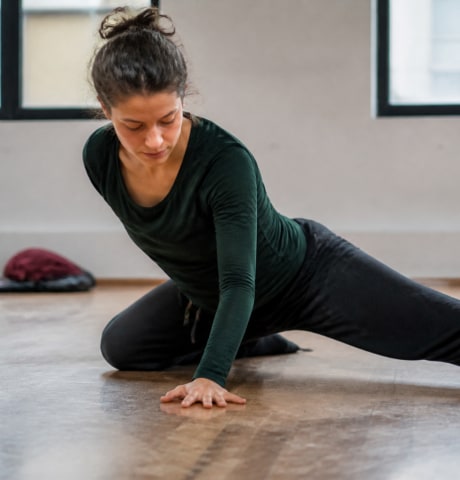
Feeling your own movement in space is the foundation of every dancer's development. But what is the real state of your self-perception when dancing? Many adults join courses and initially focus heavily on copying steps in the mirror. True ease, however, only emerges when you take your eyes off the mirror and develop a deep sense for your muscles, joints, and gravity. Especially in Contemporary Dance, where the constant shift between balance and conscious release sets the tone, your body awareness determines the quality of your movement.

When you move through space, countless receptors in your muscles and tendons work to report the exact position of your limbs to your brain. This sense is also known as proprioception. A targeted body awareness dance test helps you uncover blind spots in your movement execution. If, for example, you often experience uncertainty when transitioning from standing to the floor, a well-founded look at your technique can help you. Take a look at our guide From standing to the floor: Contemporary floorwork guide to train smooth transitions without loss of energy.

Find out your dance level of body awareness

  1. How do you orient yourself in space when you learn a new movement?

    • A: I look in the mirror constantly to visually check my posture
    • B: I focus on the exact placement of my bones and joints
    • C: I feel into the flow of movement and let myself be guided by the feeling
  2. What happens when you close your eyes while dancing?

    • A: I immediately lose my orientation and feel insecure in the space
    • B: I can continue the movement, but I think very hard about every step
    • C: I feel the movement even more intensely and feel completely connected to the floor
  3. How does your body react when you lose your balance?

    • A: I get a brief fright and frantically try to catch myself with my arms
    • B: I immediately engage my core to catch the fall in a controlled manner
    • C: I give in to the momentum and roll softly across the floor
  4. How do you know that a movement felt right for you?

    • A: When it looked exactly like the instructor demonstrated in the mirror
    • B: When I maintained all anatomical alignment points without any errors
    • C: When the transition felt effortless, fluid, and organic

Your evaluation

Mostly A: The visual movement type

You rely heavily on visual cues when dancing and prefer to check your posture in the mirror. This gives you security, but sometimes blocks the natural flow of movement. Try to consciously close your eyes during training to strengthen your deep proprioception while dancing and to detach yourself from the external image.

Mostly B: The technically controlled type

You analyze movement sequences very precisely and execute steps with high accuracy and muscle control. Sometimes, however, this focus prevents you from simply surrendering your weight to gravity. Treat yourself to moments of free improvisation to complement pure technical control with fluid dynamics.

Mostly C: The intuitive movement type

You dance very much from your feelings and perceive your body and the space around you intensely. You feel the flow of the movement, but sometimes lose sight of anatomical precision. A little more focus on the exact alignment of your joints can help you dance even more stably and without injury.

The movement types in direct comparison

CriterionVisual type (A)Controlled type (B)Intuitive type (C)
Focus in the dance studioMirror image and opticsTechnique and anatomySpatial awareness and dynamics
StrengthQuickly mimicking posesHigh precision and stabilityFluid, soft transitions
ChallengeDependence on visual contactTendency towards high muscle tensionSometimes lack of precision
Best training tipPractice with eyes closedTrain conscious letting goPay attention to joint alignment

The transitions between the types are fluid and depend heavily on your daily form and dance experience.

Using your test result in everyday dance

As soon as you know your current level, you can shape your training much more specifically. Those who are particularly strong in the intuitive area benefit from technical structure to prevent injuries. If, on the other hand, you dance very technically, consciously releasing muscle tension helps you become softer and more fluid. In contemporary dance, we call this principle release. It protects the joints and gives your movements an organic aesthetic.

Use your test result to consciously set new priorities in the dance studio. Close your eyes more often during warm-ups, feel the weight of your pelvis, and allow yourself to accept mistakes as part of the learning process. If you want to expand your skills in a group and exchange ideas with others, guided improvisation is a wonderful next step. You can find inspiration for this in our guide Improvisation in contemporary dance: Your own movement. Let go of your head and trust your body.

Frequently Asked Questions

  1. Body awareness in dance, also known as proprioception, is the ability to perceive the position, orientation, and movement of your own body parts in space without visual control. It enables you to maintain balance and coordinate movements fluidly.

Modern Dance courses near you

Find the right course to develop your body awareness under professional guidance.

View all matching courses

Find your dance community

Find like-minded dance enthusiasts, suitable courses for contemporary dance, and exciting workshops near you on udansa.

Find your dance community