

Find your Contemporary studio
On udansa, you can find like-minded people and professional studios for your introduction to contemporary dance. Connect with dance partners for workshops or discover courses that open up the world of floorwork to you.


Floorwork in contemporary dance often appears effortless and fluid, but it requires a deep understanding of your own anatomy. Learn how to use the floor as a partner to move elegantly and without injury.
Contemporary Floorwork refers to all dance movements performed on the floor, such as gliding, rolling, sliding, and the fluid transition from standing to a push-up position or sitting.
In contemporary dance, the floor is not a deep obstacle, but a constant partner. In professional Contemporary-Floorwork-Training, you learn not to fight gravity, but to use it for your movements. Instead of pushing yourself up from the floor with pure muscle power, you use the momentum and leverage of your own skeleton. This saves energy and gives your movement sequences that typical, fluid lightness.
For a safe start, it is important to let go of the fear of falling. When you learn Modern Dance and Contemporary as an adult, floor contact is often unfamiliar. Good training therefore begins on all fours or lying down to develop a feeling for your own body weight. You learn which bony points of your body can carry weight and how to slide smoothly across the dance floor.
Anyone who sinks to the floor unprepared and without the right technique risks painful bruises on their knees, hips, or shoulders. The secret lies in a biomechanical understanding: to master rolling without injury in dance, you must learn to distribute your weight over the largest possible body surface area. Instead of landing hard, you roll in a spiral over the soft muscle areas of your back or thighs.
Targeted body awareness in Modern Dance helps you protect your joints. You learn to release muscle tension at the right moment (release) and to tense it again in a targeted manner the next moment. Healthy contemporary floorwork training teaches this fine coordination, so that you always maintain control and land softly, even during fast transitions.
Use soft knee pads under your trousers at the beginning of your training. They give you confidence and take away the fear of floor contact until your rolling technique is solid.
The floor doesn't fall, it already supports us. As soon as we stop fighting against it, every movement on the floor becomes feather-light and effortless.
A strong floorwork session is an excellent full-body workout. Systematic strength building in contemporary dance specifically targets the deep muscles in your core, shoulders, and legs. Since you are constantly moving against the resistance of the floor and supporting your own body weight, your functional strength improves incredibly fast.
At the same time, floorwork promotes flexibility in modern dance in a very healthy way. Through constant mobilization of the spine and stretching in the hip joints, you become more flexible without overloading your joints. If you are also interested in more dynamic movements, taking a look at acrobatics in dance can help you further refine your strength and body tension.
Using gravity fluidly
You use gravity to build momentum. Muscles only tense where necessary, while the rest of your body remains soft and permeable to glide smoothly across the floor.
Pushing off the floor powerfully
You actively push yourself away from the floor to gain height or change direction. The bone structure carries the weight, while the core muscles provide the necessary stability.
Tight-fitting but elastic clothing is ideal. Long trousers and a t-shirt that covers your shoulders protect your skin from friction on the dance floor. Many dancers also wear socks to be able to slide better.
Find the right studio now to learn contemporary dance and floorwork professionally with udansa.
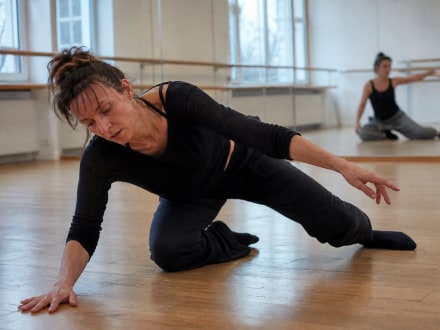 Modern and Contemporary Dance for Adults: Getting StartedThe ideal introduction to the world of contemporary dance for adults. Discover how you can express your creativity and improve your fitness in the studio, even without prior experience.
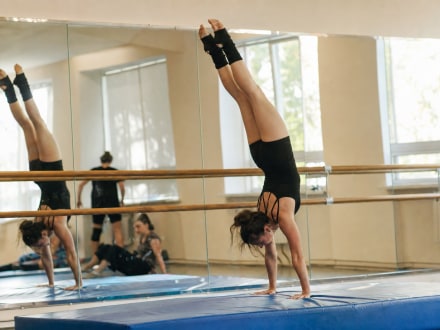 Acro Dance: Acrobatics for Teens & AdultsAcro Dance fascinates through the fusion of athleticism and elegance. Learn how teens and adults can safely master this demanding style.
 From Standing to Floor: Contemporary Floorwork GuideMaster the fluid transition between standing and floor work in contemporary dance. Our guide shows you the safe way to move down.
 Anatomy in contemporary dance: Understanding the spineLearn how to move your spine anatomically correctly in contemporary dance. Master the basics of arch and curl for a healthy, fluid dance experience.