Contemporary technique5 minutes

Release technique in contemporary dance: Save energy by letting go

In short
  • The release principle in contemporary dance uses gravity and your own body weight as primary impulses for fluid movements.
  • By specifically releasing excess muscle tension, the energy expenditure while dancing is drastically reduced.
  • The bone structure supports the weight, which keeps the joints free and permeable for dynamic changes of direction.
  • Release differs from mere passivity through an active, elastic readiness for movement of the entire body.

If you are looking for lightness in contemporary dance, you have to learn to let go of control. Consciously releasing muscle tension opens the door to fluid movements that require surprisingly little effort.

DefinitionRelease Engagement

Release engagement refers to the conscious release of unnecessary muscle tension in dance, in order to use gravity and bone structure efficiently for movement. It creates a state of dynamic lightness with minimal effort.

The difference between method and movement principle

In contemporary dance, you constantly encounter the term release. It is often mistakenly equated only with a historical era or a rigid method from the 1970s in the USA. However, the actual release principle in contemporary is much more than that: it is a universal physical practice that you use in every modern dance class. It is about detecting chronic tension in the muscles, releasing it in a targeted way, and using only the strength that is truly necessary for the current movement. Instead of working against the body with raw muscle power, you learn to understand the bone structure as a supporting framework.

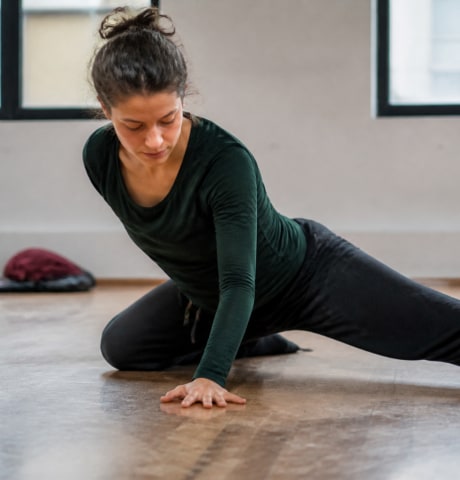
When you prepare a contemporary dance class for the first time, you will quickly notice how exhausting constant rigidity is. Releasing muscle tension while dancing does not mean collapsing limply. It describes the state of dynamic readiness. You shed unnecessary ballast to create space for new, efficient movement impulses. The skeleton carries the weight, while the muscles remain elastic and ready to react.

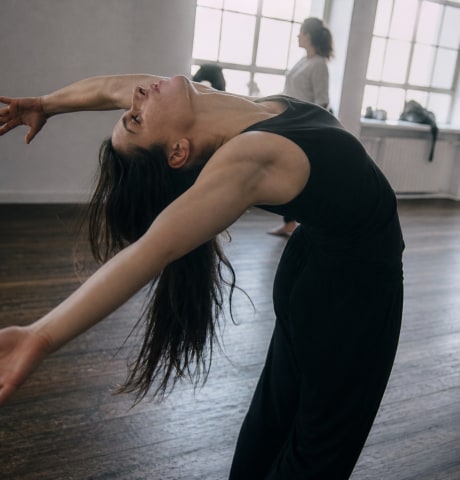
Supple joints and playing with gravity allow for fluid transitions, without the body becoming blocked.

How gravity becomes the engine of your movement

Anyone who tries to control movements in contemporary dance solely through the muscle power of the arms and legs will quickly reach their limits and tire easily. The solution lies in the skeleton and the optimal use of physical forces. As soon as you learn to use gravity in dance, your entire dynamic changes. The weight of your limbs is no longer felt as a burden that must be laboriously lifted, but as a natural source of momentum.

A falling arm generates kinetic energy through its own weight, which can guide you into a turn or towards the floor without any additional effort. This interaction requires a deep understanding of your own biomechanics. In our guide on the anatomy of the spine in contemporary dance, you will learn how the vertebral joints conduct this energy in waves through the entire body without the muscles causing blockages.

  • Release weight: Trust the floor with your body weight instead of tensely holding yourself up.
  • Open joints: Keep elbows, knees, and hips permeable so as not to stop the flow of movement.
  • Use momentum: Let movements swing out instead of actively braking them with muscle power.

The path to effortless movement

Like this

  • Keep your joints soft and supple
  • Let the weight of your arms drop
  • Let your breath flow and use it as an impulse
  • Understand your bone structure as support

Don't do this

  • Lock your joints
  • Force movements downwards using muscle power
  • Hold your breath during strenuous phases
  • Support your body using only muscle power

Only when we stop standing in our own way can movement truly flow through the body. The skeleton is our most loyal ally.

Contemporary dance instructor, Berlin

Refined coordination through the alternation of tension and relaxation

The path to true release leads through the perception of contrasts. Only those who feel what absolute firmness feels like can consciously initiate the moment of letting go. In training, we use the principle of tension and relaxation for this. You consciously contract a muscle group to the maximum, only to let the tension flow completely into the floor with the next breath. This conscious interplay trains the nervous system and refines your movement coordination.

Over time, you develop a fine sense for the minimal dose of strength that a movement requires. This economical way of dancing not only protects your joints, but also gives your movements the typical, effortless aesthetic of contemporary dance. You no longer dance against the resistance of your own body, but in harmony with its natural anatomy.

Two methods of movement control in comparison

Letting go

Release weight and flow

Let gravity do the work

You actively use gravity and let the weight of your limbs drop to generate momentum for the next movement. Your muscles react elastically.

Holding on

Maintaining constant muscle tension

Working against the body

You keep your body under constant, rigid control. Every movement is forced with maximum effort, which blocks your joints and makes you tire quickly.

Frequently Asked Questions

  1. No, release does not mean becoming limp. It is a state of dynamic readiness where only the muscles absolutely necessary for stability and direction are working, while the rest remain relaxed.

Contemporary courses near you

Find the right studio to learn the release principle directly in practice.

View all matching courses

Find your partner for Release

On udansa you can find dance enthusiasts in your area to try out the conscious letting go and fluid movements of contemporary dance together in a class.

Find your partner for Release