Floorwork5 minutes

Using gravity in contemporary dance

In a nutshell
  • Contemporary dancers use gravity as a continuous impulse for their movements, instead of fighting against it with muscle power.
  • By deliberately letting body parts like the head or pelvis drop, momentum is generated that carries the body effortlessly into the next movement.
  • In floorwork, controlled weight shifting allows for fluid gliding while protecting the joints from hard impacts.
  • Consciously releasing muscle tension at the right moment is the key to efficiently using physical forces for dance.

If you are looking for lightness in contemporary dance, you first have to learn how to be heavy. Only by consciously releasing your own weight into the floor does the energy for fluid, dynamic movements in space emerge.

DefinitionUsing gravity in contemporary dance

Using gravity in contemporary dance describes the method of using physical gravitational force and your own body weight as the primary energy source for movements and changes in direction.

Using the physics of dance as a driving force

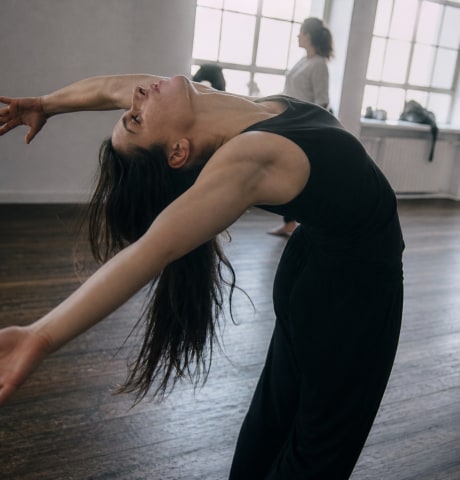
Anyone starting with contemporary dance often instinctively tries to brace themselves against gravity. Every movement is controlled with enormous muscular effort to keep the body upright or in an exact pose. However, the physics of contemporary dance is based on the opposite principle: gravity is not fought as an enemy, but understood as a driving force. As soon as you learn to consciously allow the pull of gravity, the downward pull transforms into pure dynamics.

This principle forms the foundation for fluid movements in space. Instead of using force to start a movement, you use the controlled dropping of individual body parts. A heavy head that sinks to the side pulls the spine into a spiral and sets off a chain reaction that carries you effortlessly across the floor. Once you familiarize yourself with this concept, you will notice that your movements instantly appear more organic and less mechanical.

Understand the floor as a partner: If you control how you transfer your weight, you will flow through the room without any effort.

How body weight drives floorwork

Work on the floor, also known as floorwork, is the perfect laboratory to explore the interplay between weight and gravity. It is all about using your own body weight in a targeted way to generate momentum. When you let your pelvis sink low, a deep center of gravity is created. From this state of grounding, you can push off, roll, or glide with minimal effort. Every shift in weight becomes the impulse for the next movement element.

A typical mistake for beginners is to make the body stiff as a board to avoid losing control. However, this blocks the flow of energy and risks painful falls. To learn to glide painlessly, it is advisable to keep your joints soft and accept the floor as a supporting surface. Those who internalize the principles of relaxation use the release technique in contemporary dance to reduce unnecessary tension and let the body react elastically to gravity.

How to handle attraction the right way

Like this

  • Let your head hang heavy to initiate movements
  • Keep your joints soft to cushion the impact
  • Accept the floor as a supporting, carrying surface
  • Consciously relax your muscles in the moment of sinking

Don't do this

  • Keep your head rigid and tense your neck muscles
  • Lock your joints stiffly to force control
  • Fight against the floor and tense up
  • Maintain constant muscle tension throughout your whole body

Only when we stop trying desperately to keep ourselves in the air, do we discover the infinite dynamics that the floor gives us.

Instructor for contemporary dance, Berlin

Targeted shifting of your own center of gravity

The secret to fluid transitions in contemporary dance lies in the timing of releasing and catching. You throw your weight in one direction and catch it at the exact right moment to change direction or to let the movement fade out gently. This alternation between surrender and control requires a fine perception of your own center of gravity, which is usually located in the pelvis. As soon as you consciously shift this point, the rest of your body follows all by itself.

To deepen this connection, it helps to experiment with different qualities of weight during training. Let your arms swing like heavy pendulums or feel how your ribcage pulls you into a deep curve. When you use these impulses, you will realize that contemporary dance is not a sequence of static poses, but a continuous flow. If you are wondering how good your sense for these fine nuances already is, you can put your skills in the area of body awareness in dance to the test.

Two phases of a fluid movement

Sinking

The power of letting go

Inviting gravity

You consciously release your own weight to the floor, let your joints soften, and use the downward pull to initiate a fluid movement or spiral.

Pushing off

The power of stability

Using the support of the floor

You use the pressure against the floor to push off, to straighten your body, or to change direction, all while maintaining control over your axis.

Frequently Asked Questions

  1. You use it by deliberately releasing muscle tension and initiating movements by dropping body parts like your head, arms, or pelvis. This creates natural momentum.

Contemporary courses near you

Find the right studio to learn the art of floorwork from scratch.

View all matching courses

Find your partner for floorwork

On udansa, you will find like-minded people who want to explore the laws of physics on the dance floor with you. Discover suitable courses and find your ideal training partner for contemporary dance.

Find your partner for floorwork