Floorwork4 minutes

Breathing in contemporary dance: Flow and power on the floor

By Mary De LucaUpdated

In a nutshell
  • Proper breathing while dancing Contemporary provides the necessary strength for demanding floorwork phases and ensures a continuous flow of movement.
  • Exhalation supports melting into the floor and releasing muscle tension during weight shifts.
  • Inhalation creates the necessary core tension and expands the body for explosive impulses and rising from the floor.
  • Synchronizing breath and movement prevents energy-draining breath-holding and protects the body from premature fatigue.

Gravity on the floor challenges your entire body. With the right breathing technique, you use your lung capacity as an invisible lever to master heavy support moments effortlessly and fluidly.

DefinitionBreath control in contemporary dance

Breathing while dancing contemporary describes the conscious coordination of the breath cycle with the movement phases, in order to minimize effort and support the flow of movement.

Why we often run out of breath on the floor

Anyone dancing a demanding floorwork sequence for the first time knows the phenomenon: at the end of the movement, your breath is gone, your muscles are burning, and your face turns red. The reason for this usually lies in an unconscious breath-holding, known as the Valsalva maneuver. As soon as the body has to support its own weight against gravity, we intuitively block our airways to stabilize the torso. In contemporary dance, however, this is counterproductive. Breathing in contemporary dance is not a passive background process, but the primary engine for strength and fluidity.

When we hold our breath, we signal stress to the nervous system. The muscles cramp, making soft transitions and expansive movements impossible. Breathing correctly in contemporary dance means synchronizing the breathing movement with the flow of movement. Instead of blocking the air, we use the airflow to activate and relax muscle chains at exactly the right moment.

The dynamics of inhaling and exhaling on the floor

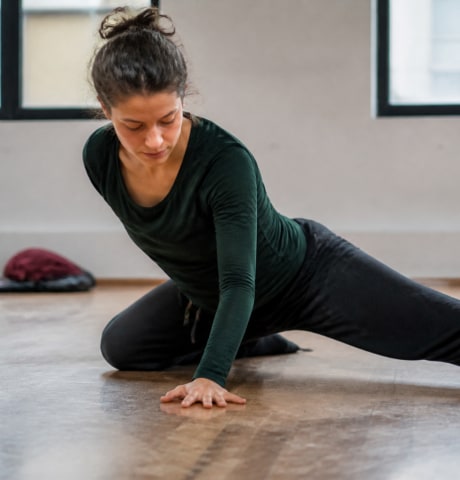
To make optimal use of gravity on the floor, inhalation and exhalation must be specifically linked to the phases of movement. As a rule of thumb: every sinking, melting, and yielding into the floor is accompanied by the exhalation. The exhalation initiates the release, which makes us heavier and allows us to make optimal use of the friction on the floor, as described in the guide on gliding over the floor in contemporary.

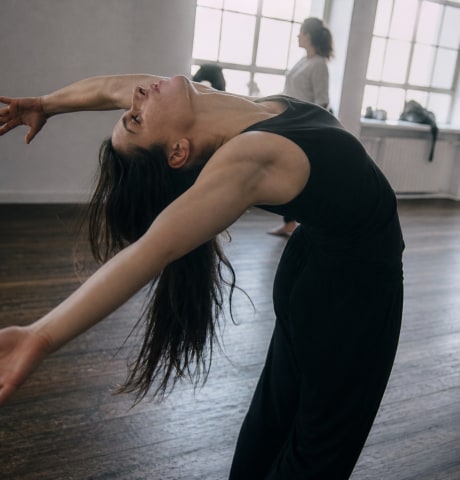
Inhalation, on the other hand, prepares for activation. It fills the ribcage, creates space between the ribs, and initiates the impulse to push ourselves away from the floor or to draw a spiral into the space. Anyone who internalizes this floorwork breathing technique will find that leverage and support moments suddenly cost only a fraction of the usual effort. The air carries the movement instead of blocking it.

Breath control in comparison

Breathing correctly

  • Exhale consciously when sinking into the floor
  • Use the breath flow as an impulse generator
  • Allow the breathing movement throughout the entire torso

Common mistakes

  • Holding your breath during strenuous lifts
  • Fighting against gravity
  • Only breathing shallowly into your upper chest

Breath is the link between inner strength and outer movement. If you block your breath on the floor, you are fighting against your own body.

Contemporary instructor, Berlin

From breathing patterns to fluid dance terrain

The biggest challenge is transferring conscious breath control from static training into the dynamics of a choreography. This is where the connection between breath and musicality helps. Anyone who learns to think of musical phrasing not just in steps, but also in breaths, gains a completely new quality of movement. You can find out more about this topic in the guide on Contemporary dance musicality.

Start by performing simple floor rolls or spirals at your own breathing pace. Let the movement start only when the breath flow begins. The next time you get tangled up in a complex combination, do not focus on your feet or hands, but direct your attention entirely to the exhalation at the lowest point of the movement. You will notice how blockages dissolve and the flow of movement returns almost by itself.

The two phases of breath in floorwork

Inhalation

Building space and tension

The impulse for expansion and posture

Inhalation opens the chest and creates space in the body. It prepares the impulse, builds the necessary basic tension, and lifts the pelvis slightly off the floor.

Exhalation

Release weight and glide

Giving in to gravity

The exhalation lets your body weight sink deep into the floor. It releases excess muscle tension and enables soft, gliding transitions without resistance.

Frequently Asked Questions

  1. During strenuous support phases, we tend to hold our breath, which blocks the body. If you exhale consciously, you activate the deep core muscles and let the movement flow.

Contemporary courses near you

Find the right course to practice your breathing technique in contemporary dance directly on the dance floor.

See all matching courses

Don't find your rhythm alone

Find like-minded dance partners and the right courses near you on udansa to take your floorwork technique to the next level together.

Don't find your rhythm alone