Musicality5 minutes

Contemporary dance musicality: moving beyond the beat

In short
  • Contemporary musicality moves away from classical beat counting and instead uses melodic arcs, pauses, and sound textures as impulses for movement.
  • Noises and sounds are translated directly into physical qualities like flow, hardness, lightness, or sudden stops.
  • Movement can run synchronously with the sound, but it can also consciously rebel against the dynamics of the music as a contrast.
  • Intuitive improvisation arises from trusting the first physical impulse instead of rational planning in the head.

Forget about rigid counting to eight. In contemporary dance, music becomes a three-dimensional space that you can shape, stretch, and break completely freely with your body.

DefinitionContemporary dance musicality

Contemporary dance musicality refers to the ability to interpret music in contemporary dance beyond rigid beat structures and to translate sounds, rhythms, pauses, and sound textures into movement in an individual way.

Breaking out of the corset of the classic beat

Anyone starting with contemporary dance often brings along learned patterns from other styles or everyday life: you wait for the one, count to eight in your head, and try to place every step exactly on the beat. But contemporary music consciously breaks these rigid rules. It is not about imitating a metronome with your feet, but about perceiving the music as a landscape. You do not move on the beat, but in it, around it, or even consciously against it.

To feel this freedom, a change of perspective helps: do not just listen to the loud drums, but look for the quiet layers in the background. This can be the hum of a bass line, the singer's breathing, or the reverberation of a piano note. When you learn to orient yourself to these flowing elements, the tension in your body dissolves. You start to breathe the music instead of working through it. This gives you the space for an authentic Contemporary Solo Choreography that emerges organically from the sound.
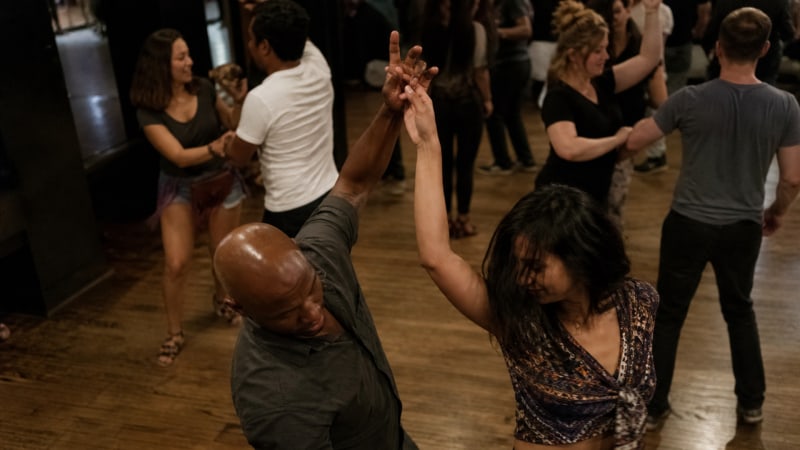
Movement does not follow a rigid grid: in contemporary dance, the dynamics of the body become a visible echo of the invisible sound.

How sounds and textures shape the body

Music consists not only of melodies, but of a multitude of textures. A scratching sound, a sudden silence, a swelling rush: all of these are invitations for your body. In contemporary dance, we translate these acoustic qualities directly into physical dynamics. A rough, crackling sound in the background can trigger a trembling movement in the fingertips. A long, drawn-out, clean synthesizer tone invites a fluid, space-encompassing shift of weight.

This play with qualities requires courage, because there is no right or wrong. When the music stops abruptly, you do not have to freeze: you can use the physical echo of the last note to slowly coast to a stop, or use the sudden contrast to place an extremely fast movement into the silence. Through this way of working, you develop a deep connection to the sound that goes far beyond mere listening. You yourself become a part of the arrangement.

Dealing with free music in contemporary

Correct

  • Pay attention to subtle background noises and sound textures
  • Adapt movement qualities, such as soft or sharp, to the sound
  • Use pauses and silence as independent dance moments
  • Follow your first physical impulse without overthinking

Wrong

  • Clinging rigidly to a loud beat metronome
  • Doubling every beat with steps one-to-one
  • Panicking when the music has no clear structure
  • Wanting to logically plan every movement in your head first

For us, music is not a railway network that we travel on, but an open terrain that we are free to map out and explore anew with every step.

Contemporary dance instructor, Hamburg

Using intuitive reaction in open space

The biggest hurdle in improvisation is often the mind, which wants to control and plan. If you try to intellectually analyze every movement, you will always be one step behind the moment. Musicality in improvisation means trusting your first impulse and letting your body react before your mind can intervene. This works particularly well when you engage with unconventional structures and consciously let go of control.

An excellent starting point is playing with contrasts. When the music becomes extremely hectic and dense, try to move extremely slowly and minimally. When the sound almost comes to a standstill, set explosive accents. Through this conscious friction between what is heard and what is danced, an enormous stage-effective tension is created. You learn not just to double the music, but to comment on it. In case you are wondering beforehand whether your physical prerequisites are sufficient for these intense movement experiences, a quick body awareness self-test will help you train your own mindfulness.

Two ways of musical interpretation

Fusion

Flowing with the wave

Harmony with the flow of sound

You pick up the flow of the music and let yourself be carried by the sounds. Your movements merge with the melodic arcs, you become one with the dynamics and make the sound visible to the audience.

Friction

Swimming against the current

The conscious contrast to the sound

You set conscious counterpoints to the music. When the sound flows, you move in a choppy way: when the music explodes loudly, you remain in absolute silence. This creates a tension-filled friction.

Frequently Asked Questions

  1. No, absolutely not. In contemporary dance, dancing off-beat is an established art form where you orient yourself to soundscapes, sound effects, breathing sounds, or pure silence.

Contemporary courses near you

Find the right studio to discover your own movement language in contemporary dance.

View all matching courses

Find your dance community

Find like-minded people on udansa who want to break the rhythm and try out new forms of movement with you. Discover courses for contemporary dance and improvisation workshops in your area.

Find your dance community