

Finding your own movement together
On udansa you will find like-minded people who want to share the space with you and explore the freedom of movement. Find your perfect course or dance partner for contemporary projects now.

Improvisation opens the door to your very own personal movement language. It frees you from rigid patterns and lets you experience dance in the here and now as a creative adventure.
Improvisation in contemporary dance refers to the creation of movements in the moment of execution, guided by physical tasks, inner images, or external impulses. It serves both as an independent art form and as a tool for developing pieces.
Improvisation in contemporary dance is far more than just stringing steps together without a plan. It is an independent art form based on precise physical and mental tools. When you dance Modern Dance and Contemporary, you use improvisation techniques in dance to break up movement patterns and discover your own movement language. Instead of copying predefined choreographies, your body reacts in the moment to impulses like gravity, spatial lines, or inner images.
For beginners, this freedom often feels unfamiliar at first. The fear of being blocked or appearing aimless is completely normal. However, contemporary improvisation works with clear structures, so-called scores or tasks. You are not moving in a vacuum, but following a concrete idea, such as the notion that your joints are being pulled by strings or that you are drawing the room with your fingertips. This focus distracts the mind and gives the body the freedom to react instinctively and authentically.
A special branch of improvisation is Contact Improvisation. This is about physical communication between two or more bodies through a constantly shifting point of contact. If you want to learn Contact Improvisation, the focus is on sensing weight, balance, and momentum. It is a constant give and take of impulses, where there is no fixed leading role.
To make this form of dance safe and fluid, clear Contact Improvisation rules apply. The most important rule is constant awareness of your own boundaries and those of your partner. It is not about forcing spectacular lifts, but about rolling shared weight organically across the floor or guiding it gently into the air. By playing with gravity, a fascinating dialogue emerges that requires no words and creates deep trust in your own body awareness.
Film yourself during your first improvisations with your smartphone. When watching them later, you will often discover beautiful, unconscious movement details that are the perfect starting point for your own choreography.
Improvisation is not arbitrariness, but the highest form of attention to your own body and the moment in the room.
The step from free movement to a fixed structure is fluid. If you want to create your own choreography and anchor it in Contemporary, you often use moments found during your improvisation. Dance theater for adults additionally combines these movement patterns with theatrical elements, emotions, and everyday gestures. A dance theater piece development usually begins with a question or a theme that the dancers improvise to, from which fixed scenes are later forged.
To develop a piece, you capture improvised sequences by repeating them, varying them, or rearranging them in the space. You play with the tempo, enlarge small movements, or insert deliberate pauses. In this way, a fleeting moment on the dance floor becomes an expressive work of art that tells a story or conveys a specific mood. The creative process connects your personal experience directly with the art on stage.
Discovering your own world of movement
You move entirely for yourself, following your inner impulses, images, or the music. This form trains self-awareness and lets you explore your very own personal movement language without any external distractions.
Playing with gravity together
In physical contact with others, you share weight and momentum. This form requires absolute outward attention, trains your responsiveness, and allows a shared, unpredictable work of movement art to emerge in the moment.
When improvising in dance, clear tasks, known as scores, are helpful. Focus on a specific detail, such as leading a movement with your elbows, to switch off your mind and let your body act intuitively.
Find the right space to freely unfold your creative movement.
Wednesday · 17:00-18:00 · Nov 5
Mehrgnerationenhaus Brück
Monday · 17:40-18:30 · Sep 8
Flow Motion Studio Neukölln
Wednesday · 17:50-17:50 · Sep 10
Flow Motion Studio Wedding
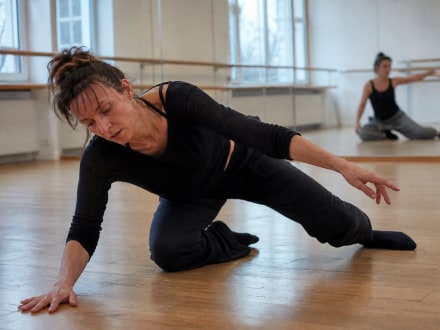 Modern and Contemporary Dance for Adults: Getting StartedThe ideal introduction to the world of contemporary dance for adults. Discover how you can express your creativity and improve your fitness in the studio, even without prior experience.
 Contemporary in Munich: Contemporary dance by the IsarDiscover the world of contemporary dance in Munich. We show you the best studios for contemporary dance and how you can get started, even as a beginner.
 Learn Contact Improvisation: Your StartLearn the basics of Contact Improvisation in contemporary dance. Discover how to share your body weight and improvise in the moment without fixed steps.
 Creating Modern Dance Choreography: Creative PathsLearn how to develop your own choreographies in Modern Dance. Practical methods and creative techniques help you overcome blocks and find your own style.