Find your creative dance partner
On udansa connect, you will meet like-minded people who want to explore new forms of movement and realize creative projects in contemporary dance with you.

By Mary De LucaUpdated
On udansa connect, you will meet like-minded people who want to explore new forms of movement and realize creative projects in contemporary dance with you.
Objects in the room are not mere decoration for dancers. They challenge the body, break up habitual movement patterns, and open up completely new paths for your dance improvisation.
Practical feasibility
Every concept must be implementable in a normal dance studio without complex stage equipment.
Movement relevance
The prop must demonstrably change the movement and cannot just stand in the room as decoration.
Physical focus
Only physical objects and spatial structures are listed, not light or sound effects.
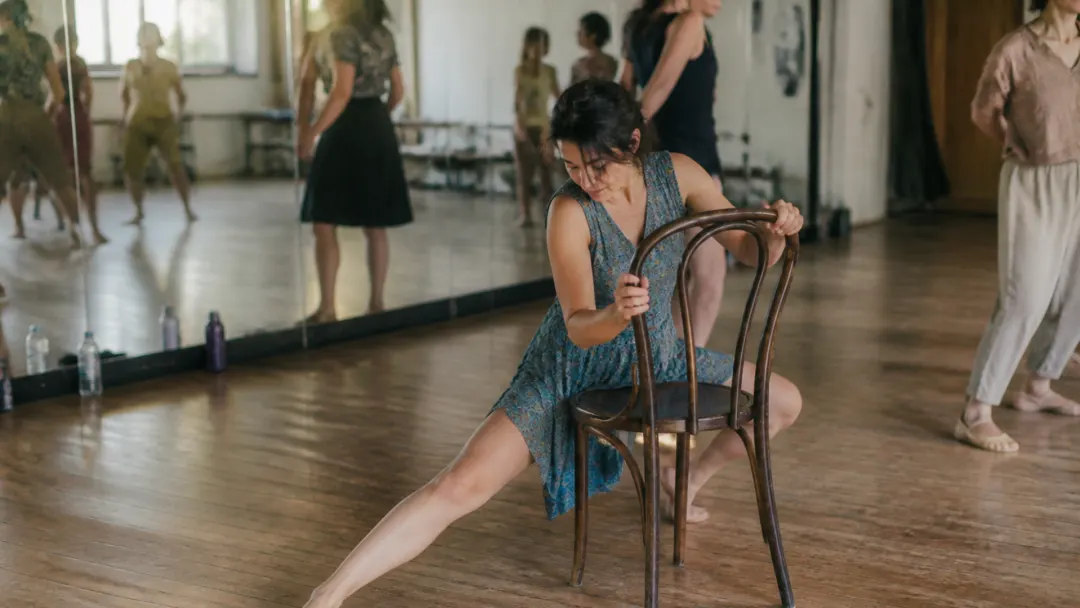
Dance studio or living room, flexibly applicable, highly physical
The chair is the classic prop for contemporary dance. It serves as a pedestal, obstacle, or partner, changes the levels of dancing, and challenges your balance through unusual leverage effects.
Dance studio with anchor points, variable in length, visually striking
Elastic bands or ropes stretch lines through the room. They limit the range of motion, create resistance, and make tensile and compressive forces directly visible for the dancer and the audience.
Large open space, lightweight material, dynamic and flowing
Large fabric panels extend the body's movements into the space. They catch the air, slow down the fall, and make the dynamics of swings visible beyond the physical reach of the arms.
Solid wall surface, barrier-free, ideal for solos and duets
A wall is not the end of the room, but an additional level. Leaning, pushing off, and sliding along a solid boundary allows for extreme inclinations and new leverage for the body.
Directly on the body, no preparation needed, close to everyday life
Using everyday clothing items like loose coats or heavy shoes changes your body awareness. The weight of the fabric influences the centrifugal force during turns and breaks familiar movement patterns.
Find the right course to expand your expressive power in contemporary dance.
No courses for this dance style here yet
 festivalOnly 5 spots leftModern Dance
Working with objects in dance requires conscious preparation of the body to avoid injuries and to make movement fluid. Before you dedicate yourself to improvisation with heavy or unwieldy objects, a solid technical foundation helps. Elements from the Limon technique in modern dance support you in understanding the principle of fall and recovery, which is particularly useful when catching weights or playing with gravity against walls.
In addition, you should master the transition to the floor. Interaction with props close to the ground succeeds more smoothly if you can move downwards in space safely. A practical guide for this is provided by the contemporary floorwork guide, which shows you how to make the path from standing to the floor organic and joint-friendly. Use these techniques to integrate the props into your choreography not just as decoration, but as a real dance partner.
An everyday object like a chair or a cloth is most suitable. These objects are easily available and offer countless possibilities for weight shifts and spatial changes.
Safety is the top priority. Test the stability of the object beforehand, avoid slippery surfaces, and practice risky movements slowly and close to the floor at first.
By using the object in an unconventional way. Do not use a table to lean on, but crawl underneath it or balance it on your back to receive new movement impulses.
 Contemporary dance improvisation: finding your own movement
 Preparing for your first Contact Improvisation Jam
 Contemporary dance trends: New paths in movement
 Contemporary Dance Musicality: Moving beyond the beat
 Best dance improvisation exercises at home
 Setting boundaries in Contact Improvisation: Mindful dancing
 Instant Composition in dance: Spontaneous art on stage