Dance trends4 minutes

Trends in contemporary dance: New paths of movement

In a nutshell
  • Current trends in contemporary dance emphasize the fusion of different movement cultures and a departure from classical stage concepts.
  • Contemporary improvisation increasingly uses somatic practices to develop authentic movements from deep body awareness.
  • Modern performance concepts break down the barrier to the audience and often take place in unconventional, urban spaces.
  • No acrobatic prior knowledge is necessary for getting started, as the focus is on individual anatomy and personal expression.

The contemporary dance scene reinvents itself every day. Beyond rigid traditions, dynamic forms of movement emerge that perceive the body as an honest medium for the moment and push the boundaries of performance.

How new movement impulses emerge in the scene

Unlike classical partner dances or historically shaped styles, trends in contemporary dance rarely spread through viral social media feeds or fixed curricula. The scene thrives on direct encounters in studios, at international workshops, and on independent performance stages. New impulses emerge organically when dancers cross different movement languages and put their own body awareness in dance to the test. What starts today as an experiment in a small rehearsal room will shape the worldwide training concepts of studios tomorrow.

The driving force behind this constant renewal is the desire for authentic expression and physical honesty. Instead of perfectly copying prescribed forms, performers look for ways to capture the rawness of the moment. This makes current developments particularly attractive for adults looking to get started: It is not about serving pre-made templates, but about exploring and developing your own movement in the here and now.
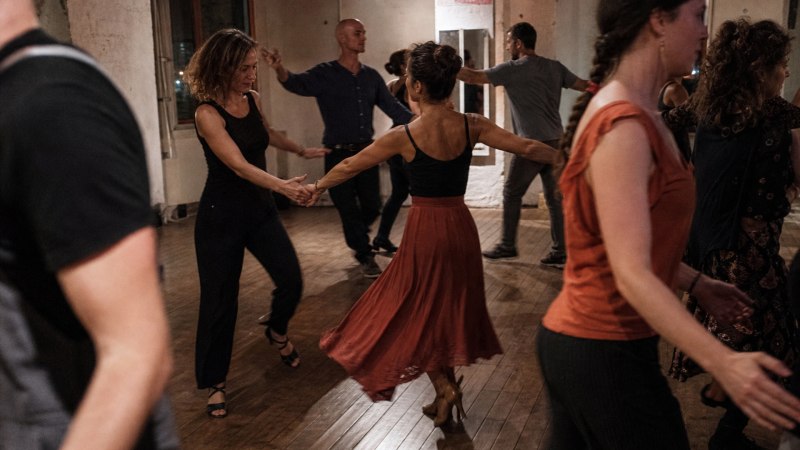
Improvisation in a collective: By letting go of rigid choreographies, a completely new dynamic emerges in the shared space.

Trends currently moving the dance world

  • Contemporary Urban Fusion

    This approach combines contemporary dance with urban styles such as Breaking or Popping. Performers use the rhythmic precision of street styles and break them up with the fluid, expansive movements of contemporary, creating an extremely dynamic contrast.

    • Urban
    • Fusion
    • Floorwork
  • Somatic Movement Design

    Here, the focus is on functional anatomy. Dancers use physiological principles from Spiraldynamics and the Feldenkrais Method to make movements extremely joint-friendly and efficient, which makes it particularly easy to get started in adulthood.

    • Somatic
    • anatomy
    • flow
  • Site-Specific Performance

    This movement completely dissolves the classic stage situation. The dancers move directly among the audience in the room, react to their presence, and incorporate the architecture of the location directly into their spontaneous improvisation.

    • Immersive
    • space
    • interaction

The evolution of performance on and off the stage

Current trends are consistently breaking with old expectations of a classic stage presentation. Performance art in 2026 is moving away from purely frontal staging towards immersive experiences, where the boundary between performers and the audience blurs. If you visit a contemporary dance theater today, you often find yourself in the middle of the action instead of just watching from a distance. This proximity requires dancers to have enormous presence and the ability to react spontaneously to the space and those present.

Anyone who wants to try these contemporary approaches for themselves will find an open and experimental atmosphere in modern studios. Entry barriers are being deliberately dismantled, as the focus is on individual anatomy and personal movement potential. A structured Contemporary level test can help you assess your current body awareness and find the right studio offer for your dance journey.

Contemporary dance in 2026 no longer asks how a movement looks from the outside, but how it feels from the inside and what it triggers in the space.

Instructor for contemporary dance, Berlin

Your path into contemporary dance practice

Correct

  • Use your own body as the starting point for movement
  • Engage with the unpredictable moment of improvisation
  • Courageously cross different styles and influences with each other

Wrong

  • Trying to rigidly copy classic movement patterns
  • Letting yourself be blocked by the pressure to perform perfect poses
  • Staying exclusively within familiar comfort zones

Frequently Asked Questions

  1. Current trends in contemporary dance are characterized by strong interdisciplinarity. Elements from urban dance styles, somatic practices, and martial arts are integrated to create a freer and more individual movement language.

Contemporary courses near you

Find the right studio and start your journey into the world of contemporary movement.

View all matching courses

Find your place in the scene

Find like-minded people for your next jam, discover workshops near you, and connect with the vibrant community for contemporary movement.

Find your place in the scene