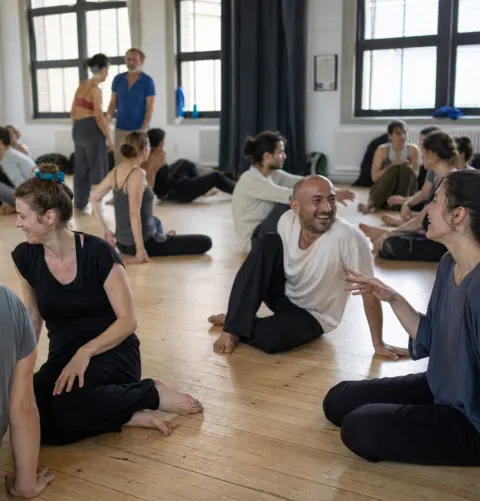
Find your dancing community
On udansa you will find like-minded people, inspiring workshops, and open practice spaces to continue your dance journey. Use our platform to expand your creative network.

By Bernhard De LucaUpdated
On udansa you will find like-minded people, inspiring workshops, and open practice spaces to continue your dance journey. Use our platform to expand your creative network.
Your own living room becomes a stage where no one is watching. With targeted tasks, you can unfold your creativity, completely without pressure and at your own rhythm.
Pure solo concept
All exercises are specifically designed for independent training without a partner.
Easy to implement
The tasks do not require any special equipment and work in any living space.
Versatility of impulses
The exercises cover various aspects of flow, space, and body awareness.
Independent selection
None of the featured exercises are based on paid placements or partnerships.
Living room, 5 to 10 minutes, focus on body parts
In this exercise, a specific body part leads the entire movement. Start with your nose, elbow, or toes and let the impulse pull you through the room to discover new paths in contemporary solo improvisation.
Open space, 10 minutes, focus on texture
Imagine you are moving through a viscous medium like honey or water. This exercise is perfect for training your own flow of movement and consciously controlling your muscle tension.
At a free wall, 5 to 8 minutes, physical contact
Use the walls in your room as direct dance partners. Push off, slide down them, or find balance points to create a creative solo dance workout with clear architectural boundaries.
Living room, 8 minutes, focus on speed
Alternate between moving in extreme slow motion and sudden, fast bursts. This sharp contrast trains your tempo control and brings surprising dynamics to your improvisation.
Mat or floor, 5 minutes, focus on breathing
Focus entirely on your breath. Let the inhalation make your movements big and expansive, and use the exhalation to let your weight sink and for small, delicate gestures.
Find the right course to deepen your improvisation techniques in the studio.
No courses for this dance style here yet
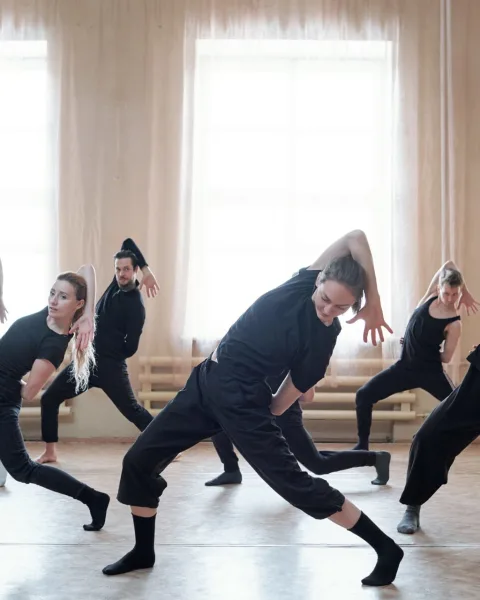 festivalOnly 5 spots leftModern Dance
Training within your own four walls offers invaluable intimacy. Without being observed by others, you can focus entirely on your body awareness and break through movement patterns. To make the best use of the influence of gravity in dance, you should clear a space of at least two by two meters. A smooth floor, where you can glide barefoot or in socks, is ideal. Suitable clothing, like what you wear in the studio, helps you mentally switch from everyday life into training mode. If you are unsure which style suits you best, take a look at our guide on Contemporary Dance clothing.
Consciously make use of the conditions in your apartment. Walls, room corners, or the edges of furniture do not have to be obstacles. In improvisation, they serve as physical reference points that you can push off from, lean against, or glide along. Begin every solo session by briefly arriving in a standing position, allowing your breath to flow and directing your focus entirely to your own body.
For effective dance improvisation at home, a clear area of about two by two meters is sufficient. It is important that there are no sharp-edged pieces of furniture in the way, so that you can move freely and dynamically without any risk of injury.
No, music is not a must. Improvising in silence sharpens your awareness of your own breathing rhythm and the natural sounds of movement. However, music can be used as an additional source of inspiration.
For beginners, short sessions of 15 to 20 minutes are suitable. More important than a long duration is the regularity of the training, in order to train and consolidate the creative flow of movement in the long term.
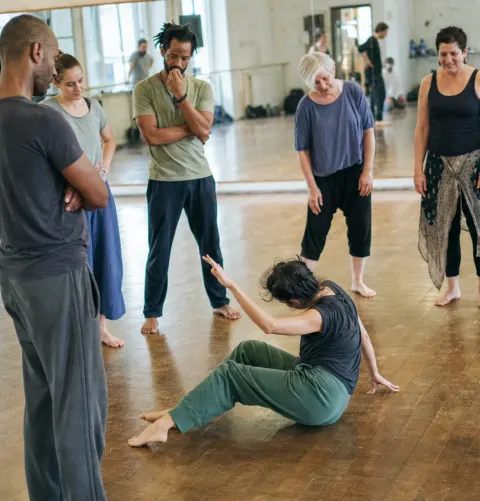 Contemporary dance improvisation: finding your own movement
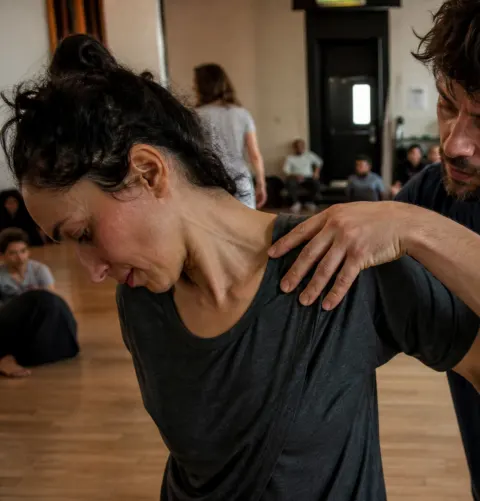 Setting boundaries in Contact Improvisation: Mindful dancing
 Instant Composition in dance: Spontaneous art on stage
 Learn Contact Improvisation: Your Start
 Creating Modern Dance Choreography: Creative Paths
 Dance Theater for Adults: Expression and Movement
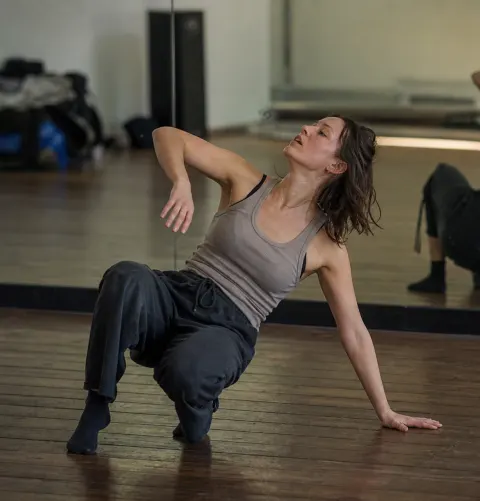 Create your own Contemporary solo choreography