

Find your perfect connection
On udansa you will find like-minded people who share your passion for Tango, as well as suitable courses in your area to try out both forms of embrace yourself.


The embrace in Argentine Tango is much more than just a posture, it determines how two bodies physically interact with each other. Whether close proximity or airy distance, every form fundamentally changes the statics and the communication within the couple.
The Argentine Tango embrace close open describes the two fundamental postures in Argentine Tango, which differ in the distance between partners and the way physical signals are transmitted.
In Argentine Tango, the embrace, also known as the abrazo, is the heart of the dance. It is not a rigid structure, but a living communication channel. The open embrace offers dancers physical space. The partners stand opposite each other at arm's length and touch primarily at the hands and through the extended frame of the arms. Anatomically, the pelvis usually remains in a neutral, vertical position over the feet in this posture.
The physical laws of leverage play the main role here. The distance creates a larger radius of action, where the arms act as flexible shock absorbers and impulse generators. Anyone moving in Argentine Tango uses the inertia of the body in the open posture to announce changes in direction and dynamics via the extended lever of the arms. This requires controlled muscle tension in the entire shoulder girdle so that the signals do not dissipate in the space.
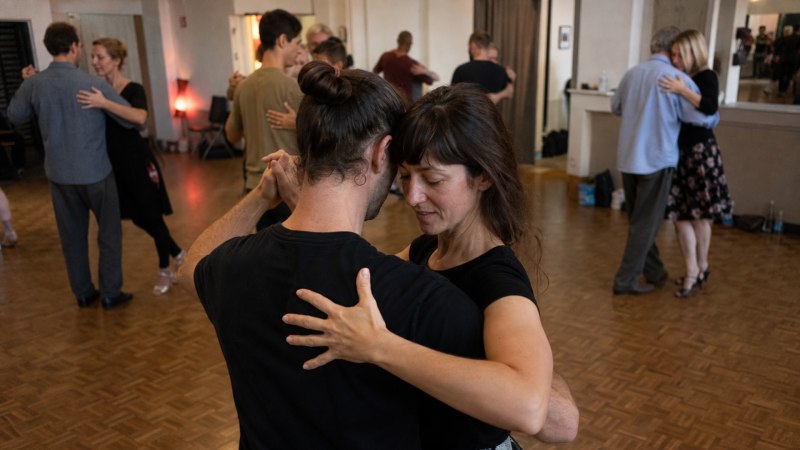
The close embrace, often referred to in the traditional style as the Milonguero embrace, reduces the physical distance to a minimum. Here, the dancers' chests nestle against each other, which fundamentally changes the statics of the pair. Anatomically, the center of gravity for both partners shifts slightly forward onto the balls of the feet. The spine remains long, but tilts minimally as a unit toward the partner, creating a subtle, shared weight shift.
From a physical perspective, two separate bodies merge into a single, biomechanical unit. Since the direct contact is via the sternum, the time delay that occurs when signals are transmitted via the arms is eliminated. Every weight shift by the leader is transmitted immediately and one-to-one to the follower. This immediate transmission requires a high level of trust and a sensitive dosage of one's own body tension so as not to throw the partner off balance.
Use your breathing to regulate the tension in your embrace. A deep exhale before the first step lets excess tension in the shoulders melt away and makes the connection softer immediately.
The embrace in Tango is not a prison, it is a protected space where two axes speak to each other without losing themselves.
The decisive difference between the two forms of embrace lies in the way signals are transmitted and weight is distributed. While the open embrace relies on distance and leverage, the close embrace uses direct upper body contact and the inclination of the body axes. In the open embrace, each dancer maintains their own independent axis. In the close embrace, however, the partners lean slightly against each other, creating a temporary, shared axis.
Anyone familiar with the standard dance posture knows how important a firm frame is. In Tango Argentino, however, this frame is highly flexible. While the open embrace allows for maximum visual control and space for expansive movements, the close embrace shifts perception entirely inward. The choice of embrace therefore determines not only the distance, but also filters the entire communication and sensory experience on the dance floor.
The open embrace in Tango
Offers plenty of physical freedom and uses the arms as leverage. Ideal for dynamic movements that require visual space and independence of the axes.
The traditional milonguero embrace
Focuses on maximum body contact at the chest. Enables immediate, intuitive signal transmission via the shared, slightly forward-leaning axis.
The main difference lies in the distance and the transmission of signals. The open embrace uses the arms as levers at a distance, while the close embrace is based on direct chest contact and a shared axis.
Experience the art of subtle connection in Argentine Tango for yourself.
 Learning Argentine Tango: Your start in partner danceArgentine Tango is pure improvisation and a deep connection between partners. Learn how to get started and what makes this dance so special.
 Ballroom Dance Posture: How to build the perfect frameProper posture and a stable frame are the foundation of every ballroom dance. Learn how to glide elegantly across the floor with the right body tension and orientation.
 Argentine Tango embrace: The art of subtle connectionThe abrazo is the heart of Argentine Tango. Discover how to build a harmonious connection with your dance partner through proper posture and a sensitive embrace.
 Shared axis in Tango Argentino: A guide for couplesThe shared axis is the foundation of Tango Argentino. With this guide, couples learn how to share their balance and merge into a stable connection.