

Finding the perfect posture together
On udansa you will find like-minded people to refine your posture with. Sign up and discover dance courses and dance partners in your area for the perfect start on the dance floor.


The correct posture in ballroom dancing determines the balance of the couple and the ease of movement. It transforms individual steps into a fluid, harmonious whole on the dance floor.
Line of Direction refers to the established counter-clockwise direction of dance along which all couples move on the floor in ballroom dancing. It serves to avoid collisions and ensures the flow of movement.
The concept of dance posture is often misunderstood in ballroom dancing. It is by no means about stiff, unnatural posing, but rather about creating a dynamic, springy connection between two bodies. A correct ballroom dance posture is characterized by the fact that both dancers keep their own spine upright and stable, without leaning on each other. The posture positions in partner dancing are designed to guarantee maximum freedom of movement while maintaining stability. Anyone who has their first dance lesson ahead of them will quickly feel that this uprightness challenges the entire body and forms the basis for every elegant step.
A good ballroom dance posture requires a fine balance. The shoulders remain low and relaxed, while the core muscles work actively. The chest is lifted slightly, and the gaze is directed proudly over the partner's right shoulder. This proud uprightness not only ensures the typically majestic aesthetic in the Slow Waltz or Quickstep, but also makes it possible to glide smoothly across the dance floor.
The ballroom dance frame, often simply referred to as the frame in English, is the invisible connecting element that transmits impulses without delay. To keep this frame stable, the arms of both partners form a firm, yet elastic unit. The elbows point outwards and upwards, creating a wide, round space between the couple. Precise ballroom dance leading is not based on muscle strength in the hands, but on the movement of the entire upper body. When the leader turns, the entire frame moves as a solid unit, and the follower can follow the movement effortlessly.
A common mistake is the collapsing of the elbows or clutching onto the partner. As soon as the frame collapses, the connection is lost, and the steps appear uncoordinated. Anyone who wants to maintain the ballroom dance frame must imagine carrying a large, light exercise ball gently in front of their chest. This round, stable shape remains unchanged throughout the entire dance, no matter how fast or complex the figures become.
Stand in front of a mirror at home without a partner and build your frame. Hold the position for two minutes to strengthen the deep back muscles that you need for your dance frame.
A perfect frame feels featherlight to your partner, but at the same time it is as stable as a bridge construction made of steel.
Besides posture and frame, orientation in space is crucial for a harmonious experience on the dance floor. In ballroom dancing, all couples move counter-clockwise along a defined circular path. This orbit is known as the line of dance in ballroom dancing. It ensures that collisions are avoided even on a crowded dance floor and that a continuous flow is maintained. Faster couples tend to use the outer lane, while slower couples or dancers trying out new figures stay further towards the inside.
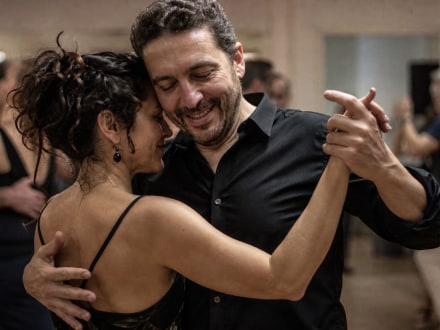
Adhering to the line of dance requires constant attention and adaptability. The leader must act with foresight and keep an eye on the path ahead of the couple. Much like in Tango Argentino, where navigation in space is an art form in itself, orientation in classic ballroom dances is a sign of dance maturity. Anyone who masters the traffic rules of the dance floor dances more relaxed and gives their partner a feeling of absolute safety.
Stability and navigation in the room
The leader builds the frame, keeps the elbows stable at shoulder height, and navigates the couple safely along the line of dance by transmitting impulses from their own body center.
Body tension and sensitive reaction
The following person maintains their own body tension, actively fills the frame offered, and sensitively reads changes in direction via the contact points on the hands and upper body.
You can achieve a stable dance posture in ballroom dancing through active core muscles, low shoulders, and a slightly lifted chest. Imagine that the crown of your head is pulling upward while your feet are firmly anchored to the floor.
Find the right course now to take your posture and technique to the next level.
Sunday · 14:30-16:00 · Nov 15 - Nov 29
Limbach-Oberfrohna
Sunday · 14:30-16:00 · Sep 6 - Sep 20
Limbach-Oberfrohna
 Your first dance class in Berlin: How to prepareEvery beginning is easy: With this guide, you can prepare perfectly for your very first dance class in Berlin and get started completely stress-free.
 Learning Argentine Tango: Your start in partner danceArgentine Tango is pure improvisation and a deep connection between partners. Learn how to get started and what makes this dance so special.