Tango technique4 minutes

Practicing Argentine Tango posture solo: 5 effective exercises

In a nutshell
  • A proud Tango posture is based on stable core and back muscles as well as a precise alignment of your own body axis.
  • Through targeted solo exercises at home, you can systematically build up the necessary body tension and balance without a partner.
  • The exercises focus on activating the deep muscles in the upper back and stabilizing the standing leg.
  • Regular solo training prevents leaning on your partner and ensures a light, floating embrace on the dance floor.

A proud Tango posture does not just emerge while dancing as a couple, it matures through solo practice at home. With these targeted exercises, you strengthen your back muscles and refine your balance for the dance.

How we selected the posture exercises

  • No partner and little space required

    All the exercises presented can be performed without a partner and in the smallest of spaces within your own four walls.

  • Focus on Tango muscles

    The exercises target the muscle groups relevant for Tango directly, such as the core, upper back, and ankles.

  • Doable without expensive equipment

    No expensive fitness equipment or special tools are required to perform the movements.

The 5 best solo exercises for your Tango posture

  1. 01

    Single-leg centering

    At home, without equipment, 2 minutes per leg

    • Balance
    • foot stability
    • axis

    Stand barefoot on one leg and lift the other slightly. Try to center your weight exactly over the ball of your standing foot, without clawing your toes into the floor. This exercise trains the fine deep muscles in the foot and ensures the typical, secure stance in Tango.

  2. 02

    The cobra in U-hold

    Living room, mat, 3 sets of 10 repetitions

    • Back strength
    • shoulder blades
    • posture

    Lie on your stomach, bend your arms at a 90-degree angle (U-hold), and gently lift your upper body and arms. Actively pull your shoulder blades back and down. This strengthens the upper back and prevents your shoulders from rounding during an embrace.

  3. 03

    The standing helix rotation

    Anywhere while standing, 3 minutes of controlled rotation

    • Dissociation
    • core tension
    • flexibility

    Stand upright and extend your arms to the sides, as if you were gesturing a wide embrace. Now, slowly rotate your ribcage to the left and right, while your pelvis remains stably aligned forward. This trains the dissociation that is essential for Tango.

  4. 04

    Controlled heel raises

    Against a wall or free standing, 15 to 20 repetitions

    • Calf strength
    • ankles
    • balance

    While standing upright, slowly lift both heels until you are on the balls of your feet, then lower them back down in a controlled manner without touching the floor completely. This exercise strengthens your calves and ankles, which gives you maximum stability during steps and turns.

  5. 05

    The static Tango pose

    Standing, ideal in front of the mirror, 3 repetitions

    • Body tension
    • statics
    • breathing

    Take your imaginary Tango embrace and consciously tense your abdominal and gluteal muscles. Hold this proud, slightly forward-leaning position for 30 seconds while continuing to breathe deeply and evenly. This trains muscle memory for the dance floor.

Why your own axis is the foundation for the embrace

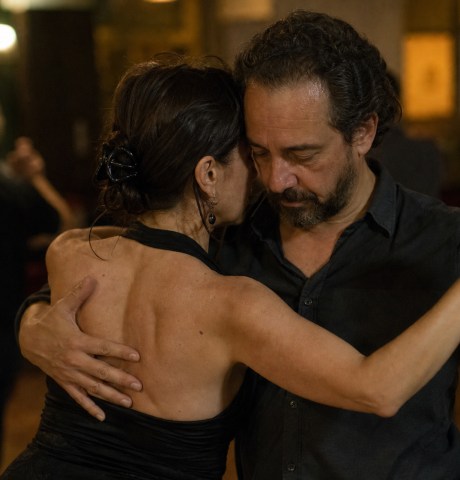
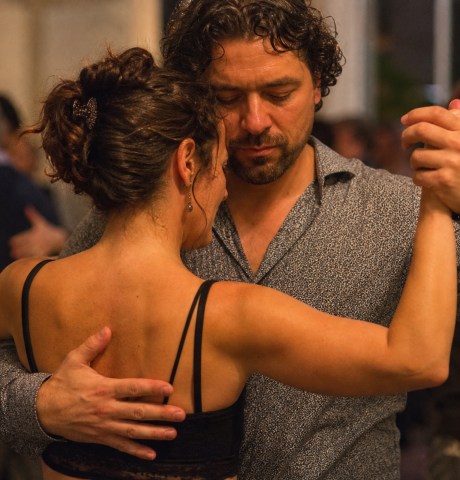
The proud posture in Argentine Tango does not come from rigid holding, but from a dynamic interplay of core stability, an active back, and fine balance. If you want to bring the Argentine Tango embrace to life, you need a stable axis of your own. Only those who learn in solo training to precisely align their own weight over the standing leg and activate the deep muscles in the upper back can move completely freely as a couple.

A common misconception is that the posture in tango must be stiff. The opposite is the case: good posture gives you flexibility. By specifically training the muscles around the shoulder blades and the spine, you prevent yourself from collapsing into yourself or leaning on your partner while dancing as a couple. Use these exercises regularly for a few minutes before going to bed or as a warm-up before the next milonga to noticeably improve your presence.

Your posture training at a glance

exercises for a quick workout
5
minutes a day are already enough
10
Additional equipment is required
0

Frequently Asked Questions

  1. Ideally, you should practice the exercises three to four times a week for about 10 to 15 minutes. Consistency is more important than duration so that your body adopts the new posture into its muscle memory.

Tango courses near you

Find the right course to try out your new posture directly in partner dance.

View all matching courses

Find your dance partner for Tango

On udansa you will find like-minded people who, just like you, are working on their technique, as well as first-class Tango courses in your area. Sign up and bring your new body awareness directly to the dance floor!

Find your dance partner for Tango