Step technique5 minutes

Milonga vs. Argentine Tango: differences in the steps

By Bernhard De LucaUpdated

In a nutshell
  • The classic Argentine Tango is based on a sustained four-four time with gliding, expansive steps and deliberate pauses.
  • The Milonga is danced to a fast, syncopated two-four time, which requires short and flat steps.
  • The footwork in the Milonga is more compact and avoids elaborate figures in favor of quick rhythm changes like the traspié.
  • While the Tango offers space for elegance and melancholy, the Milonga is characterized by dynamics, agility, and playful accents.

Switching from the sustained Tango to the fast Milonga rhythm challenges even experienced dancers. Anyone who understands the difference in footwork transforms hectic movement into pure joy on the dance floor.

DefinitionTraspié

In Tango and Milonga, traspié refers to a quick syncopated step where the weight is briefly shifted onto the free foot within a single beat and immediately shifted back.

Elegant walking gives way to a fast beat

Anyone starting with Argentine Tango first learns how to walk. This walking is not ordinary walking, but a conscious, gliding transfer of body weight from one foot to the other. Every step is initiated from the hip, and the feet maintain close contact with the floor. This sustained movement fits perfectly with the classic, often melancholic tango rhythm in four-four time. Here, there is plenty of room for pauses in tango, where the movement freezes for a moment to feel the melody.

As soon as a Milonga is played, however, the dynamics change fundamentally. The rhythm is based on a lively two-four time, which is often heavily syncopated. The sustained gliding gives way to a rhythmic, almost springy character. Anyone who wants to learn Milonga rhythm steps will quickly notice: the steps become shorter, flatter, and are placed significantly faster. The footwork requires fine precision, as the feet barely leave the floor to master the high tempo without errors.
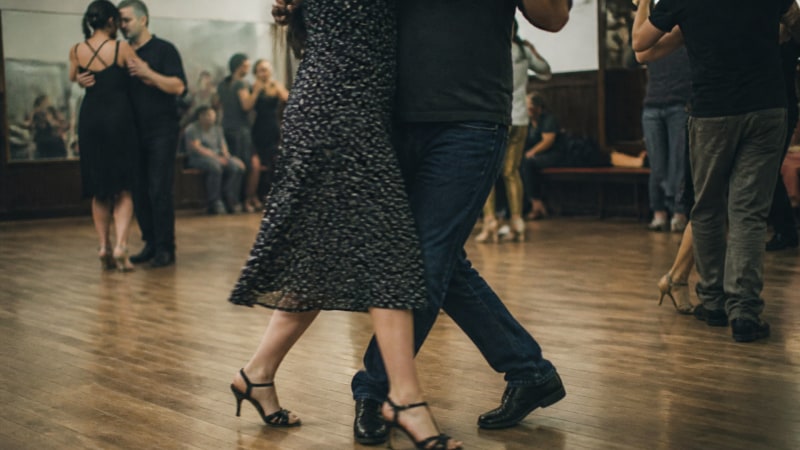
In a confined space, precision is key: short, flat steps keep the couple in perfect rhythm, even at a fast tempo.

Why large tango steps fail at the milonga

A common misconception among beginners is the attempt to transfer the expansive figures of classical tango one-to-one to the milonga. However, the fast tempo hardly allows for sweeping movements or slow turns. Anyone who tries to take large steps here immediately loses the connection to their partner and falls out of rhythm. The Tango Argentino vs milonga footwork differs primarily in spatial distribution and step size.

In classical tango, the couple utilizes the space, glides in long lines across the dance floor, and uses complex structures like the cross system. In our guide on Tango Argentino systems, you can learn more about these patterns. At the milonga, however, the couple usually remains compact in a small space. The steps are placed directly under one's own center of gravity. It is a dance of small, precise accents, where partners stay close together and interpret the music through quick weight changes.

The direct comparison for practice

Doing it right at a Milonga

  • Keep steps consciously small and under the body
  • Spring the fast two-four time with your feet
  • Use rhythmic accents like the Traspié
  • Keep the embrace compact and stable

Don'ts at a Milonga

  • Taking wide, sweeping steps
  • Lifting your legs high off the floor
  • Forcing complex, slow Tango figures
  • Moving your upper body far away from your partner

In the milonga, there is no time for grand gestures. The art lies in translating the fast rhythm into minimal, yet precise movements as a couple.

Tango teacher, Berlin

Compact movements and playing with the traspié

To successfully master the Milonga, a Milonga dance steps guide is always focused on reduction. Instead of complex step combinations, the focus is on simple forward, backward, and side steps that are rhythmically varied. A central element is the so-called traspié: a quick double step on half beats, where the weight is briefly shifted and immediately brought back without the position in the room changing significantly.

These rhythmic playfulnesses are what make the Milonga so appealing. They require an extremely high level of concentration and responsiveness from both partners. Since the movements are so compact, communication within the pair must be even more sensitive than in classic Tango. Anyone looking for this fine coordination will find plenty of inspiration in the current Argentine Tango steps on how to combine traditional elements and modern dynamics on the dance floor.

Two worlds on the same dance floor

Tango

Elegance in length

The sustained gliding through space

The focus is on elegant, long steps and gliding fluidly across the dance floor. The music leaves plenty of room for pauses, embellishments, and melancholic interpretation.

Milonga

Precision in the beat

The rhythmic play in a confined space

Small, flat steps directly under the center of gravity dominate the picture. Quick weight changes and rhythmic playfulness like the traspié determine the flow of the dance.

Frequently Asked Questions

  1. The main difference lies in the rhythm and the size of the steps. While Argentine Tango is danced in a sustained four-four time with large steps, the milonga requires a fast two-four time with very short, flat steps.

Tango courses near you

Find the right course to learn the subtleties of Tango and Milonga from scratch.

View all matching courses

Find your dance partners for the next Milonga

Find like-minded dance enthusiasts on udansa who want to practice the fast rhythm of the Milonga or explore the calm paths of Tango with you. Experience the diversity of the dance community and start your next dance adventure.

Find your dance partners for the next Milonga