Find your rhythm partner at udansa
On udansa, you will find like-minded people who want to feel the music just as intensely as you do, as well as the right dance courses for your path to true musicality.

By Bernhard De LucaUpdated
On udansa, you will find like-minded people who want to feel the music just as intensely as you do, as well as the right dance courses for your path to true musicality.
The greatest art in Tango lies not in speed, but in the courage to be slow. Whoever learns to endure the silence in the rhythm immediately gains confidence and elegance on the dance floor.
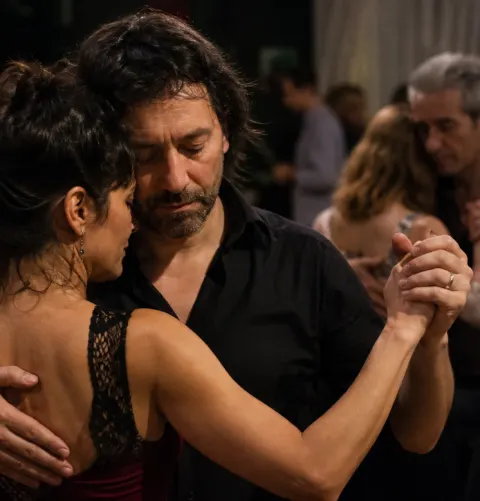
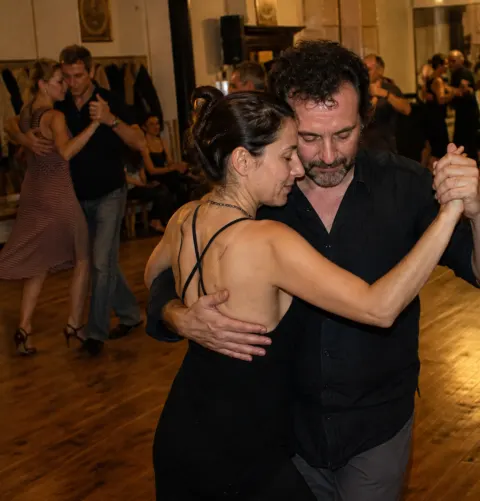
Many beginners in Argentine Tango believe that a good dance consists of an uninterrupted chain of steps and complex figures. On the dance floor, this misconception quickly leads to haste, stress, and collisions. However, the true magic and the deepest connection between the couple often arise in the moments where absolutely nothing moves. The ability to use dancing pauses in Argentine Tango as a creative element distinguishes experienced dancers from beginners. It is not about simply standing still because you have run out of steps. Rather, the pause is a conscious decision to give the music space and to intensely feel the shared embrace.
To keep the Argentine Tango hand position and the overall posture stable, the rest phase actually requires more concentration than the step itself. The orchestra breathes, and as a dance couple, you breathe with it. When the bandoneon draws the note and the violins become quieter, a natural delay occurs. Using this Tango musicality to rest gives the follower time to trace the movement and the leader the opportunity to prepare the next impulse stress-free. Those who dance the silence dance more relaxed and expressively.
When listening to the music, focus on the end of the melodic phrases. Often, a pause is announced by a slowing bandoneon or a short delay in the piano.
Complete the last step before the pause as usual. Transfer your weight completely onto the new standing leg, so that the free hip and the working leg are completely relaxed.
Consciously exhale at the moment of stillness and lower your center of gravity minimally. By doing this, you signal absolute security, calmness, and presence in the room to your partner.
Use the pause in the music to strengthen the connection in the embrace. Maintain contact in the upper body, without building up pressure or changing your posture.
Wait until the orchestra plays the new impulse or the next heavy beat. Only then should you start the new step to cleanly bring the gained dynamics onto the dance floor.
Find the right dance school now to take your musicality in Argentine Tango to the next level.
Student DanceLimbach-Oberfrohna · Germany
Aufbaukurs Limbach Dienstag Schuljahr 2026/27Tuesday · 16:00 · Nov 10, 2026 - Jan 26, 2027
Limbach-Oberfrohna
Student DanceBurgstädt · Germany
Tanzschuljahr & Tanzkreis Burgstädt DienstagTuesday · 17:45 · Nov 10
Burgstädt
Couple danceLimbach-Oberfrohna · Germany
PaartanzkreisTuesday · 18:45 · Nov 10
Limbach-Oberfrohna
Like this
Not like this
Preparation
Arrival
During
A pause in Tango usually lasts for one to two beats, often at the end of a musical phrase. However, with dramatic orchestras like Pugliese, it can be held significantly longer, as long as the music sustains the tension.
No, on the contrary. Consciously taking a pause shows great musicality and gives your partner time to finish the movement elegantly. It appears confident and calms the flow of dance on the floor.
You can recognize them by descending melodies, long-drawn-out notes from the bandoneon, or when the tempo of the orchestra noticeably slows down. The silence is particularly suitable at the end of a four-bar phrase.
 Argentine Tango Music: Understanding Rhythms and Orchestras
 Neotango Music Trends: Modern Rhythms on the Rise
 Dancing Pugliese: The art of dramatic tempo changes
 How to create a Tango playlist for home practice
 Syncopation in Argentine Tango: Rhythm tricks for dancers
 Tango, Vals and Milonga: The three rhythms explained
 Argentine Tango: Famous Orchestras of the Golden Age