Find your Tango partner on udansa
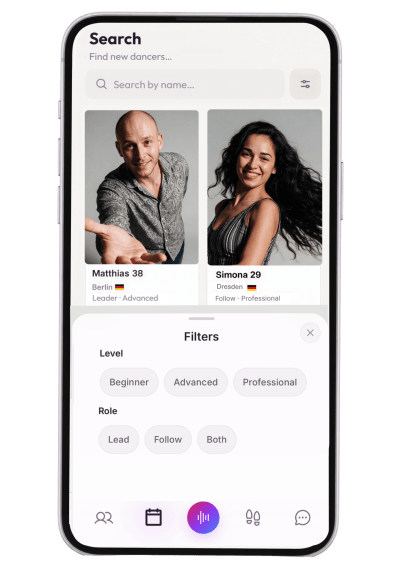
On udansa you will find like-minded people who share your passion for Tango, as well as the right courses and milongas in your area. Make connections and head onto the dance floor feeling well prepared.

Getting started in the traditional Tango world is easy once you understand the subtle signals of the community. Learn how to move confidently on the dance floor and what matters when it comes to the perfect footwear.
A Milonga refers to both the traditional dance event for Argentine Tango and an independent, fast-paced musical style in 2/4 time. At a milonga, dancers of all levels come together to dance and socialize.
Anyone stepping into a milonga for the first time immediately feels the special, almost magical atmosphere. A milonga is not an ordinary dance evening, but a social space with decades-old traditions. The most important rule for harmonious interaction concerns the direction of dance: all couples move in concentric circles counter-clockwise on the dance floor, the so-called ronda. Anyone who ignores this unwritten law and dances across the room risks painful collisions.
Adhering to the milonga etiquette ensures that all dancers feel safe and respected. This also includes leaving the dance floor together after a tanda, a musical set of usually four songs. Partners are traditionally changed during the breaks in between, which are announced by a short, danceable interruption called the cortina. Anyone who understands these procedures will quickly lose their shyness about their first visit.
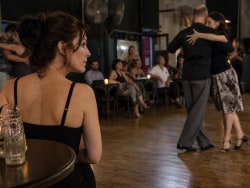
In traditional Argentine Tango, the invitation to dance follows a fascinating, silent ritual: the cabeceo. Instead of approaching a person directly and asking them verbally, dancers use eye contact. You look at the desired person until they return your gaze. If the other person confirms their interest with a subtle nod, the invitation is complete. Looking away, on the other hand, signals a friendly but unmistakable refusal, without anyone losing face.
This non-contact dialogue, known as the cabeceo in Argentine Tango, protects privacy and takes the pressure out of making contact. It is one of the most important Argentine Tango codes that is understood at milongas worldwide. Anyone who engages in this game of glances and subtle gestures will experience a whole new form of appreciative communication before the first step is even danced.
Break in new tango shoes at home before your first visit to a milonga. This way, you avoid blisters and get used to the feeling of turning on the soles.
The milonga is a place of mutual respect. Anyone who understands the codes and respects the ronda will be warmly welcomed anywhere in the world.
In addition to the rules of conduct, equipment plays a decisive role in your well-being at the milonga. High-quality Argentine Tango shoes are not a luxury, but an important tool for stability and ease of turning. The sole is usually made of smooth leather or chrome leather, which makes turning on the ball of the foot easier and protects the knees. Anyone dancing in blunt street shoes risks long-term joint damage.
For men, men's tango dance shoes are often equipped with a slightly raised heel, which optimally shifts the weight forward. Women should ensure that their tango shoes for women are comfortable and offer a secure hold in the heel area despite the heel. Good cushioning in the forefoot area ensures that your feet do not hurt even after hours of dancing. If you would like to dive deeper into the world of tango, you will find valuable tips for your start in the guide Learning Argentine Tango: The entry into partner dance.
The silent invitation in tango
The cabeceo allows for a discreet invitation via eye contact. Both partners can decide, without pressure and without losing face, whether they would like to share a tanda with each other.
The circular path on the dance floor
The ronda regulates the flow of traffic on the dance floor in a counter-clockwise direction. It protects couples from collisions and ensures a harmonious, flowing experience together.
The cabeceo is the traditional way to invite someone to dance using eye contact and a slight nod. It prevents awkward situations and verbal rejections on the dance floor.
Find the right course and learn the steps for your first Milonga.