

Find your dance partner on udansa
Find like-minded Tango dancers in your area on udansa who appreciate traditional etiquette just as much as you do. Connect easily for your next course or the upcoming milonga.

If you want to enjoy a milonga without any stress, you cannot avoid the cabeceo. This silent art of invitation protects both sides from embarrassment and ensures a relaxed atmosphere on the dance floor.
The term Cabeceo describes the traditional, purely visual invitation to Tango Argentino. This method has proven itself over decades in the dance halls of Buenos Aires and is now the standard at traditional milongas worldwide. Instead of walking across the room and pressuring someone verbally, both sides use eye contact to clarify mutual interest. This protects against uncomfortable situations: anyone who does not want to dance simply looks away, without an awkward, loud rejection taking place in front of everyone present. Only when eye contact is established and confirmed by a slight nod (the actual Cabeceo) does the person inviting move toward the other person.
To use this non-verbal communication successfully, an upright standard dance posture and good positioning in the room are crucial. Anyone sitting deep in a dark corner can neither be seen nor establish eye contact themselves. The Cabeceo is not a mysterious flirting game, but a highly efficient tool of mutual respect. It ensures that every milonga night remains fluid, relaxed, and free of social pressure. If you are looking for an entry into this fascinating dance world, our guide on learning Tango Argentino: The entry into partner dance will help you.
If you are unsure whether the nod was really meant for you, it is better to wait a moment or point to yourself with a questioning gesture before you stand up. This avoids confusion at crowded milongas.
Position yourself in the room so that you have a clear line of sight to the other dancers. Anyone hiding behind pillars or only looking at the floor cannot be asked to dance.
Let your gaze wander over the rows of seats during the cortina or at the beginning of a new tanda. Specifically look for the eyes of the person you would like to dance with.
As soon as your eyes meet, hold the gaze for a few seconds. A short, questioning raise of the eyebrows signals your intention to dance.
Wait for a clear, slight nod from your partner. Only once this confirmation is given is the invitation mutually accepted, and you may stand up.
Approach the person directly and without detours. Maintain eye contact while doing so, so that no other person mistakenly thinks you are coming for them.
The cabeceo is the traditional, purely visual way to invite someone to dance Argentine Tango using eye contact followed by a nod. This method allows for discreet communication from a distance.
Find the perfect opportunity to try out the cabeceo live in practice.
 Ballroom Dance Posture: How to build the perfect frameProper posture and a stable frame are the foundation of every ballroom dance. Learn how to glide elegantly across the floor with the right body tension and orientation.
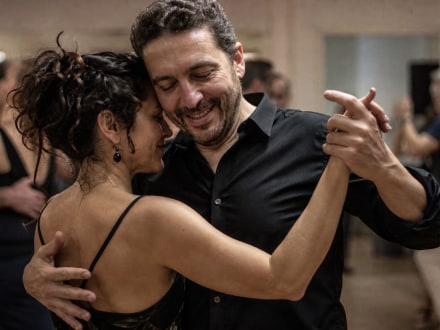 Learning Argentine Tango: Your start in partner danceArgentine Tango is pure improvisation and a deep connection between partners. Learn how to get started and what makes this dance so special.