Competition sport5 minutes

Which Samba competition class suits you? The test

By Mary De LucaUpdated

In short
  • Entry into Latin American tournament dancing is regulated through a system of five progressive performance classes from D to S.
  • The Samba D-class forms the entry level with a strict limitation to simple basic figures without complex poses.
  • As the level rises from the C-class through the B and A-classes to the S-class, the demands on athleticism, choreography, and expression increase.
  • A well-founded self-test helps tournament beginners realistically determine their own dancing potential and the appropriate entry point.

Find your way in competitive dance

Are you looking for the right challenge for your dance development? On udansa, you can connect with like-minded people, find ambitious training partners, and discover suitable competitive dance clubs in your region.

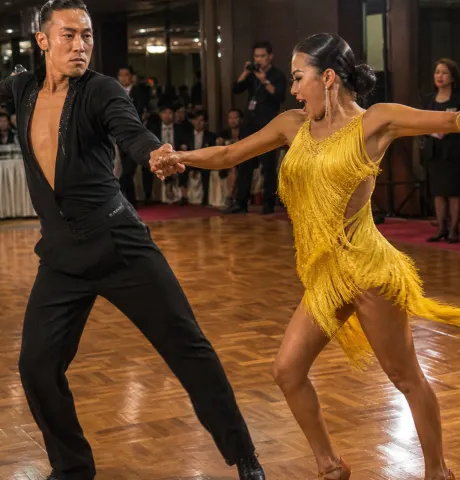
Find your way in competitive dance

Stepping onto the competition floor requires courage, discipline, and an honest self-assessment. Find out with our targeted test what level you are at in Samba and which starting class suits you best with udansa.

The path through the Latin dance classes in tournament dancing

Getting started in Latin tournament dancing is an exciting step, which takes your training to a completely new level. Samba, with its infectious rhythm and demanding movements, is often the key to success on the dance floor. But before you register for your first tournament, there is a fundamental question to address: which tournament level in Latin dances actually corresponds to your current skills? The classification into official starting classes ensures that you compete against couples who have a similar level of training.

To determine your own Latin dance starting class, it is worth taking a look at the structure of the German Dance Sport Association. The system is logically built upon itself and ranges from the beginner class to the absolute top class. Each level places specific demands on your coordination, your musicality, and your stamina. If you assess your own performance realistically, you avoid both being overwhelmed and frustration on the dance floor, and you lay the foundation for sustainable athletic success.

Take the Samba tournament class test

  1. How confident do you feel with fast rhythm changes in Samba?

    • A: I focus entirely on the basic beat and avoid too much hustle.
    • B: Syncopations and small rhythm variations usually work well for me.
    • C: Complex rhythms and fast changes are no problem for me.
  2. How important is creative freedom in your choreography to you?

    • A: I prefer dancing simple, clean figures that I have mastered perfectly.
    • B: I enjoy a few more demanding figures and light poses.
    • C: I want to dance a completely free, individual choreography without any restrictions.
  3. How would you rate your stamina during a full Latin dance round?

    • A: After two dances with full energy, I need a short breather.
    • B: I can manage five dances in a row, but my concentration fades towards the end.
    • C: I can dance through several rounds with full physical effort without any problems.
  4. What role does visual presentation (clothing, charisma) play for you?

    • A: Simple, clean practice clothes are perfectly enough for me to feel comfortable.
    • B: A chic competition outfit is important to me, but it doesn't have to be over the top.
    • C: A custom-made, eye-catching competition dress and perfect styling are part of it for me.

Your evaluation

Mostly A: The solid beginner (D-class)

You are right at the beginning of your tournament dance journey or you value solid foundations the most. The D-class is your perfect environment to get a taste of tournament life without overwhelming yourself with complex choreographies. Focus your training primarily on precise timing and clean footwork.

Mostly B: The ambitious rising star (C-class)

You have internalized the basics and are ready for the first creative subtleties. In the C-class, new rhythms and more demanding figures are added, where you can put your technical precision to the test. Now work more intensively on your knee and ankle work for a dynamic bounce.

Mostly C: The experienced competitive athlete (B/A class)

You already bring a lot of experience, excellent physical condition, and a high level of body control. Having reached the B or A class, you dance free choreographies and compete against very strong couples. Your focus should now be on artistic expression, couple harmony, and athletic impact.

The Latin starting classes in direct comparison

CriterionD-ClassC-ClassB-/A-Class
Permitted figuresStrict step limitation to basic stepsExtended figure selection without difficult posesCompletely free choreography without restrictions
Typical outfitSimple clothing without glitter and feathersCompetition clothing with initial design detailsElaborate, custom-made competition wardrobe
Dance focusTiming, footwork and basic postureTechnique, rhythm variations and dynamicsPresentation, athleticism and couple harmony

The classification and the permitted figures are based on the official tournament regulations (TSO) of the dance sports association.

From test result to your first competition book

Once you have determined your current level, it is time for the practical implementation. Starting in the D-class is the healthiest path for the vast majority of couples, as it allows you to get a taste of competition atmosphere under real conditions without being distracted by highly complex choreographies. In this phase, it is particularly advisable to consolidate the basics, such as the characteristic bounce and precise footwork, before aiming for the promotion to the C-class.

Regardless of your test result, regular feedback from experienced coaches is irreplaceable. They see details in your hip movement and timing that you might miss yourself in the mirror. Use your result as a guide for your next conversation at the club or to precisely define your training goals for the coming months. The journey through the classes is not a sprint, but a fascinating development process.

Frequently Asked Questions

  1. The D-class is the lowest starting level in competitive dance. At this level, only selected basic figures are permitted in Samba, and the focus is entirely on rhythm, clean footwork, and a stable shared posture.

Ballroom and Latin courses near you

Find the right club or dance school for your tournament training.

View all matching courses