Dance practice4 minutes

Switching from ballroom to social dance

Kurz gesagt
  • Der Wechsel vom Standardtanz zum Social Dance gelingt durch das bewusste Loslassen starrer Choreografien und das Einlassen auf spontane Interaktion.
  • Anstatt feste Schrittfolgen abzuarbeiten, konzentrieren sich Führende und Folgende ganz auf die feinen, physischen Signale im jeweiligen Moment.
  • Die Improvisation beim Paartanz wird gelernt, indem bekannte Figuren in kleinste Bausteine zerlegt und völlig neu miteinander kombiniert werden.
  • Regelmäßige Besuche von freien Tanzpartys und das Tanzen mit wechselnden Partnern beschleunigen den Lernprozess abseits des gewohnten Kursraums.

Der Wechsel von starren Choreografien zur freien Improvisation auf der Tanzfläche erfordert Mut. Mit den richtigen Schritten löst du dich von festen Mustern und entdeckst die pure Freude am spontanen Paartanz.

What you should bring for the transition

  • Solides Rhythmusgefühl und Taktsicherheit
  • Bereitschaft, sich auf die Führung des Partners einzulassen
  • Kenntnis der absoluten Basics des neuen Tanzstils
  • Offenheit für kleine Fehler und spontane Anpassungen

The leap from fixed patterns to spontaneous movement

Anyone who has trained for years in classic competitive dance or a traditional dance school often moves within fixed grids. Every figure follows an exact count, the posture is strictly prescribed, and the couple moves along an invisible, but strictly defined circular path through the room. In social dance, however, this rigid construct breaks open. Here, there are no judges and no fixed choreographies that must be reeled off without error. Instead, the focus is on the spontaneous connection to the music and to the other person.

The switch from ballroom dance to social dance primarily means a mental adjustment. You have to learn to let go of control a little bit and trust the impulses of the moment. While the focus in a classic dance school is often on the flawless performance of a learned sequence, free dancing is about constant, wordless communication between partners. These principles of lead and follow are the key to breaking away from fixed patterns and discovering your own creativity on the dance floor.
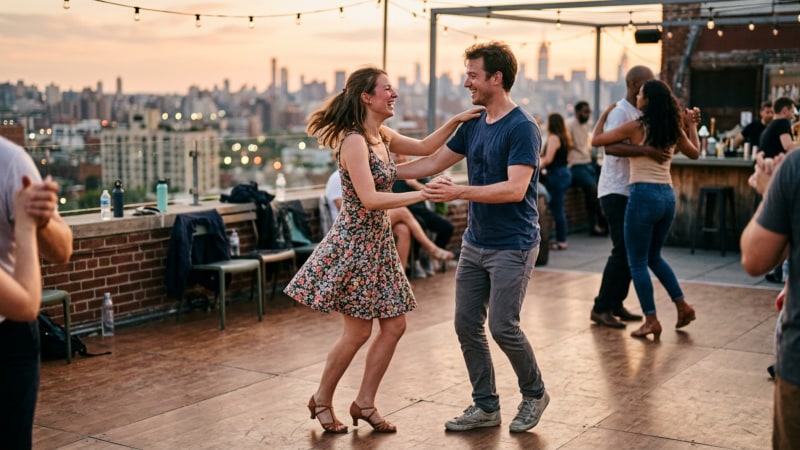
Improvisation in the moment: When dancing freely, movement emerges from the direct connection with your partner, completely without rigid guidelines.
udansa-Tipp

Schließe beim Üben des Grundschritts mit deinem Stammpartner für zwei Minuten die Augen. Ohne visuellen Fokus nimmst du die physische Führung deines Gegenübers sofort viel intensiver wahr.

Four steps to dancing freely with udansa

  1. Consciously relax your posture

    Say goodbye to the wide, extreme body tension of ballroom dancing. Let your shoulders drop, take some pressure out of your arms, and allow your center of gravity to sink more naturally and deeply.

  2. Focus on weight

    When dancing, focus exclusively on the principle of weight and release. Feel which foot your partner is standing on, and follow these weight shifts without thinking about the next move.

  3. Muster aktiv aufbrechen

    Nimm eine dir bekannte Standard-Figur und teile sie gedanklich in ihre Einzelteile. Setze nach der Hälfte der Bewegung einen anderen Schritt an oder ändere spontan die Richtung, um die Improvisation beim Paartanz zu trainieren.

  4. Die Komfortzone verlassen

    Besuche gezielt freie Übungsabende oder Social-Dance-Partys. Nutze die Gelegenheit, mit fremden Tänzern zu üben, da dich dies zwingt, wirklich zu führen oder zu folgen, statt sich auf Gewohnheiten zu verlassen.

How to master improvisation in partner dance

Richtig

  • Figuren in einzelne Grundelemente zerlegen
  • Auf die feinen Impulse des Partners reagieren
  • Fehler als kreative Abzweigung nutzen
  • Mit vielen unterschiedlichen Partnern üben

Wrong

  • Forcing memorized choreographies
  • Sticking to the stiff, wide standard posture and creating frustration
  • Stopping in frustration when missing a step
  • Only dancing with your familiar regular partner

Your checklist for a successful transition

Vor dem ersten Tanzabend

Vorbereitung

On the dance floor

Arrival

During the party

During

Häufige Fragen

  1. Der Hauptunterschied liegt in der Struktur. Während in der klassischen Tanzschule meist feste Schrittfolgen und Choreografien für das Parkett gelernt werden, basiert Social Dance auf reiner Improvisation und der direkten Kommunikation im Paar.

Find your perfect dance course

Discover courses in your area and learn the art of improvisation in partner dance.

View all matching courses
udansa community

Finde deine Tanz-Community auf udansa

Hier triffst du Gleichgesinnte, die den Schritt auf die freie Tanzfläche wagen. Tausche dich aus und finde die perfekte Begleitung für deinen nächsten Tanzabend.

Sources

Empirical values from the many years of practical experience of dance instructors in the field of ballroom and social dance, as of August 2026.