Figure practice5 minutes

5 Rock'n'Roll figures without acrobatics for your training

By Bernhard De LucaUpdated

In short
  • Changing places, an underarm turn, a leader's turn, a hand change behind the back, and a basket can all be danced without lifts.
  • The sequence gradually increases coordination demands, from simple traveling patterns to turns with two hand connections.
  • Each variation described here begins and ends in a set partner position.
  • To maintain continuous contact with the floor, practice these figures without jumps and without the airborne phase that would otherwise be possible.

A new figure is only useful if you can find your bearings again afterward. It's often the seemingly insignificant hand changes that determine whether both of you can keep dancing comfortably or end up standing there with your arms twisted.

How the selection is organized

  • Footwork before hand coordination

    First come figures with a single-hand connection, followed by additional hand changes and two-hand holds.

  • Your own weight on your own feet

    Only floor-level variations without lifts, jumps, falling figures, or carried body weight are included.

  • No Paid Listings

    No one paid to be listed; the figures shown are common figures, not providers.

  • As of October 31, 2026

    The selection describes practice variations and is neither an official figure catalogue nor a recommendation for a starting class.

A sole that grips too much when turning puts unnecessary twisting strain on your knees and ankles.

Five figures in order of increasing coordination requirements

  1. 01

    Place Change Without an Underarm Turn

    Start: open, left-to-right handhold; End: open, places exchanged

    • Travel path
    • one handhold
    • no arm turn

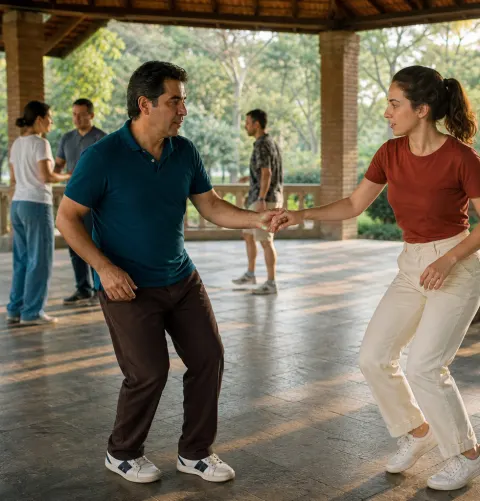
    The leading dancer holds the following dancer’s right hand with their left, opens a passage to the side and lets them pass, while they exchange places and then turn to face each other again. This variation comes first because you create the pathway without adding a turn under an arm: you both stay on separate paths, the connected hand stays roughly at hip height, and at the end you’re facing each other again.

  2. 02

    Follower's underarm turn

    Start: open, left-to-right; end: open, left-to-right

    • Right turn
    • own axis
    • same handhold

    From the open facing position, the leader raises their left hand, and the follower dances a full right turn under the connection until they are facing each other again. Unlike the change of places, this move adds a turn on the follower's own axis: the raised hand creates space above the head but does not pull on the arm. Small steps keep the turn grounded, and the original left-to-right connection stays in place until the starting position is reached.

  3. 03

    Leader's underarm turn

    Start: open, left to right; end: open, left to right

    • Left turn
    • role change
    • same handhold

    Here, the leader turns fully to the left under their own raised left hand, while the follower gives them room and keeps their right hand moving with them. This figure, also often called a man's turn, requires extra spatial awareness because the leader briefly looks away and still has to finish their turn without pulling on their partner's hand. Afterward, both face each other again, without changing places and with the same handhold.

  4. 04

    Hand Change Behind the Back

    Start: open, left-to-right; end: open, right-to-right

    • Full Left Turn
    • Hand Handoff
    • Behind-the-Back Pass

    In this variation, the leading partner turns fully to the left, guides the partner’s held right hand low behind their own back, and takes it there with their right hand before turning back to face the following partner. The added coordination challenge is the handoff outside the field of vision: the left hand releases only when the right hand has made contact, and the arm stays relaxed instead of being pinned behind the back.

  5. 05

    Basket through a wrap

    Start: facing each other, both hands connected; end: side by side, hands connected

    • Two hand connections
    • half turn
    • same direction

    You start facing each other with both hands connected; the leader raises their left-hand connection and guides the follower through a half turn to the left into the side basket position, while the other connection stays low. This figure comes last because both arms and the distance between you have to work at the same time: at the end, you stand side by side facing the same direction, with your hands loosely connected in front of your bodies, without either arm wrapping around the neck or supporting body weight.

The ending position makes a move repeatable

The list shows common Rock'n'Roll dance figures in explicitly described variations. Names may differ in class: for example, an underarm turn may also be taught with a change of places. The paths and hand connections specified here are therefore what matters for this selection, not just the name of the figure.

First, practise each figure on its own, with a deliberate finish. After the last step, take a stable stance: your facing direction, distance and handhold should be right without any readjustment afterward. Repeat the same entry instead of immediately adding a second figure. This way, you can tell whether a botched handover comes from the movement or whether the starting position was already unclear.

The basic step and controlled kicks are assumed. If weight changes still feel uncertain, the overview of the basics for joining a course later can help. When there is a difference in level within the pair, the less confident person sets the pace for practising.

Athletic Rock'n'Roll can include springy actions with short flight phases, even without acrobatics. For these low-impact exercises, leave out the jumps and keep one foot on the ground while walking or turning. This is an adaptation for practising figures, not a description of every athletic variation. Flat shoes that fit securely make controlled changes of direction easier.

The scope of this selection

Individually described floor figures
5
Entries with a hand connection
4
Lifts in the variations shown
0

Frequently Asked Questions

  1. You need clear paths and enough distance from other couples, but not an acrobatics mat. When changing places, you move through the room more than when turning on the spot. So start by practicing without other couples right next to you, and keep your steps small without crossing your legs.

You need connection for hand changes

On udansa, you can find dance partners to practice Rock'n'Roll together. With the right practice partner, you can repeat your pathways and hand changes before dancing longer sequences.

You need connection for hand changes