Partner Technique6 minutes

How West Coast Swing Patterns Work in the Slot

By Bernhard De LucaUpdated

Kurz gesagt
  • West Coast Swing Figuren unterscheiden sich durch Laufwege, Richtungswechsel und die Position der Tanzenden zueinander.
  • Beim Sugar Push kehrt der Follow um, beim Side Pass passiert er den Lead.
  • Der Whip führt den Follow durch eine gemeinsame Rotation zurück entlang des Slots.
  • Verbindung und Anchor Step ermöglichen klare Übergänge, ohne den Partner zu ziehen oder wegzudrücken.

Two couples can dance the same figure and still look completely different. When you recognize their paths and how they respond to each other, an apparently complicated sequence becomes an understandable movement conversation.

DefinitionSlot

In West Coast Swing, the slot is an imaginary narrow lane along which the Follow moves mostly forward and backward. The Lead clears this lane or uses their position in it to change direction.

Three patterns reveal different pathways

A pattern is a recognizable sequence of movements. In lessons, the West Coast Swing basic step is often taught as a first basic pattern, but no single step explains the whole dance. Three different pathways help you understand the figures: approaching and reversing, passing by, and rotating back.

In the Sugar Push, the Follow approaches the Lead. The Lead receives the approach, often with both hands in contact. A brief compression creates the reversal: the Follow moves backward along the slot again. The reversal comes from coordinated body movement, not from a push of the hands.

In the Left Side Pass, the Lead makes space so the Follow can pass by on their left side. The Follow reaches the other end of the slot instead of reversing in front of the Lead. The Underarm Pass also follows a passing pathway, with the added lead under the raised arm.

In the Whip, the Lead brings the Follow into a temporarily closed connection. They coordinate a shared rotation before the Follow moves back out along the slot. That is why the Whip is not simply a longer Side Pass. For context alongside other swing techniques, the overview of the learning path in Swing gives you the bigger picture.

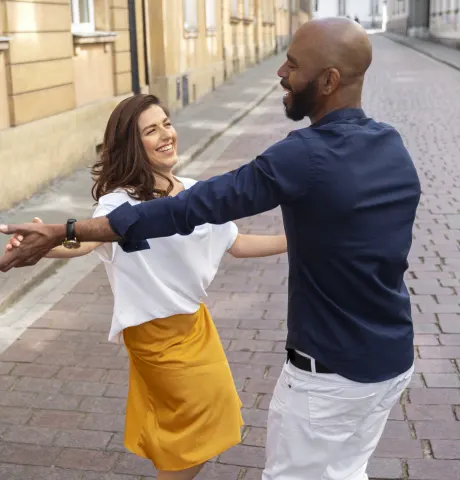
A smiling couple dances Swing, shown in full.
Technique starts when you change your shoes: the right sole makes it easier to change direction without slipping out of control.

Verbindung entsteht durch abgestimmte Gegenbewegung

Die West Coast Swing Verbindung übermittelt Veränderungen von Richtung und Bewegung. Dafür brauchen beide einen eigenen stabilen Stand und bewegliche Arme. Wenn die Hand wandert, aber der Körper stehen bleibt, kommt beim Gegenüber oft nur ein unklarer Zug an. Eine lesbare Bewegung beginnt deshalb mit der Organisation des eigenen Körpers.

Bei Kompression bewegen sich die Körper aufeinander zu und nehmen über den Kontakt einen sanften Druck auf. Bei Extension bewegen sich die Körper auseinander; die Verbindung bekommt eine leichte Zugspannung. Gegenbewegung heißt dabei nicht, mit voller Kraft gegenzuhalten. Die Arme bleiben anpassungsfähig, die Schultern entspannt und die Füße tragen weiterhin das eigene Gewicht.

Der Anchor Step bildet am Ende vieler Patterns einen Übergang mit eigener Gewichtsorganisation und einer elastischen Verbindung. Er ist weder ein Festkleben am Boden noch ein absichtliches Zurücklehnen. Die genaue Fußgestaltung kann variieren, solange Balance und gemeinsamer Abschluss erhalten bleiben.

Der neue Weg entsteht erst aus einer neuen Führungsinformation. Wenn der Follow bereits beim letzten Schritt losläuft, weil er die nächste Figur erwartet, verschwindet dieser Übergang. Umgekehrt kann der Lead keinen sauberen Beginn erzeugen, indem er einen noch nicht abgeschlossenen Gewichtswechsel mit dem Arm überholt. Beide Rollen tragen zur Klarheit bei.

How to recognize a clear connection

That's right

  • Prepare the path with your body
  • Absorb compression with yielding elbows
  • Dance the anchor through your own weight shifts
  • Shorten your traveling steps when space is limited

Not like this

  • Move your partner using only your arm
  • Force compression with stiff arms
  • Hang on your partner during the anchor
  • Extend your slot into neighboring couples' space

A figure becomes clear when both partners know where their own body is moving and where their shared path ends.

Dance Guide Editorial Team

Variations change the form, not the communication

Technical variations start at different points: You can replace a foot action, add a turn, or extend a traveling pattern. These are different kinds of changes. A different foot action can happen within the same amount of time; an extension, by contrast, needs a shared, understandable timing framework. The familiar figure remains recognizable only if its transitions are preserved.

A Side Pass with an extra turn needs space, the right preparation, and a follow who controls the turn themselves. Simply raising your arm higher is not enough. A delayed finish must not cause one partner to move on while the other is still in the old pattern.

In Jack and Jill, partners are assigned by draw and improvise together. In Strictly Swing, you usually compete with a partner you choose yourself, also improvising. Routine formats like Classic or Showcase, on the other hand, use prepared choreography; the rules for which elements are allowed are set by the regulations for each event.

This changes the task: With an unfamiliar partner, immediate readability matters, while a complex variation can be prepared together in a routine. Classes with partner changes and targeted technique corrections bring both together. The guide to dance classes for adults explains the different options. Difficult figures cannot replace a solid connection in any format.

Two perspectives on the same figure

Lead

Make the path clear

Offer space and direction

As the lead, you decide whether the path stays open or a change of direction is being prepared. Your position makes this decision visible. Effective leading gives the follow time to shift their weight on their own.

Follow

Den angebotenen Weg ausfüllen

Bewegung aufnehmen und ausgestalten

Als Follow bewegst du dich auf dem angebotenen Weg mit eigener Balance weiter. Du reagierst auf eine neue Information, statt die vermutete Figur vorwegzunehmen. Innerhalb dieses Rahmens kannst du Schritte und Körperbewegung musikalisch ausgestalten.

Häufige Fragen

  1. West Coast Swing ist nicht grundsätzlich schwerer, verlangt aber früh Aufmerksamkeit für Verbindung und eigene Balance. Die Schwierigkeit entsteht oft, wenn du Figuren auswendig tanzt und dabei den Laufweg übersiehst. Wenige gut verstandene Patterns geben dir eine tragfähigere Grundlage als viele Namen.

Figuren brauchen ein Gegenüber

Auf udansa findest du Tanzpartner, mit denen du Sugar Push, Side Pass und Whip mit wechselnden Rollen oder festen Rollen vertiefen kannst.

Figuren brauchen ein Gegenüber