

Taking the plunge together
Find motivated like-minded people on udansa to take the plunge with you, or discover the best fitness classes in your area.

By Mary De LucaUpdated

Find motivated like-minded people on udansa to take the plunge with you, or discover the best fitness classes in your area.
If you are looking for an effective workout that is gentle on the joints while still releasing maximum energy, you will find the perfect solution in the water. Here, hot rhythms merge with the gentle power of water.
Aqua Zumba refers to a special fitness format that transfers the dynamic dance steps and Latin American rhythms of classic Zumba into chest-deep water. It combines the principles of water aerobics with the fun factor of a dance class.
When you think of Latin American rhythms, you usually imagine sweaty movements in a crowded dance studio. But it can be done differently: in this special fitness format, the entire action shifts into the cool water of a swimming pool. The principle remains wonderfully uncomplicated. A licensed instructor stands at the edge of the pool and demonstrates the choreographies to high-energy music, while the participants stand in chest-deep water and mirror the movements.
The combination of hot rhythms and the cooling environment creates a completely new body sensation. The familiar Zumba for beginners entry is noticeably easier here, as gravity loses its significance in the water. The movements are dynamic, fun, and feel almost weightless due to the buoyancy of the water. It is the perfect mix of a dance party and an effective full-body workout that carries absolutely everyone along.
The biggest advantage of this wet workout lies in the physics of water. Thanks to natural buoyancy, your own body weight is reduced by up to ninety percent in the pool. This massively relieves the spine, knees, and ankles. While jumps and quick changes of direction on a solid gym floor can put a lot of strain on the joints, the water gently cushions every impact. Therefore, this training is excellent for people who want to become physically active again after a long break.
At the same time, the training is by no means less effective than classic Zumba Fitness on land. Water has a significantly higher density than air. Every arm movement, every lunge, and every hip rotation must be performed against this noticeable resistance. This means: although the movements feel soft and fluid, the muscles have to work constantly. Strength and endurance are trained at the same time, without you perceiving it as extreme exertion.
Correct
Wrong
Training in the water relieves the joints of the burden of everyday life and gives the body a lightness that you can hardly experience while dancing on land.
A typical class usually lasts 45 to 60 minutes and follows a fixed structure that is perfectly tailored to the conditions in the water. Everything begins with a thorough warm-up, where the body gets used to the water temperature and the muscles are gently warmed up. The movements here are still slow and controlled to gradually get the circulation going.
This is followed by the main part, where things really get going. Simple choreographies are danced to Latin American and international rhythms like Salsa, Merengue, and Cha-Cha. The steps are designed to make optimal use of water resistance: large arm movements under water, rhythmic steps, and hip movements challenge the deep muscles. The session concludes with a relaxing cool-down with stretching exercises, which feel particularly soothing in the warm water and effectively prevent muscle soreness.
The workout on solid dance floor
The classic version on land focuses on maximum speed, quick changes of direction, and high jumping power on solid ground. It challenges your joints intensively and makes you sweat quickly due to gravity.
The splashy alternative in the pool
The wet version uses water resistance for gentle strength training. The buoyancy relieves the entire musculoskeletal system, while the cooling environment is easy on the circulation and allows for fluid movements.
No, you do not need to be a professional swimmer. The training takes place in chest-deep water, so you have solid ground under your feet at all times and can focus fully on the dance steps.
Normal, well-fitting swimwear such as a sports swimsuit or sturdy swimming trunks is ideal. It is important that nothing can slip while dancing and jumping in the water and that you can move without restriction.
Yes, special aqua shoes with non-slip soles are highly recommended. They give you the necessary grip for fast dance steps on the often slippery tiled floor of the pool and protect your feet.
Discover great dance workouts and find the right group for your training.
ZumbaLimbach-Oberfrohna
ZUMBA® Fitness Clubrunning since Aug 18
Limbach-Oberfrohna
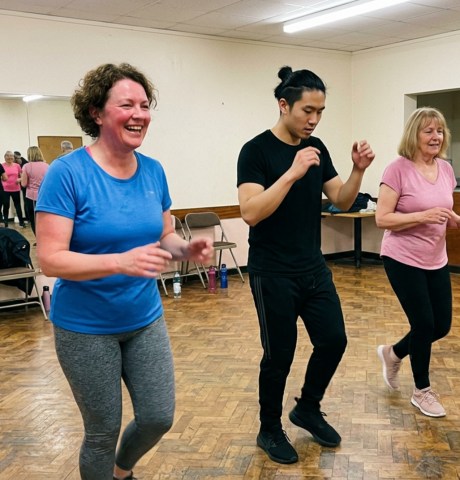 Zumba for beginners: The easy way to start your dance workoutGetting started is easy: With our beginner's guide to Zumba, you will learn about the most important formats and find out what to expect in your first class.
 Zumba Fitness: The effective workout for body and mindZumba Fitness is the perfect workout for anyone who loves to move and wants to improve their health at the same time. Find out how to get perfectly equipped here.Zumba for beginners: The easy way to start your dance workoutGetting started is easy: With our beginner's guide to Zumba, you will learn about the most important formats and find out what to expect in your first class.
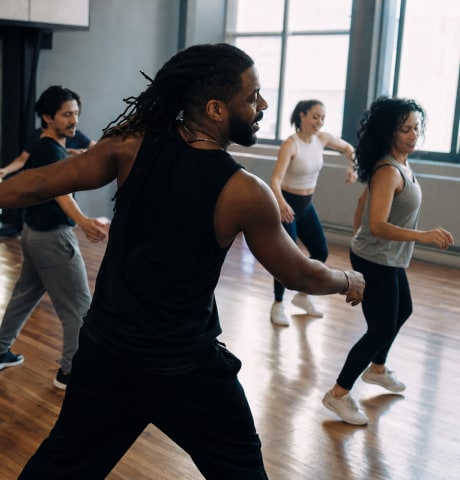 Zumba Trends 2026: The latest workout formatsThe Zumba trends for 2026 bring a fresh breeze to your fitness routine. Discover new, beginner-friendly fusion formats that perfectly combine dance and strength training.
 Zumba for Kids: Fun and Games with Zumba KidsZumba Kids is the perfect mix of dance, play, and fitness for children. Discover how this playful workout boosts coordination and self-confidence.
 Finding a Zumba class: How to choose the best studioWant to start Zumba but don't know where? Our guide shows you the best ways to find the right class near you and what you need to look for.
 Zumba Sentao for beginners: The chair workoutudansa brings a breath of fresh air to your fitness routine. Learn how to effectively train your strength, balance, and endurance using a simple chair.
 Zumba Cool Down Guide: How to cool down properly after classAfter your Zumba class comes recovery. With this guide, you will learn how to cool down properly, stretch effectively, and prevent muscle soreness.
 Zumba Toning for beginners: Dance with light weightsZumba Toning combines exciting dance steps with the use of light weights. Learn how this workout shapes your muscles and how to get started.