Performing Arts5 minutes

OUTNOW Bremen: How to place dance in the festival

By Bernhard De LucaUpdated

In brief
  • OUTNOW! was held in Bremen as a joint festival by Schwankhalle and Theater Bremen.
  • The festival took place every two years, it was not the name of a single production.
  • You can recognize dance by the fact that choreographed movement, the body and space are essential to the contribution.
  • Theater, language and performance can combine with dance, without clear boundaries between the forms.

A festival name tells you little about what happens on stage. An evening becomes interesting when you notice that even a step, a pause, or a glance can change an entire scene.

DefinitionChoreography

Choreography is the intentional design of movement, body relationships, and sequences in space and time. It can include fixed steps, as well as walking, standing still, or rules for improvised movement.

A joint festival is not a single production

OUTNOW! was held in Bremen by Schwankhalle together with Theater Bremen and was conceived as a biennial festival. The name therefore refers to a shared event framework, not a play or a dance style. The connection between the two venues is the concrete starting point for understanding the festival.

A festival brings together individual artistic works under a shared name. Still, each production has its own form: the cast, the way it uses language and the significance of movement all belong to the individual work. The organizers' collaboration therefore does not mean that all contributions share the same aesthetic or show dance exclusively. Nor does the name of a venue indicate a genre.

As a viewer, these are two separate levels: the festival framework explains the context in which a work is presented. The production itself determines what you experience. You can't infer the character of an individual contribution from the festival name. The other Bremen festival, Vier Tage Tanz, has its own context and is therefore treated separately. This page does not assume a current program or an upcoming edition of OUTNOW!.
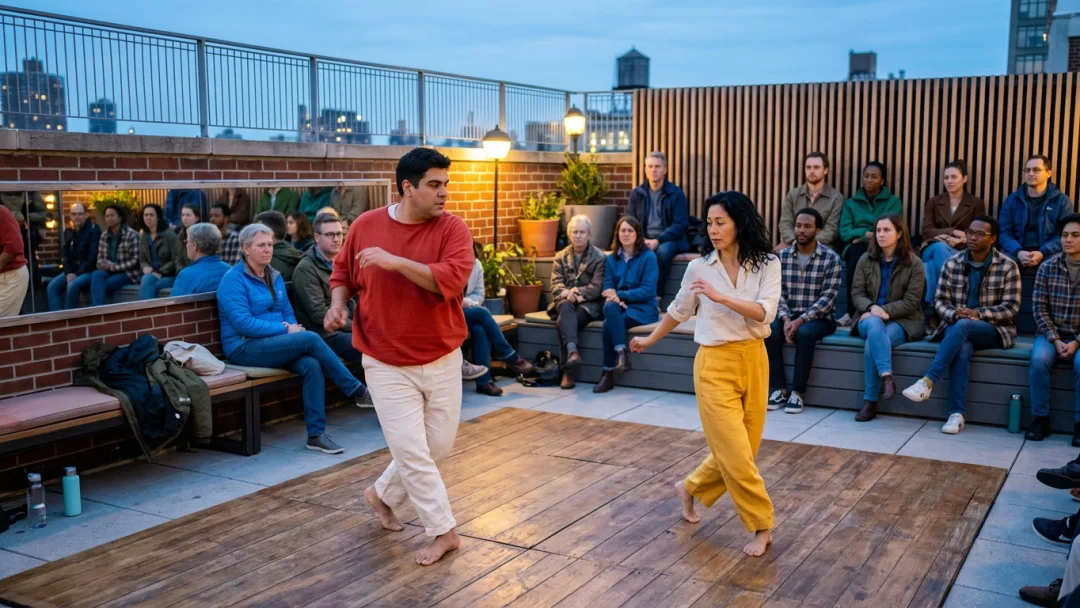
Being close to the action makes small shifts of weight visible, details that can easily be missed from farther away.

Dance is shaped by design, not by the number of steps

A person walks across the room, stops and turns their head. As an everyday action, this would seem unremarkable at first. Repeat the same path, slow it down or interrupt it with a second person, and a visible structure begins to emerge. You start comparing duration, distance and direction. Relationships like these can form the basis of a choreography.

That is why high jumps, fast turns and continuous music are not essential features of a dance piece. Nor does spoken text rule out dance. What matters is the role that the movement of the body plays: does it merely accompany a narrated action, or does movement itself create a significant part of the meaning?

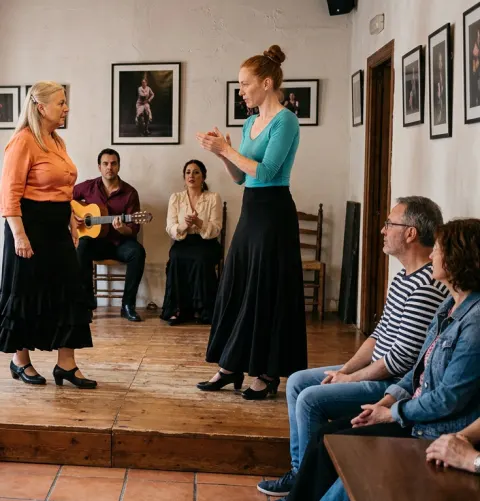
The boundary remains fluid. In theatre, gestures can be strongly choreographed; in dance, performers can speak and tell stories. Performance, in turn, can place an action, a task or an encounter with the audience at its centre. These terms are guides, not separate boxes. To understand a piece, what matters is the function of each element within it. The different stage context of a Tablao in Flamenco shows how much the spatial arrangement can also shape a performance: proximity changes which details you notice.

Recognize the signs, avoid premature labels

So, yes

  • Track recurring movements and their variations
  • Consider language and the body as possible partners
  • Perceive stillness in relation to movement
  • Distinguish between the festival and an individual production

Not like this

  • Counting only jumps and turns as dance
  • Treating spoken lines as a reason to rule something out as dance
  • Considering every pause an interruption
  • Generalizing from the festival name to all contributions

A spoken word does not end the dance, it can change how you perceive the movement before and after.

udansa-Redaktion

Hybrid forms change the way you watch

In a mixed performance format, your attention can shift between different layers. A sentence might express closeness while the bodies keep moving farther apart. You don't have to resolve this contradiction: it may be exactly what the scene is showing. Language and movement then offer not a double explanation, but different kinds of information.

An object works in a similar way. A chair can be part of a story's apartment, but it can also become an obstacle that all the paths circle around. When it is moved, the spatial order changes. In moments like these, you can tell whether a piece draws its impact primarily from a story, a physical composition, or the shift between the two.

For your own interpretation, a specific observation is therefore more helpful than a quick judgment like “That wasn't real dance.” For example, you could say: “The spoken lines helped me find my bearings, but the distances between the people created the tension.” This describes the work without reducing it to a label. A festival framework like OUTNOW! and the form of an individual piece remain distinct: being presented together doesn't mean being artistically alike. You can let several interpretations stand side by side.

Two ways into the same performance

Bodies

You follow the movement

Weight, distance and rhythm become legible

You observe how bodies yield to, support or hold one another back. Relationships can emerge from this without anyone naming them. This approach also makes a scene without action or music understandable.

Narrative

You follow the situation

Words, objects and roles provide orientation

You pay attention to who is speaking, what is at stake and how a situation shifts. Movements can reinforce this narrative or contradict it. This approach is helpful when dance works with clearly recognizable characters or text.

Frequently Asked Questions

  1. No, you don’t need to know specific dance styles to perceive relationships and changes on stage. A body moving closer, an interrupted path or a repeated gesture can be understood without specialist terms. Not every observation needs to have a clear meaning right away.

The performing arts are best seen together

On udansa connect, you can find people in Bremen to go to a dance night with. Afterwards, you can talk about which movements and moments stood out to each of you.

The performing arts are best seen together