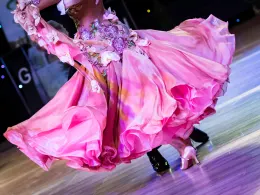
Ballroom Dancing5 minutes

Ballroom Dancing in Dortmund: Understanding Waltz and Quickstep

By Bernhard De LucaUpdated

In brief
  • In Dortmund, ballroom dancing mainly refers to Slow Waltz, Viennese Waltz, Tango, Foxtrot, and Quickstep.
  • The dances differ in rhythm, movement style, and the amount of space their steps require.
  • On the same dance floor, couples have to continually coordinate their timing, direction of travel, and step size.
  • In the current course filter for Dortmund, you can compare classes by style, level, and teaching format.

When you watch a dance floor, you often notice not the steps first, but different ways of moving: one couple glides, while another quickly changes direction. This contrast is precisely what makes the standard dances easy to understand.

DefinitionBallroom dance

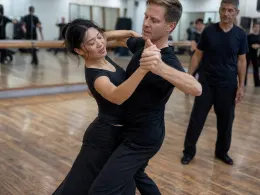
Ballroom dance refers to a group of social dances performed by a couple in a characteristic dance hold while moving around the dance floor.

Five Standard Dances, Five Movement Characters

Standard dance is a group of different dances, not a single sequence of steps. It includes Slow Waltz, Viennese Waltz, Tango, Foxtrot and Quickstep. To get an overview of standard dance in Dortmund, it’s worth knowing these differences before choosing a course.

The Slow Waltz is usually experienced as flowing and graceful. The Viennese Waltz is also a waltz in triple time, but its faster tempo makes it feel much more rotational. Tango focuses more on distinctive steps and clear accents. Foxtrot moves through the room at a walking, steady pace, while Quickstep feels livelier, with its springy, fast passages.

Tango in standard dance is also not the same as Argentine Tango. The shared name can be confusing, but the posture and way of moving are different. So when assessing a course in Dortmund, the specific course name is more informative than the general term ballroom dancing.
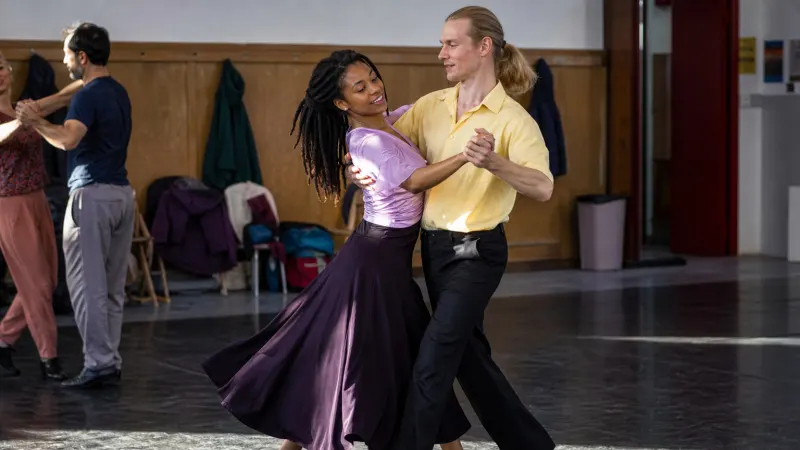
When the couple takes smaller steps, the rhythm is maintained and the shared dance floor is used more safely.

Timing, line of dance and step size go together

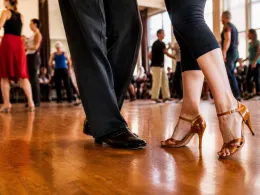
A couple does not dance to the music alone, but shares the floor with others. When a dance floor is used for round dances, couples usually move in the same direction along the edge. Anyone who ignores these paths and cuts across the room can easily throw others off beat.

The rhythm determines when a step begins and how long the movement lasts. The line of dance helps you read the path across the floor. Step size determines how much space the couple needs. These three things work together: a large step may be right on an open floor, but with oncoming traffic, that same step can quickly become an obstacle.

This does not mean every figure has to be danced with large or small steps. What matters is responding to the situation without becoming frantic. If the basic rhythm stays steady, the couple can make their movements smaller and expand them again later. Quickstep makes it especially clear that speed does not automatically mean taking large steps. In Waltz, the same awareness helps keep a turn from getting in the way of other couples.

Sharing space together on the dance floor

Do it this way

  • Before a turn, adjust your stride to the available space
  • When facing oncoming traffic, calmly shorten your path
  • At the edge, line up in the direction of travel
  • Keep the beat and take smaller steps

Don't do this

  • Forcing turns while keeping your steps large
  • Stopping abruptly when you encounter oncoming traffic
  • Cutting through the middle and getting in the way of other couples
  • Stepping faster than the music because you feel unsure

When the dance floor gets more crowded, the beat stays the same, but your steps can get smaller.

Ballroom and Latin dance instructor

A course shows how technique and social dancing come together

A ballroom dance course can place different emphasis on technique, figures, and dancing with changing partners. So when comparing courses in Dortmund, it’s worth looking beyond the style name. Check whether the course is intended for beginners or dancers with prior experience, which dances are actually taught, and whether practice sessions on a shared dance floor are included.

If you want to learn to dance the Waltz, ask about the tempo and whether you’ll practice basic steps first or start with turns. For Quickstep, it’s helpful to know whether the group is already familiar with short step sequences. These questions help you figure out whether the pace of the lessons suits you, without assuming you have prior experience.

If you want to get started without a regular partner, find information about dance courses without a partner in Dortmund. For a general search, there’s also an overview of dance courses in Dortmund. The current course filter shows available options and dates, so you can check the details instead of drawing conclusions about local practices from general descriptions.

Two Tempos, Two Ways of Feeling the Movement

Waltz

Sway and keep gliding

Calm flow with expansive movement arcs

In the Waltz, an impression of continuous flow emerges. The movement is carried by the rhythm, while the couple places its steps so that the connection remains calm.

Quickstep

Switch between feathering and compact steps

Light-footed with quick step sequences

Quickstep feels lively and springy, and its fast passages call for clear coordination. When space is limited, the steps can become smaller without losing the character of the dance.

Frequently Asked Questions

  1. No, Foxtrot and Quickstep are different ballroom dances. Foxtrot feels more like a flowing walking step with changing tempos, while Quickstep sounds and moves livelier. In class, it helps to distinguish them not only by the music, but also by the quality of the steps.

Ballroom Dance Classes in Dortmund

Compare current classes and dates in Dortmund and find the lessons that match your level.

Find the right dance class for you

On udansa, you can compare ballroom dance classes in Dortmund by style and level. That way, you can see which type of instruction suits your starting point or dance experience.

Find the right dance class for you