Course organization5 minutes

Making up a missed dance class: scheduling and approval

By Mary De LucaUpdated

In short
  • Whether you can make up a dance class you missed is determined by the agreed make-up policy.
  • A suitable alternative class matches your dance style, course level, and the material covered in the missed class.
  • Your request should include the missed class, your regular course, and your preferred make-up date, along with the required number of participants.
  • Only attend once the dance school has confirmed the specific make-up class for you.

In the calendar, another class night can quickly look like just the right opening. But the group may already be at a very different point in the ongoing course, and a date you can see doesn’t mean a spot is reserved.

What you need to organize it

  • Booking confirmation with the course name or course number
  • Date of the class you missed
  • Agreed course terms, including the make-up policy
  • Timetable with possible parallel classes
  • Days you are available within the make-up period

A make-up class also needs to fit the schedule

A make-up class is another group with comparable instruction. Having the same level name alone is not enough: Two beginner classes may have started on different dates and therefore cover different sequences. For your make-up session, what matters is which part of the course corresponds to the missed class. A class that started later may be a better fit precisely because of this than the group running at the same time.

For classes that cover multiple dances, the focus of that particular evening also matters. One group may be covering Rumba while your missed class was about Waltz. For a class focused on a specific style, the teaching format and structure need to match. The guide to Swing classes with different learning goals shows just how different classes in the same dance family can be.

Approval applies to a specific class, not automatically to every class at the same level. Groups need enough room to move, and the instructor must be able to accommodate additional participants in the lesson. Even a class that is open for booking may have limited places for make-up students. For organizational purposes, it helps to clearly link the visit to your regular class: The attendance records distinguish regular attendance from make-up visits. This makes it clear which missed class your visit is linked to.
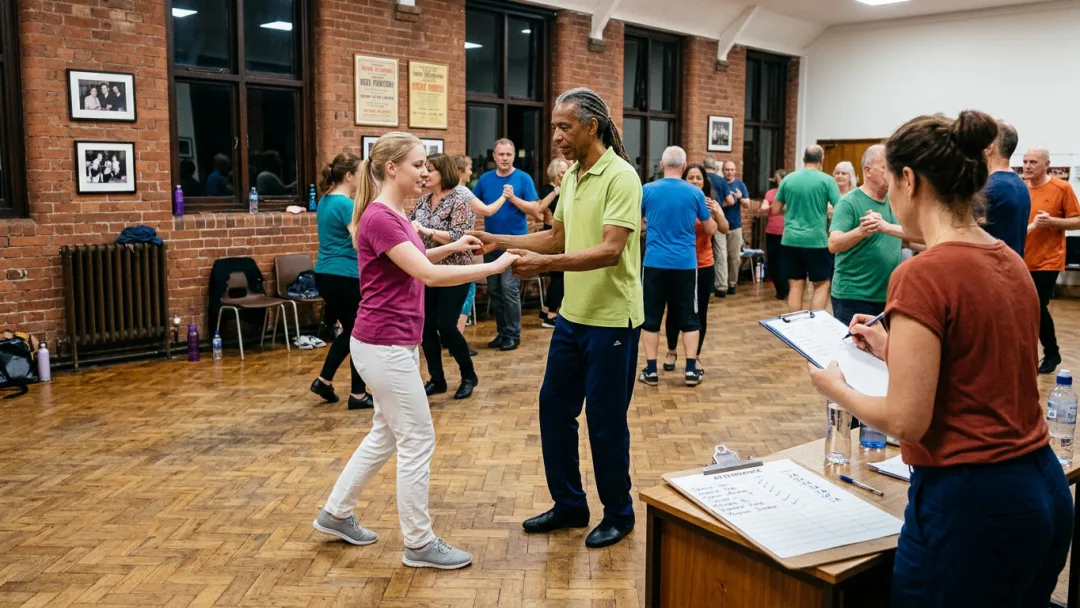
A clear course assignment prevents your make-up session from accidentally being recorded as an additional booking.

How to organize your make-up lesson

  1. Clearly identify the missed class

    Note the course number, level, and date of the missed class from your booking. Add the name you registered under so the administration can identify your missed class without confusion.

  2. Read the agreed terms

    Check your course terms to see whether make-up classes are offered and what deadline, limit, or registration requirements apply. Also note whether additional costs are mentioned; if no make-up policy is provided, don't infer that attendance is permitted.

  3. Choose a suitable alternative class session

    Choose a session from the timetable with the right style and level, and a clearly identifiable section of the course within the allowed timeframe. If it's unclear where the class is up to, note this uncertainty in your one consolidated inquiry instead of entering the session as booked.

  4. Request attendance for a group

    Using the designated contact method, send something like: “I missed course [number] on [date] and would like to make it up on [date, time, course]. There will be [number of participants] people. Is the class level suitable, and can you confirm our participation and any possible costs?”

  5. Keep a record of the specific confirmation

    Check the reply for the date, time, course, number of participants, and any costs. An acknowledgement of receipt or “Making up the class is generally possible” is not yet confirmation of the date; save the explicit confirmation first, then add its details to your calendar.

  6. Register before class starts

    Arrive a little early for the confirmed class and register as a make-up guest from your regular class. Keep your confirmation handy; if you’re unsure where you’ve been assigned, wait at the side instead of joining the group during an explanation.

  7. Complete your make-up class

    After you attend, record the actual date of your make-up class next to the session you missed. If the school uses a make-up slip or attendance log, keep the relevant entry; your next regular class remains scheduled unless agreed otherwise.

These details make all the difference

This way

  • Specify the exact date of the missed class
  • Identify the replacement class by date and time
  • State the actual number of participants
  • Use an approval for this visit only

Not like this

  • Only write “sometime last week”
  • Only write “the class on Tuesday”
  • Bring additional people who aren't registered
  • Transfer an old confirmation to a new date

Your checklist before your visit

Before submitting a request

Assignment

After confirmation

Reservation

After attending

Completion

Frequently Asked Questions

  1. Illness does not automatically entitle you to make up a class. Your agreement and, where applicable, the applicable law determine whether you can. A sick note may be relevant to a special provision in your contract, but it does not replace approval for a class. Only send sensitive documentation if the agreed rules actually require it, not as a precaution with every request.

Your next dance class night is locked in

On udansa, you'll find dance classes for adults with schedules that fit your week. Whether you can make up a class in your existing course is ultimately up to your dance school.

Your next dance class night is locked in