Career paths5 minutes

Understanding the profession and responsibilities of a dance therapist

By Bernhard De LucaUpdated

In brief
  • Dance therapists can work in organizations or as self-employed professionals, depending on their qualifications, assignment, and legal framework.
  • A training qualification certifies acquired competencies, while an association qualification confirms that the relevant professional standards have been met.
  • Neither a training qualification nor an association qualification, on its own, grants state authorization to provide independent therapeutic treatment.
  • The profession involves documentation, collaboration, and the responsible handling of personal boundaries, in addition to movement work.

Between an impactful hands-on experience and a sustainable career path lies work you barely see on the dance floor: explaining decisions, respecting responsibilities, and staying attentive even when a movement is interrupted.

DefinitionPractice of Medicine

Under Germany's Heilpraktikergesetz, the practice of medicine refers to professional activity aimed at diagnosing, curing, or alleviating diseases, ailments, or physical injuries in people. Whether a specific service falls under this definition depends on what it actually involves, not just what it is called.

The workplace determines your professional remit

If you want to become a dance therapist, the first question to consider is what responsibilities a position actually entails. Potential fields of employment include clinical, rehabilitative and psychosocial settings. The different fields of application for dance therapy should not be equated with interchangeable job profiles.

As part of a treatment team, for example, your role may be to support agreed goals through movement-based work and contribute relevant observations to case discussions. In a psychosocial program, the focus may be more on participation and opportunities for connection. The same job title therefore does not tell you whether you will provide treatment independently, contribute under professional supervision or lead a non-clinical program.

Your day-to-day work includes tasks before and after the movement session. You take account of participants’ limits, document progress, coordinate with other professionals and recognize situations that fall outside your remit. A specific example: repeated withdrawal is an observation at first, not a diagnosis. Whether this leads to an adjustment to the program or feedback to the treatment team depends on the assignment and context. Personal information is shared only within the limits permitted.
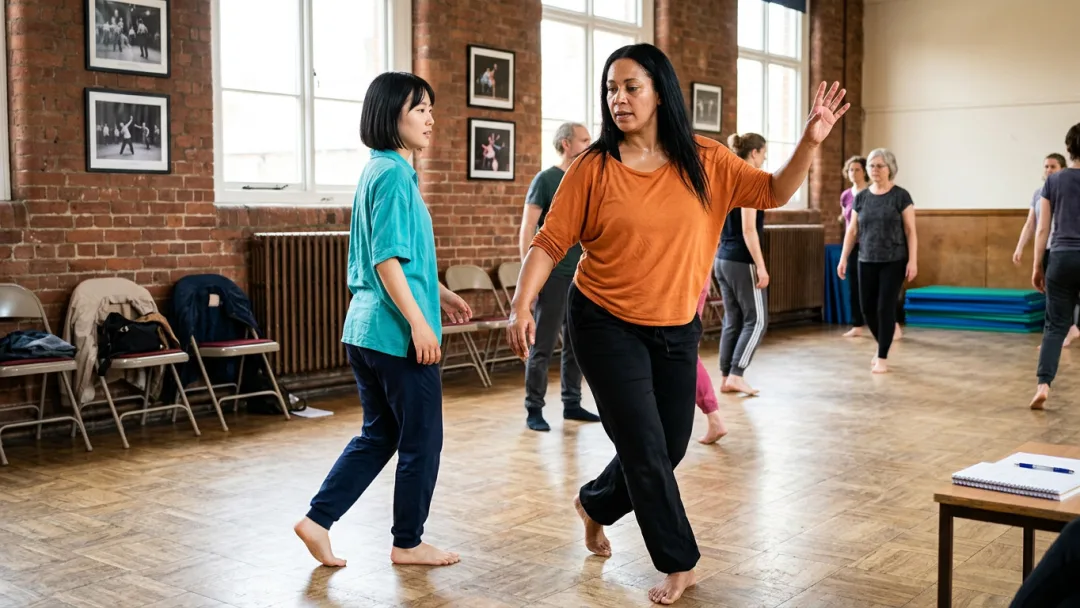
A factual progress note keeps observation and interpretation separate, so later decisions remain understandable.

Three qualification levels must not be conflated

A training qualification documents that you have met the requirements of a particular training program. It says something about your professional preparation, but does not automatically mean that you are officially recognized by the state. A professional association qualification, for example from the Professional Association of Dance Therapists in Germany, relates instead to the standards set by that association. Both credentials may be relevant to employers, but they answer a different question from professional law.

To practise the healing professions independently, you generally need the corresponding legal authorization. Depending on the activity, this may take the form of a relevant professional license or an appropriate permit under the German Heilpraktiker Act. For example, a permit limited to psychotherapy is not a general permit for all healing professions. Having authorization also does not replace methodological competence.

A certificate does not automatically expand the legal limits of another qualification. Nor does employment at a clinic automatically replace every required authorization: what matters is the specific task and its legal framework. Before starting work, clarify that you have the authorization required for the work you intend to do by seeking qualified advice on professional regulations. Calling it “coaching” or “movement support” does not change anything if you are in fact treating illnesses.

What the evidence actually says

Correct

  • State the training qualification as proof of competence
  • Name the specific association for your association qualification
  • Present authorization to provide treatment separately from certificates
  • Describe the actual purpose of your offering

False

  • Presenting a training certificate as a license to practice
  • Describing an association qualification as state approval
  • Inferring authorization to provide treatment from every certificate
  • Simply relabeling therapeutic work as a movement class

A movement may raise a professional question, but it does not, by itself, constitute a diagnosis.

udansa editorial team for dance and health

Career prospects depend on the specific role profile

Career prospects in dance therapy cannot be reliably inferred from the number of possible settings. An institution may offer movement-based work without creating a dedicated full-time position for it. Some tasks are part of a multidisciplinary role, while others are covered through individual fee-based sessions. An existing primary profession can therefore be just as relevant to a position as additional training in dance therapy.

If you work independently as a dance therapist, unpaid time is part of the financial reality: preparation, documentation, coordination, and practice administration. An agreed session fee is therefore not the same as your available hourly earnings. You also need to account for costs such as room rental, insurance, and cancellations. Completing a qualification does not guarantee a full schedule or a particular income.

Professional responsibility also means arranging for professional feedback. Supervision offers a protected setting in which to reflect on uncertainty, relationship dynamics, and your own reactions. This is especially important when movement touches on emotions: expressing feelings through dance does not in itself make a situation a form of treatment. For your career path, it matters that you can clearly define your role and recognize when other professionals need to take over.

Two types of employment with different obligations

Employment

Working as part of a team at an institution

Integration into processes and areas of responsibility

You work within an institutional mandate and contribute your observations to the team's work. Staff scheduling, case discussions, and existing crisis procedures provide a framework, but also limit your scope for decision-making.

Self-employment

Organizing your own work setup

Combining professional work with running a practice

You arrange appointments and services within your professional and legal boundaries. At the same time, you organize contracts, data protection, liability coverage, and backup arrangements. These tasks have to fit alongside your work with participants.

Frequently Asked Questions

  1. In Germany, dance therapist is not a nationally standardized vocational qualification that automatically grants state authorization to provide treatment. That is why the specific qualification, any professional association credentials, and legal authorization must be considered separately. The professional title is also not the same as the protected title psychotherapist.

Support others professionally, dance yourself

On udansa, you can find people to share your own dance practice with. Dancing together can complement your everyday life, but it does not replace professional qualifications or therapeutic supervision.

Support others professionally, dance yourself