
Find the perfect beat for you
On udansa you will find like-minded people who share your favorite tempo, as well as the right courses in your area. Sign up and take your timing to the next level together with new dance partners.



By Mary De LucaUpdated
On udansa you will find like-minded people who share your favorite tempo, as well as the right courses in your area. Sign up and take your timing to the next level together with new dance partners.
The right speed determines whether a dance feels like flying or like stumbling. If you understand the beats per minute, you will find your entry effortlessly and master every dance floor with the appropriate dynamics.
Beats per Minute, abbreviated as BPM, is the unit of measurement for the tempo of musical pieces and indicates the number of beats per minute. In partner dance, this value significantly determines how much time dancers have to execute their steps and figures.
The speed in Discofox is measured in beats per minute (BPM), which simply describes the number of quarter notes per minute. For beginners, the right tempo is the decisive key to internalizing the coordination of feet and music in the first place. If the beat speed is too high, you quickly fall into a rush, lose your balance, and trip over your own feet. Music that is too slow, on the other hand, requires extremely clean weight transfer and a high level of body tension, which can also overwhelm beginners.
A moderate tempo in the range of 115 to 120 BPM is ideal for your first attempts. Within this framework, there is enough time to execute the classic three-step precisely and to consciously perceive the partner's signals. Once you have internalized the basic Discofox steps, you gain the necessary confidence to venture into faster rhythms later on. In this phase, the music acts as a patient timekeeper that forgives mistakes and leaves room for your own development.

Once the basics are solid, your perception of speed changes. Advanced dancers usually move in a range of 120 to 126 BPM. This tempo challenges your reaction time, but at the same time, it leaves enough room for initial dynamic turns and wrap figures. The dynamics on the dance floor increase noticeably: movements appear more fluid, and playing with acceleration and deceleration becomes truly fun.
In this medium tempo range, it becomes clear how important clean Discofox technique is. Since the pauses between steps become shorter, the impulses for leading and following must be set more precisely. Anyone taking steps that are too large here will inevitably fall out of rhythm. Short, controlled movements under your own center of gravity are the secret to maintaining full control over the dynamics as a couple, even when the tempo picks up.
Correct
Wrong
The greatest art in Discofox is not dancing to fast beats, but the ability to maintain a shared axis and calmness as a couple at any tempo.
The premier class of Discofox starts at around 128 BPM and reaches up to a rapid 132 BPM or more. In this range, the music is an energetic driver that demands maximum concentration and physical fitness. Every movement must be precise, as there is no time left for long deliberation. This is where you see whether the automation of steps and the non-verbal communication between partners harmonize perfectly.
At very high speeds, the dance dynamics change fundamentally. Large, sweeping figures give way to compact, fast turns close to your partner. The art lies in not appearing tense despite the speed, but rather maintaining loose, springy knee action. Those who master this level experience a real rush of speed on the dance floor, where music and movement merge into a perfect, high-energy unit.
Focus on safety and precision
A slow to medium tempo gives you the time to focus entirely on coordination, clean weight transfer, and fine communication with your partner. Mistakes can be easily corrected without you immediately losing the beat.
Dynamics and quick reflexes required
A fast tempo challenges your reflexes and your stamina. Your movements must be completely automated, as there is no time for conscious decisions. Large figures give way to fast, compact turns.
For absolute beginners, a range of 115 to 120 BPM is optimal. This tempo is slow enough to coordinate the steps cleanly, and fast enough to feel the natural swing of the dance.
Advanced dancers usually prefer a tempo between 120 and 126 BPM. In this range, the Discofox unfolds its typical, lively dynamics without the precision of the figures suffering from too much haste.
Yes, the faster the music gets, the smaller your steps must be. At a high tempo, large steps inevitably lead to you falling behind the beat and losing your balance.
When it comes to fast songs, focus on very compact figures directly on the spot. Avoid expansive wrapping figures and rely instead on simple, precise solo turns and a closer dance hold.
Find the right course to train your sense of rhythm and your steps at the right pace.
DiscofoxLimbach-Oberfrohna · Germany
Discofox Club - 14-tägigWednesday · 20:30 · Oct 21
Limbach-Oberfrohna
Couple danceLimbach-Oberfrohna · Germany
PaartanzkreisFriday · 18:15 · Oct 23
Limbach-Oberfrohna
Couple danceLimbach-Oberfrohna · Germany
Silberkurs für PaareSunday · 16:15 · Oct 25 - Nov 15
Limbach-Oberfrohna
 Dancing Discofox: steps, figures, and music of the most popular couple danceDiscofox is the most versatile couple dance of all. Learn everything about steps, styles, and how to get started quickly.
 Learn Discofox steps: The easy way to the basic stepThe Discofox basic step is the foundation for every dance night. Learn how to master the rhythm and perform the steps flawlessly on the dance floor.
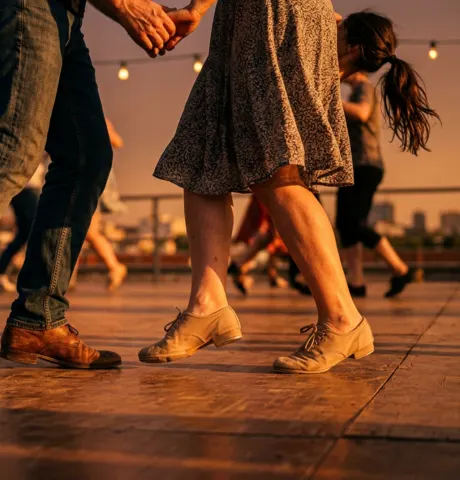 Discofox technique: The key to posture, leading, and stylingMaster the Discofox technique for an elegant performance on the dance floor. Learn everything about proper posture, subtle leading, and stylish moves.
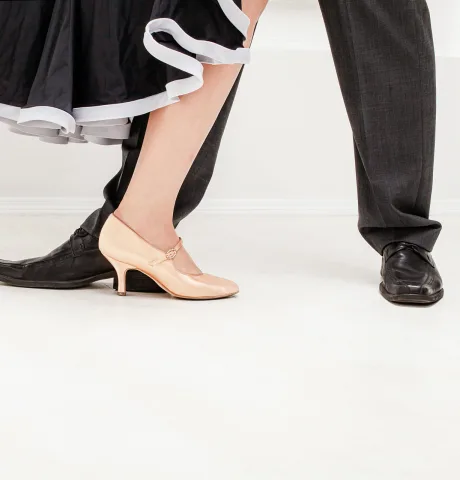 Discofox music and practice: Perfect timing for every eventDiscover the variety of Discofox music, learn the rhythm in detail, and find out how to connect with others at events and dance cafes.
 Creating a Discofox playlist: Step-by-step to the perfect party mixA perfect Discofox playlist keeps the dance floor full. Learn in this guide how to structure your set and build an exciting musical arc.
 Find Discofox parties: The best locations and eventsAre you looking for the perfect dance floor for your next Discofox night? We present the best locations and events in Germany, from iconic dance cafés to large clubs.
 Discofox Etiquette: Dance with confidence and charmA packed club and great music are perfect for Discofox, but things can get crowded fast. With the right etiquette and mutual consideration, you can glide through every party night elegantly and collision-free.
 What kind of Discofox dancer are you? Take the testWhat kind of Discofox dancer are you? Find out which music and events best suit your dance preferences with our simple self-test.
 Discofox Trends 2026: How the scene sounds and dances todayThe Discofox scene is reinventing itself in 2026. Discover the most exciting trends in music, movement, and events.
 Discofox Marathon: Tips for ultimate endurance dancingA Discofox marathon is the ultimate challenge for all amateur dancers looking to combine stamina and fun. With the right tactics and preparation, you are guaranteed to make it to the final.