
Find your way in together
On udansa, you connect with dance enthusiasts in your area and find exactly the flexible courses and communities that fit your modern everyday life.


By Bernhard De LucaUpdated
On udansa, you connect with dance enthusiasts in your area and find exactly the flexible courses and communities that fit your modern everyday life.
The way we approach dancing is changing fundamentally. Rigid course times are giving way to dynamic models that adapt perfectly to your life.
Dance trends behave fundamentally differently than the rapid fashion waves of the fashion world or the viral hits on social media platforms. While a new dance step on TikTok collects millions of clicks within a few hours, a real trend in partner dance takes months or even years to establish itself in the dance hall. This is due to the nature of dancing: you do not learn steps in passing, but through physical interaction, regular practice, and direct exchange at dance parties. The transformation happens from person to person, which is why modern dance school concepts today focus on strengthening the social space outside of class.
Those starting today are usually looking for a flexible community instead of rigid commitments. The connection between learning and experiencing is the focus, which is why the classic Your first trial lesson in a dance course often transitions directly into a relaxed practice party today. Only when a new impulse is carried into the courses by the dance instructors and tried out from there at the weekly socials does a trend come to life. This organic path ensures that once established concepts have a much longer half-life than fleeting online phenomena.

This model replaces classic, time-limited courses. Members pay a monthly fee and can use the entire spectrum of the dance school, from ballroom dances to modern solo styles, whenever it fits into their daily routine.
Dance schools provide their members with professional video platforms. Here, the steps shown in class are explained precisely, so you can easily catch up on missed lessons or consolidate what you have learned from home.
Traditional classroom-style teaching gives way to open practice floors. Here, dance instructors act more like coaches who move from couple to couple to provide individual feedback, while the music plays continuously to create a real party atmosphere.
The impulses for the dance instruction of the future emerge at the intersections of global metropolises and spread via international festivals and congresses before reaching local dance schools. From there, new didactic concepts migrate to the mainstream. A defining example of this change is the growing interest in offerings where traditional gender roles are broken down. Anyone interested in dancing today often wants to learn to understand both sides in order to be able to act more flexibly at events.
This development is also changing the requirements for beginners. In 2026, it is less about memorizing rigid choreographies and more about grasping the principle of action and reaction within a couple. Those who want to learn to dance flexibly benefit from modular systems where the basics are taught across different dance styles. This makes switching between different courses effortless, and what has been learned can be applied much faster on real dance floors.
The dance instruction of the future meets people where they are in their daily lives: flexibility and the joy of trying things out together are at the forefront today.
Modern learning
Outdated approaches
A flat rate model allows you to flexibly attend several different courses and levels for a fixed monthly fee. You are no longer tied to a fixed day of the week and can adapt your training individually to your schedule.
Hybrid dance instruction combines personal, on-site guidance with digital offerings. You learn the basic steps and the finesse in the dance studio and use accompanying online videos to repeat the figures at home at your own pace.
Yes, modern concepts are designed to be extremely beginner-friendly. Since the focus is on universal principles like weight transfer and body tension, you learn the basics much more intuitively and can start directly with flexible modules without any prior knowledge.
Discover flexible course models and contemporary instruction right in your area.
Couple danceLimbach-Oberfrohna · Germany
PaartanzkreisFriday · 18:15 · Oct 23
Limbach-Oberfrohna
BallroomMeißen · Germany
Tanzkreis | PROFESSIONALTuesday · 20:15 · Oct 27, 2026 - Jan 5, 2027
“Ein Haus für Vieles” - Saal Tanzkurse
Couple danceLimbach-Oberfrohna · Germany
Silberkurs für PaareSunday · 16:15 · Oct 25 - Nov 15
Limbach-Oberfrohna
 Dance school or dance club: Where is it better to learn to dance?Are you choosing between a classic dance school and a dance club? Our comparison shows you which model best suits your goals and your budget.
 Your first dance trial class: what to expect & tipsGetting started is easy: here is what happens during your first trial class at the dance studio and how to prepare for it perfectly.
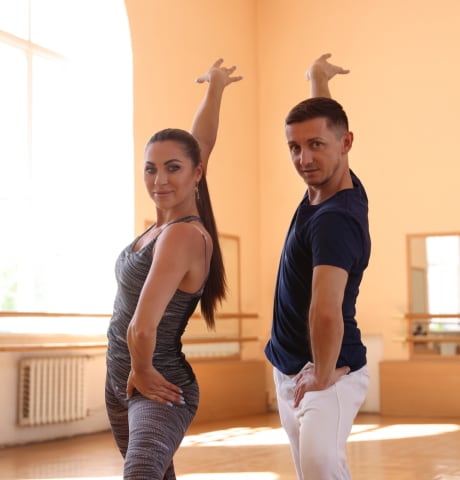 Finding a dance class for beginners: How to get started easilyGetting started is easy: With our guide, you will find the right dance class for beginners and prepare perfectly for your very first dance lesson.
 Dance Class Etiquette: The 10 Essential Rules for BeginnersFeel confident and relaxed during your first dance lesson: With our dance class etiquette for beginners, you will avoid common pitfalls and start your journey on the dance floor with ease.Your first dance trial class: what to expect & tipsGetting started is easy: here is what happens during your first trial class at the dance studio and how to prepare for it perfectly.Dance school or dance club: Where is it better to learn to dance?Are you choosing between a classic dance school and a dance club? Our comparison shows you which model best suits your goals and your budget.
 Your first dance class: What to wear and bringYour first dance class is coming up and you are wondering what to wear and pack? Our practical checklist for beginners will help you feel confident before your first steps on the dance floor.
 Which dance class is right for me? The ultimate quiz for beginnersGroup class, crash course, or private lesson? Take our quick quiz and find out which learning format best fits your daily routine and learning style.
 Dance classes without a partner: How to get started soloNo dance partner? No problem! Learn how modern dance schools organize classes for singles and why rotating partners helps you reach your goals faster.