
Find your space together
On udansa you meet like-minded people who share your passion for free movement. Find the right dance course in your region now or search specifically for partners who want to improvise with you.


By Mary De LucaUpdated
On udansa you meet like-minded people who share your passion for free movement. Find the right dance course in your region now or search specifically for partners who want to improvise with you.
Moving to the music without having to memorize steps beforehand: free dance styles give you the space to find your own rhythm. Discover how to experience the joy of movement without any pressure to perform with udansa.
Dance improvisation is a form of dance where movements are created spontaneously in the moment of performance. Instead of predefined steps, it uses creative tasks and your own body awareness as a source of inspiration.
Anyone wanting to start dancing is often put off by the idea of having to memorize endless sequences of steps. But dancing is far more than the flawless execution of predefined patterns. A free dance style brings personal experience and creative expression to the forefront. There is no right or wrong here, only the movement that arises from the music in that very moment. For many people, this exact approach is the key to finding a connection to their own body and the music, without the pressure of having to live up to a rigid choreography.
Especially for beginners, the focus on improvisation offers an invaluable advantage: the barrier to entry is extremely low. You don't have to study theory for months or practice complicated turns before you dare to step onto the dance floor. Instead, you use the natural movement of your body as a starting point. If you are wondering whether you even have a sense for movement, our guide Learning to dance without a sense of rhythm will help you overcome your own doubts and take the first step.

Improvisation in dance is often mistakenly equated with complete aimlessness or even chaos. In truth, dancing without fixed steps is a highly developed art form based on mindfulness and body awareness. Styles like dance improvisation or modern dance use clear principles such as space, time, force, and flow to give movement structure. While you move freely, you react quite consciously to impulses: the tempo of the music, gravity, or the dynamics in the room. This makes dancing a constant dialogue between you and your surroundings.
For beginners, starting with contemporary dance is particularly rewarding. A structured dance course for beginners that focuses on improvisation guides you gently. You do not learn rigid step sequences there, but are given creative tasks: for example, to move as if you were gliding through water or as if an invisible thread were pulling you upwards. These playful images help you to release the typical mental block and fully engage with the feeling of movement.
Correct
Wrong
Improvisation does not mean that anything goes, but that you have permission at the right moment to do exactly what your body needs right now.
When you choose dance styles with improvisation, you are choosing a path that also challenges and encourages you mentally. Because you do not have to think about which foot goes where next, your mind becomes free for the here and now. This form of movement is extremely liberating and is proven to help you leave everyday stress behind. You develop a completely new self-confidence, as you learn to trust your own movement impulses instead of constantly correcting yourself.
If you would rather try this freedom in a solo setting, you will find excellent inspiration at Learn to dance without a partner, which requires no coordination with another person. Whether alone or in a group: improvisation trains your adaptability and your creativity. It shows you that dance is not a rigid system that you have to conquer, but a living language that you are allowed to help shape from the very first second.
Focus on your own movement
You dance entirely for yourself, follow only your own impulses, and interpret the music exactly as your body feels it in the moment. Perfect for switching off and finding your inner balance with udansa.
Movement in dialogue
Improvisation in a pair or in a group means interaction. You react to the movements of others, share weight, or let yourself be guided through the room by shared impulses.
No, absolutely not. Free dance is not about perfect coordination, but about expression. Over time, you will automatically learn to translate the music into physical movement at your own pace.
Comfortable clothing that allows you to move without restrictions is ideal. Most of the time, people dance barefoot, in socks, or in very flexible gym shoes so that you can feel the floor well.
Yes, very well indeed. Many contemporary dance or free improvisation courses are specifically aimed at people without any dance experience, as no prior knowledge is required.
Find the right course now to experience the freedom of movement for yourself.
Modern Dance for kidsBrück · Germany
Modern Dance & Tanzimprovisation ab 8 J.Wednesday · 17:00 · Oct 14
Mehrgnerationenhaus Brück
Modern Dance for kidsBerlin · Germany
Modern Dance & Tanzimprovisation ab 8 J.Thursday · 19:45 · Oct 15
Stadtteiltreff Haus der Begegnung
Modern DanceBerlin · Germany
Modern Jazz Dance ErwachseneThursday · 20:50 · Oct 15
Hebammenpraxis Storchennest
 Can you learn to dance without a sense of rhythm?Think you have no sense of rhythm? Don't worry: learning to dance without a natural sense of rhythm is absolutely possible if you start with the right styles.
 Dance as fitness: The best styles for your staminaDo you want to improve your stamina and are looking for a motivating alternative to the gym? Discover how you can easily burn calories with the right dance styles.
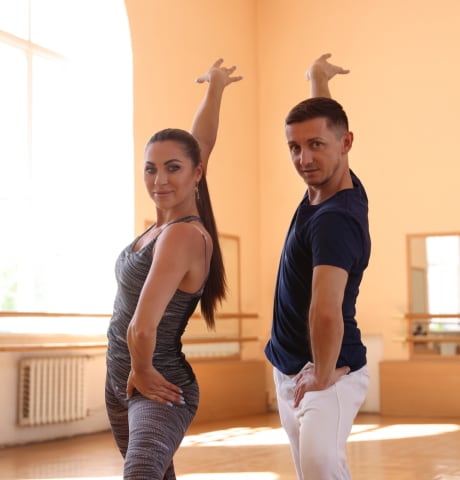 Finding a dance class for beginners: How to get started easilyGetting started is easy: With our guide, you will find the right dance class for beginners and prepare perfectly for your very first dance lesson.
 Choose a dance style based on your personality: What suits you bestFind out with our quick personality test which dance style truly matches your character, fitness level, and musical taste.
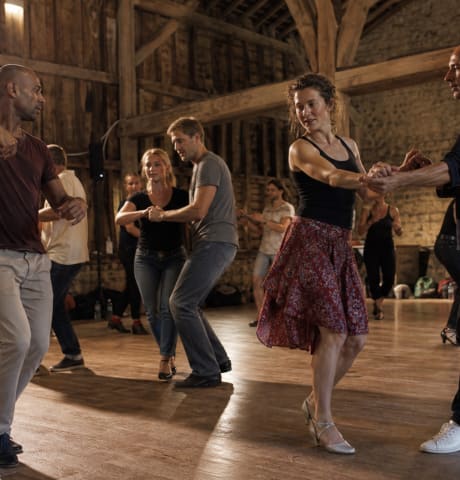 Frustrated in class: 5 mistakes to avoid when choosing a dance styleIf you quit your first dance class in frustration, you likely just chose the wrong style. Learn the typical mistakes beginners make and how to avoid them.Dance as fitness: The best styles for your staminaDo you want to improve your stamina and are looking for a motivating alternative to the gym? Discover how you can easily burn calories with the right dance styles.Can you learn to dance without a sense of rhythm?Think you have no sense of rhythm? Don't worry: learning to dance without a natural sense of rhythm is absolutely possible if you start with the right styles.
 Dancing for introverts: Top styles for youDancing does not have to be loud or stressful. Discover calm dance styles that are perfect for introverted people and do not require close physical contact.
 Assessing your physical readiness for danceHow fit are you really for the dance floor? This guide helps you properly assess your joints and stamina so you can dance injury-free and with joy.
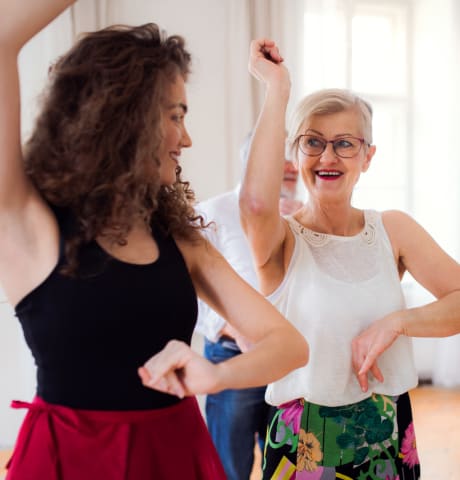 Dancing at any age: Ideal styles for late startersStarting to dance later in life is a great way to boost your joy and fitness. Discover which dance styles are perfect for late starters.