
Find your rhythm together
On udansa, you can find dance partners and courses in your area that perfectly match your pace. Sign up for free and start your dance adventure without any pressure to perform.


By Bernhard De LucaUpdated
On udansa, you can find dance partners and courses in your area that perfectly match your pace. Sign up for free and start your dance adventure without any pressure to perform.
You think you are completely unmusical and will never hit the beat? Don't worry, dancing is not a question of innate genius, but a skill that anyone can learn.
In dance, sense of rhythm refers to the ability to perceive acoustic signals in music, process them in the brain, and translate them into coordinated physical movements.
The worry of looking bad on the dance floor due to a supposedly missing sense of rhythm keeps countless people from dancing. However, science shows that true rhythm deafness, known in the field as amusia, is extremely rare. Most people who consider themselves rhythmically ungifted have simply never learned to synchronize their bodies with the sounds they hear. Learning to dance without a sense of rhythm is therefore not a contradiction, but a question of practice and the right approach.
When dancing for the unmusical, the first step is not to analyze complex polyrhythms, but to build a physical connection to the music. Every person possesses a natural heartbeat and their own walking pace. Anyone who can walk in everyday life without falling over already possesses the foundation for simple rhythms. udansa dance schools are prepared to pick up beginners exactly at this point and build confidence in their own movements step by step.

If you categorize yourself as someone who is not musical, you should initially avoid rigid, highly rhythm-focused styles like tap dance or complex Latin American dances. Instead, it is recommended to start with a dance style that does not put pressure on your sense of rhythm. This includes, above all, Discofox. Its structure is so simple and forgiving that it is excellent for learning to dance to simple rhythms without having to count constantly.
The classic Slow Waltz also offers wonderful guidance through its steady, almost swaying three-quarter time. If you are more interested in modern, freer movements, you will find a perfect outlet in Modern Dance. Here, emotional expression is in the foreground, meaning deviations from the exact beat are not perceived as mistakes, but as personal interpretation. The focus shifts away from perfection toward the joy of movement.
Correct
Wrong
No one is completely rhythm-deaf. As soon as we stop thinking about the steps and start feeling the music, the body finds its way all on its own.
The greatest enemy of a sense of rhythm is your own tension. Anyone who tries to calculate the perfect moment for the next step while feeling tense blocks their natural reflexes. A proven method is therefore to absorb the music through your body first, rather than through your mind. Gently swaying your knees while standing or quietly tapping your foot while sitting helps you internalize the vibrations of the music before the first real step is even taken.
Furthermore, dancing as a couple takes a lot of pressure off your shoulders. In classic partner dance, the partners share the responsibility. If you choose the right role, as described in the guide Lead or Follow, you can rely entirely on your partner's impulses at the beginning. As a follower, you do not necessarily have to decode the beat of the music yourself, but simply follow the lead of your partner, which makes getting started much easier.
Keep control of the structure
Here you focus entirely on structured leading. You determine the tempo and the direction, which helps you to firmly connect the steps with the heavy beats of the music.
Relying blindly on your partner
You let go of control and react sensitively to your partner's impulses. This takes the burden off you of having to constantly analyze the beat of the music yourself.
Yes, absolutely. A sense of rhythm is like a muscle that can be trained through regular listening and moving. With the right, simple dance styles, you will quickly see your first successes.
For beginners, Discofox, Slow Waltz, and Modern Dance are particularly suitable. These styles either have very steady, simple beats or leave plenty of room for free, individual movements away from rigid beats.
Focus on the low tones like bass and drums, as these provide the basic beat. Simply tap your foot to music in everyday life to strengthen the connection between your hearing and your body.
No, that is a widespread myth. Most people simply have an untrained ear or are too tense at first, which can be easily remedied through relaxed training at a dance school.
Discover courses that introduce you to dancing step by step and without pressure.
Couple danceLimbach-Oberfrohna · Germany
PaartanzkreisMonday · 19:30 · Oct 12
Limbach-Oberfrohna
Modern DanceBerlin · Germany
Modern Jazz Dance ErwachseneThursday · 20:50 · Oct 15
Hebammenpraxis Storchennest
DiscofoxLimbach-Oberfrohna · Germany
Discofox Club - 14-tägigWednesday · 20:30 · Oct 21
Limbach-Oberfrohna
 History of Discofox: How the Hustle reached EuropeLearn how Discofox evolved from the New York Hustle and the European Euro-Disco wave of the 70s and 80s into our most popular party classic.
 Which dance style suits me? The ultimate guide for beginnersYou want to start dancing but don't know which style suits you best? Our comprehensive guide gives you the perfect orientation for your start on the dance floor.
 Lead or Follow: Which dance partner role suits you?Find out whether you prefer to lead, follow, or use both roles flexibly in switch dancing. Our self-test helps you find your way.
 Choose a dance style based on your personality: What suits you bestFind out with our quick personality test which dance style truly matches your character, fitness level, and musical taste.
 Dancing for introverts: Top styles for youDancing does not have to be loud or stressful. Discover calm dance styles that are perfect for introverted people and do not require close physical contact.
 Assessing your physical readiness for danceHow fit are you really for the dance floor? This guide helps you properly assess your joints and stamina so you can dance injury-free and with joy.
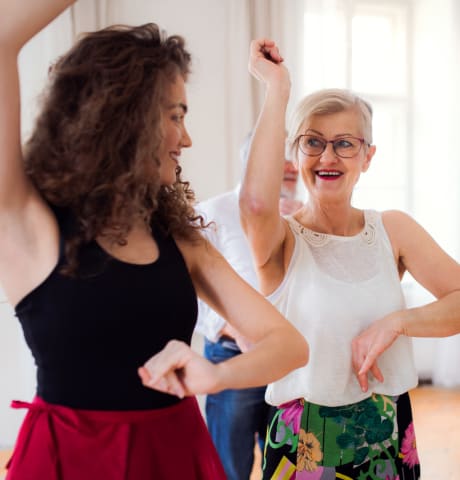 Dancing at any age: Ideal styles for late startersStarting to dance later in life is a great way to boost your joy and fitness. Discover which dance styles are perfect for late starters.
 Modern dance styles: Trends moving the sceneLooking for fresh moves beyond Waltz and Discofox? We show you the hottest modern dance styles currently taking over studios and streets.
 Dance style by music taste: Find your soundFind out which dance style perfectly matches your favorite music. Let your playlist decide whether Salsa, West Coast Swing, or Hip Hop becomes your new favorite dance.
 Dancing for stress relief: The best styles to unwindDiscover how you can effectively reduce stress and clear your head with the right dance styles. From Bachata to Modern Dance.