Bachata musicality5 minutes

Vocals in Bachata: The voice as a rhythmic compass

By Mary De LucaUpdated

In a nutshell
  • In Bachata, the vocals serve as a structural element that makes the 4/4 time signature audible through deliberate phrasing and pauses for breath.
  • Dancers can use the voice as a guide to recognize the end of musical phrases and make transitions smoother.
  • The dynamics of the vocals indicate whether a passage should be danced in a calmly flowing or rhythmically emphasized way.
  • The voice signals changes in the song structure and helps you stay on beat, even without deep knowledge of the instruments.

Forget about counting beats rigidly on the dance floor for a moment. The vocals in Bachata give you a natural feel for the flow of the music and guide you intuitively through every step.

DefinitionVocals in Bachata

Vocals in Bachata refer to the vocal part of the music, which serves as a melodic and rhythmic guide. It helps dancers recognize the end of phrases and adapt their movement dynamics to the musical mood.

The voice as an invisible guide on the dance floor

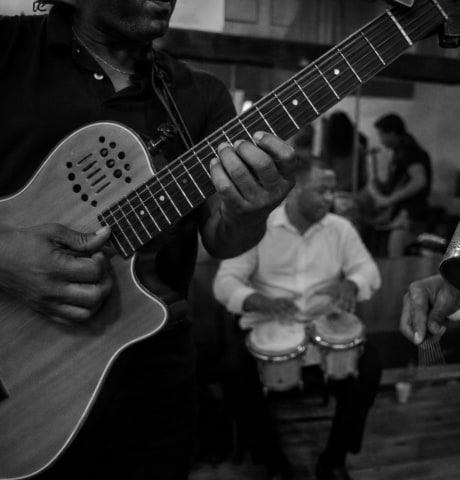
Anyone standing at a Bachata social for the first time usually focuses intensely on the instruments. You listen for the metallic scraping of the güira or try to isolate the distinctive beat of the bongo drum. However, this purely mathematical search for the one often gets lost in the hustle and bustle of the dance floor. This is exactly where the vocals in Bachata come into play. In this genre, the human voice acts not only as a carrier of emotions, but as a highly precise rhythmic guidance system. Through their phrasing, pauses for breath, and targeted accents, singers emphasize the structure of the four-four time signature so clearly that you can let yourself be guided through the song effortlessly.

The voice fills the gaps between the percussive beats and gives the movement a natural flow. When you learn to use the Bachata vocal rhythm as your orientation, you no longer have to rigidly count from one to eight in your head. Instead, you feel the breathing movement of the music. The vocals draw wide arcs across the measures and signal to you intuitively when a phrase ends and a new movement can begin. This helps you especially when the instruments in the background become more complex or recede in the arrangement.

Why phrasing does not disturb the beat, but supports it

A common misconception among dance beginners is the belief that the vocals blur the beat or distract from the actual rhythm. Sometimes a vocal line seems to drag on or starts just before the actual main beat. In music theory, this is referred to as phrasing. The Bachata voice does not convey the beat like a sterile metronome, but shapes it organically. It prepares for the upcoming accent. If you engage with it, you will quickly notice that the voice does not disturb the beat, but rather announces and frames it.

Experienced dancers use this vocal preparation for fluid transitions. When the singer raises their voice or draws out a syllable, a change in the song structure is often announced, such as the transition from the calmer verse part (Derecho) to the more energetic chorus (Majao). Those who want to dance to Bachata lyrics pay less attention to the translation of the Spanish words, and much more to the dynamics and the pauses of the voice. It shows you when you can dance soft, wave-like movements and when a crisp step on the beat is required.

Dancing intuitively by ear

Correct

  • Pay attention to the singer's pauses for breath
  • Translate the dynamics of the voice into smooth movements
  • Use the vocals as a heads-up for changes in rhythm

Mistakes

  • Clinging rigidly to the syllables
  • Hectically interpreting every word with steps
  • Viewing the voice as a distraction when counting

The singer's voice is the bridge between the hard beat of the instruments and the softness of our movements on the dance floor.

Bachata dance instructor, Cologne

Practical ear training for softer movements

To anchor the connection between vocals and movement in your own body, targeted solo training helps. You do not need to dance complicated figures right away for this. It is perfectly sufficient to follow the melody line with your upper body while standing or performing simple steps. Try to integrate the singer's breathing pauses into your dance. When the voice stops, you can also briefly freeze a movement or set a soft accent. This trains your musicality far more deeply than simply reeling off step patterns.

This fine sense for the music can be excellently prepared at home. A structured Bachata solo training plan helps you to consolidate the coordination of hearing and footwork without the pressure of a partner. Once you confidently hang on to the voice during solo training, you will notice how much more relaxed dancing together at a social becomes. You no longer derive your movements from rigid counting, but react flexibly to what the singer musically dictates to you.

Voice or drum as a rhythmic guide in comparison

Melody

Softness in the flow

Using the wave motion of the voice

The singing flows in wide arcs over the hard beats. Those who orient themselves to the voice dance more smoothly, use the space between the steps, and give their movements an organic elegance.

Percussion

Precision in the beat

Hitting the sharp accents of the instruments

The percussion instruments provide the rhythmic foundation. If you primarily orient yourself toward the bongo and güira, you will dance precisely on the beat, but without the vocals, you may sometimes lean toward mechanical or choppy footwork.

Frequently Asked Questions

  1. No, you do not need to speak Spanish. Dancing is not about the meaning of the words, but about the sound, the emphasis on the syllables, the pitch, and the singer's pauses for breath, which structure the rhythm.

Bachata courses near you

Find the right course and learn to perfectly interpret the music as a couple.

View all matching courses

Find your rhythm in partner dance

On udansa, you will find like-minded people and the right courses to train your ear and your steps in harmony with the music. Sign up and discover the variety of the Bachata scene in your area.

Find your rhythm in partner dance